Saturday, May 27, 2006

Saga review of Hybrids

The link on yesterday's blog doesn't seem to work so here's the text:


After an astounding 883 manuscripts, months of reading, weeks of deliberation and one delayed announcement due to that staggering response: ladies and gentlemen – we have a winner.

David Thorpe, 51, has won the Saga/HarperCollins competition to find a new children’s book-writing talent with his book Hybrids. His book will be published in Spring 2007. Our congratulations go out to him. “It’s a dream come true,” said David from his home in Snowdonia, near Aberdovey. “Ever since I was a kid I’ve written, and wanted to be a writer. But I had a lot of bad luck with getting anything published, and sort of gave up. Up until now.”

As outlined in the editor’s letter, David, an environmental journalist, sometime scriptwriter and cartoon-strip inventor, had to dictate his book using voice-recognition software, as mild childhood cerebral palsy had matured into painful carpal tunnel syndrome, making typing almost impossible.

His 50th birthday saw him living in Wales with his two children, Dion, 17, Nemos, 13, and Greek wife Zoe, and a complimentary copy of Saga magazine sent to him to commemorate this landmark just happened to be the issue in which we began the competition.

“I had a feeling it might be OK when my son took a draft to school and a group of kids started reading it over his shoulder. They were saying ‘Turn the page! Turn the page!’ It’s simply fabulous that I’ve won – I wrote it simply for myself, not what I thought the market was looking for, as so often tends to happen. And this is a vindication of that approach.”

One of the judges, Orange-prize winning author Helen Dunmore, said of the book: “Hybrids questions our human dependence on technology, and the loneliness of children and teenagers who may have a stronger relationship with computers and mobile phones than with flesh-and-blood family and friends. It’s a powerful ‘What if?’ fantasy, whose central premise is that humans - especially young humans - begin to bond with the pieces of technology that they use most.

“The writing is sharp, the dialogue good, and the action pacey and page-turning. But there’s a real depth to this story, too. Like all good fiction it makes the reader see the world in a different light.”

Gillie Russell, the publishing director of HarperCollins Children’s Books, said: “I was so impressed with not only the quantity of submissions to the competition but the quality of the writing. It has far and away exceeded our expectations and has been an incredibly hard job to choose the shortlist, let alone a winner.

But someone had to win, and for us the clear champion was Hybrids by David Thorpe. His wonderfully original and compelling story is told in alternating voices of the two young teenage protagonists in a totally fresh and exciting way. The reader is instantly drawn into the world which is current, but not quite; which is real, but only just; which is horribly close to our fears of what is happening and may happen in the future. Exciting, page-turning, vivid and unputdownable, Hybrids and David Thorpe will, I’m sure, be a real winner - not only within Saga, but in the children’s book market as a whole.”

Of the shortlisted three stories from a longlist of fifteen, each had their own particularly enjoyable and well –written plot, characterisation and compelling narrative. Each was very different from the other: a comic fantasy, an atmospheric ghost story and a sci-fi thriller – which certainly made the task of reading and selecting the winner varied and enjoyable.

The other two runners-up were The Standing Stones of Fowlis Wester by Alexander Gardiner, and Lord of Aldhammer by Annemarie Allan. Orange-prize winning author Helen Dunmore compiled these reports on each.

The Standing Stones of Fowlis Wester by Alexander Gardiner

Lively, fast-paced and well-constructed, this is the story of the battle between good and evil and the awakening of forces which want to destroy the human race. There are giants, ogres, dwarf armies, magical swords, a talisman and creatures which grow fat on the oozings from coffins ... and above all a very well-handled interface between the everyday human world of policemen and supermarkets and the world of magic.

Comedy and strong characterisation are the main strengths of this story. Moss Tudloch, the dwarf who drags the human boy Roger into the magical world, is very well developed. His earthiness grounds the fantasy. His romantic secrets have a humorous edge to them, and his tough, stroppy, loyal personality is completely convincing. When Roger crams the dwarf’s injured body into a stolen pushchair, and his maliciously curious neighbours pull down the tartan covers to see the ‘baby’. “Moss’s gnarled, meaty hands shot out, grabbed both women by their noses and twisted them – violently”. Moss may fit into a pushchair, but he is no pushover...

Lord of Aldhammer by Annemarie Allan

The setting is an isolated Scottish community on the shores of the Firth of Forth. This story has emotional depth as well as a strong dramatic structure. It’s a ghost story: in Aldhammer the past won’t lie down, just as the dead won’t lie peacefully in the graveyard. The past sucks the life out of the present, deforming it in a way which is uncompromisingly ugly and cruel. Aldhammer, with its bleak shoreline covered in seaweed, broken bricks and sea-clutter, its walls of mist and rain, and its bored, deviant teenagers, comes to life from the first pages. Maura’s quest to save the souls of her unborn sister and her mother from the voracious Lord of Aldhammer reveals that her own identity hides a mixture of dark and light. The quality of the writing and the solid, believable setting anchor the drama of Maura’s journey and make this an atmospheric and compelling book.

But for Helen Dunmore too, Hybrids pipped them to the post. Her review went thus: The central premise is that humans begin to bond with the pieces of technology that they use most. This hybrid virus - Creep - can give a girl a mobile for an arm, or a boy a computer monitor for a face. Like all pandemics, it creates hysteria.

David Thorpe has imagined his world through and through, with its Gene Police, its Centre for Genetic Rehabilitation, and its feral, desperate kids who have hybridised and want to stay out of the clutches of the authorities. The question of what it is to be human isn’t asked directly, but the whole book implicitly deals with it. The characterisation is very good; Johnny Online, rejected by his mother, struggling to survive, tough, feisty and wary; Cheri Winter, an idealist trying to provide refuge for the victims of hybrid plague; the street kids who pool their knowledge and don’t trust anyone; the boss of technology corporation Mu-Tech who may have released Creep into the world without reckoning on the power of the virus to mutate.

Friday, May 26, 2006

What's a hybrid?

A few notes on the origins of hybrids as used in my novel.

First, a link to the competition results page where more judges' comments and details of the runners-up can be found.

Hybrids have many qualities:
  • Are part human-part technology
  • The technology has to be electronic
  • The victims must merge with gadgets they use frequently
  • The condition is the result of a transmissible disease, probably a virus
  • The sufferers have to be adolescent when they get the disease
  • The disease operates on the dna of the subject.

Where did the idea come from?

I get asked this a lot. As there are so many aspects to hybrids, the different ideas have different roots:
  • Flan O'Brien's Third Policeman contains a literary antecedent. A character uses his bike so much he ends up swapping molecules with it and the bike begins to display human qualities - it can be found in the bar - and vice versa - our man is seen weaving down the gutter late at night. That's not electronic though.
  • There's obvious parallels with cyborgs - Star Trek's Borg, Cybermen - except that they have the emotion taken out and are mindless enemies. Hybrids are very definitely human. Maybe more like those in Dick's Do Androids Dream of Electric Sheep? (Blade Runner by Ridley Scott) as they lament their lack of humanity (but androids aren't cyborgs, they're artificially created humans)
  • Mutants - like the X-Men - have their DNA altered. But it's always puzzled me why they always seem to benefit from their mutation - and either want to save the world or destroy it. You never get a mutant who is in agony due to their condition. But that's the limitation of the superhero genre. Nevertheless, since I used to edit and write Marvel comics, I'm a big X-Men fan, especially Grant Morrison's version.
  • Aids, and how it and its victims were seen in the '80s - and still are in many places
  • On a personal level, being slightly disabled, I have always felt the discomfort and sense of 'outsideness' disabled people feel when they look at the able-bodied world. Hybrids are outside the system.
  • This can transform into growing political awareness as you realise the socially-constructed barriers to acceptance, and where they originate.
  • Genetic engineering; our dependence on and obsession with technology, how it is permeating our lives, dematerialising, and how this is fed and led by corporate expansionism. Bio-chips.
  • Our changing relationship to our bodies - we often despise and want to change them.
As regards the storyworld, this is a development of that found in my '80s work, Doc Chaos.

Is that enough?

Monday, April 24, 2006

Hybrids - what the judges said

The judges were: Gillie Russell, Fiction Publishing Director of HarperCollins Children’s Books, Emma Soames, Editor of Saga Magazine, and author Helen Dunmore, winner of the first Orange Prize for Fiction.

They said:

For me the clear champion is Hybrids by David Thorpe. His wonderfully original and compelling story is told in the alternating voices of the two young teenage protagonists in a totally fresh and exciting way.

The reader is instantly drawn into a world which is current but not quite; which is real but only just; which is horribly close to our fears of what is happening and may happen in future. Exciting, page-turning, vivid and unputdownable, Hybrids and David Thorpe will I am sure be a real winner.

The alternating voices of the two protagonists will draw children in immediately with their fresh contemporary and compelling teenage voices.

The author writes so that one is immediately drawn in -- shown rather than told the story, which is key and critical for success and isn't always the case with new writers.

It questions our human dependency on technology and the loneliness of children and teenagers who may well have a stronger relationship with their computer, iPod and their mobile than with their own families and is a powerful and interesting way of dealing with an ever present difficulty in writing children's books, that is the way of "removing the parents" from the main thrust of the plot, in an original way.

It shows the reader our world in a different light and, like all the good, seminal writers of sci-fi, it takes the new technology and pushes it further and faster than is actually happening -- thereby tapping into our fears that things are changing faster than we can really cope with -- just as the great writers like John Wyndham did with Day of the Triffids and HG Wells with the War of the worlds etc.

The narrative is vivid and the imagery is strong -- I believe children will get a real buzz from Hybrids -- it will snatch the imagination and change the world a little bit each reader, which is what good fiction does. If strong imager stay in the mind, e.g. the Gene Police chasing the boy who had bonded with a scooter and forcing him to crash.

I believe we can take Hybrids into the marketplace in a way which is fresh and exciting and that it will attract good reviews and publicity on the strength of its writing and originality.

Friday, April 21, 2006

"The new J K Rowling"

It began with a copy of Saga magazine falling gratuitously through my letterbox.


When you're 100 you get a telegram from the Queen but when you're 50 you get, through the dubious machinations of database and personal information management, a copy of Saga magazine.

Oh no, I thought. This is it. I really have joined the ranks of the oldies. From here on it's downhill. Pension funds and bus passes here I come. Zimmer frames can't be far behind. It's over.

[Which makes me think, now that more and more people are living longer, perhaps Saga should launch a new mag for Centenarians - called Gaga perhaps. I didn't say that.]

Anyway as I thumbed despondently through the pages of adverts for cut-price cruises and vitamin supplements and creams to fight aging next to pics of Cliff Richards, I came across a competition announcing in big letters "Could you be the next J K Rowling"?

Sure, I thought. Why not.

Actually, no, as I'm male and not particularly good looking.

But anyway I like literary competitions since at least it means someone is going to read what you write. And with entry restricted to over-50s, that would increase the odds.

So I started writing, in the odd hour I could snatch here and there. This work was made possible and speeded up thanks to voice dictation technology.

Yet, one year later, as the pixels coalesced on the final draft, I firmly believed that what I'd written - for myself - not calculated to aim for any market - was too 'old' for the competition's stated target readership - 8-14. But what the hell, the competition had spurred me to write it and I could always send it somewhere else. So I sent it in anyway.

Two months later, I'm phoned by Sally Gritten, MD of the Childrens Books Division of HarperCollins, to say I've won.

'Hybrids' will be published in April 2007.

Thank you to everyone who read and commented on earlier drafts, including my sons Dion and Nemos, and their friends Tudor, his girlfriend (sorry forgotten your name), Izzy Rabey, Malachy Doyle, Richard Collins, Zoe Savvidou, Lucinda Beatty, Cheryl Huntbach, Frank Jackson, Betty Jackson, and anyone else I've forgotten.

Sunday, April 16, 2006

How to be an adept

I'm dubious myself, since trying to put this stuff into words literally either sounds weak or pretentious. But here is an attempt...

We are all novices. It takes years to become an adept.

An adept at what? Ho ho.

Being an adept is about managing change. To manage change you need to understand change. All change is relative, so your terms of reference and your scale are important. You want to exert change relative to what? By how much?

These terms and scale can change for each project or operation you undertake.

For each project you must know the territory inside out. This requires substantial research, the necessary resources to be gathered, and a calm mind.

The terms of reference which you employ must coincide with the real and the potential worlds.

The potential contains the real like a bowl contains suspended solids. If you work in a nearly saturated environment, in other words one where the potential events nearly precipitate into real events, then success is more likely.

We assume that the universe operates according to natural laws and that randomness also exists.

You must be rooted in the Creative and operate in the Receptive. These exist in a reciprocal relationship, and roughly correspond to the potential and the real.

If things are in their proper place relative to each other then harmony occurs. If things are not fulfilling their function where they are then disorder results.

The role of the adept is usually to restore order. But first she must attend to this in her own life. Then more powerful actions are possible.

Harmony brings good fortune. This is called preparing the base or HQ. It follows that brute strength or surface charms are not sufficient to bring results although they may have temporary success. For example Blair!

Identification with deep structure (the laws of the universe) is important for it yields understanding of consequences, the key to managing change.

Of course it is not just about strategy but judgement too. How good is yours?

Some people rely a lot on symbols. These are useful tools but one must not be seduced into believing they are real. They are arbitrary and to be discarded by the true adept, who only needs to be guided by his or her intuition as if instinctively.

The adept's consciousness is like a membrane. On one side is the mind, the creative. On the other: the real, 'out there'. Sensations pass through it each way. It does not hold on to or judge what comes up to or onto its surface but lets it pass through, while noticing it.

The adept's centre is protected at all times, fed and nurtured by constant practice. What form the practice takes is important only in that it does not have disharmonious consequences anywhere. Otherwise it can be anything, since all is arbitrary.

Only belief and persistence are important. While belief is fundamental, you must know it is only belief -- a metaphor, a symbol, a tool. Not a thing in itself.

Powers fade. Nothing lasts. Balance is always temporary. It reforms elsewhere.

Friday, March 31, 2006

'Hybrids' achieves competition shortlist

I have just received a phone call from Sally Gritten, MD of the Childrens Books Division of HarperCollins, that my new novel, Hybrids, has been shortlisted (with two others) from a total of 850 submissions, for the Saga Magazine HarperCollins competition to find a new childrens' writer - "the next JK Rowling". It doesn't guarantee publication but is still amazing news. The final decision is expected April 20.

Monday, March 13, 2006

No such thing as Green Tobacco

David Thorpe opens up a second front attacking nicotine addiction...


Forgive me. You probably are fed up with hearing about smoking and its controversies; there’s been plenty of articles and talk about it recently. Smokers being banned from here, there and everywhere. Oppressed minority. The health and mortality statistics. But I wrote this when my father died of lung cancer having smoked all his life, and now I’m going to publish it.

If you’re a smoker, you probably know all the health arguments for giving up. Short of taking you into the future to actually see the suffering you’re causing yourself at the other end of your life, which unfortunately is not yet possible, none of those arguments has yet convinced you to quit. (Why don’t they show schoolkids videos of people having radiotherapy, lungs removed, coughing up blood, etc. to put them off?) But if you’re interested in matters ecological and ethical, and if you’re a smoker too, that’s the contradiction I want to explore.

Have you noticedthe number of environmentalists who smoke? Usually roll-ups. Now I’ve not done any market research, but from personal experience I know that these same people will make conscious and deliberate choices, sometimes involving extra expense and serious effort, to buy ethically sound or low-impact products: fair trade coffee, organic veg., low-energy lightbulbs, meat-free food, boycotting multinationals, and so on. But when it comes to smoking there’s a total blind spot. Ask them a question (and I have) like “why can’t you buy organic tobacco?” and “do you know what’s really in that thing?” they act like the thought never crossed their minds.

So here’s what I’ve managed to piece together. It’s not much: the industry is notoriously secretive. Don’t wonder why.

What’s in a fag?


When you take a drag, besides the nicotine and tar you are inhaling some 4,000 toxic chemicals. Some of these are naturally present, some derive from the pesticides and fertilisers used in the growing, and others are added during the processing. Unlike other substances you put in your mouth, they’re exempt from the requirement to describe the contents on the packaging: funny, that. But they include:
  • arsenic and cyanide (classic poisons)

  • formaldehyde (used to preserve bodies after death)

  • lead (causes brain damage, weight loss, stunts growth)

  • shellac (used in wood varnish)

  • xylene (used to be used in marker pens until discovered to be carcinogenic)

  • cadmium (highly toxic metal causing liver, brain and kidney damage being phased out in batteries)

  • phosphorous (in many foods - and rat poison)

  • ammonia (turns nicotine into a gas rendering it more swiftly absorbable - but do you want a disinfectant in your bloodstream?)

  • propylene glycol (to moisten the 30% reconstituted tobacco dust present in the average cancer stick)

  • acetone (a solvent used in nail polish remover)

  • butane (the sniffing of which is reputedly more brain-damaging than crack cocaine)

  • bleached beeswax (reason unknown)

  • turpentine (inhaling too much of which brings on seizures, vertigo and worse)

  • methoprene (due to its function as an insecticide, sprayed on tobacco crops, and one of many similar chemicals)

Of course, you are also inhaling carbon monoxide, also appearing at car exhausts, where it is sometimes tapped for the purpose of suicide.

Pollution


This gas, and carbon dioxide, also produced when tobacco is burnt, is a greenhouse gas; of course, enough tobacco is replanted to compensate by the emission of oxygen from photosynthesis, but what of the other pollutant effects of smoking?
Every day some 15 billion coffin nails are smoked: that’s a lot of empty packets, not to mention nub-ends.

Where do they all go? Many of them end up in the street, littering the countryside, and are certainly not recycled. Most of their constituents are of course biodegradable, although visually intrusive before they disappear, but not so the metal foil wrapping inside the packs. The cellophane outer wrapping also takes a little longer to decompose. Think of all the natural resources and energy that goes into just making the packs and transporting the tobacco and its products around the world.

Talk about food miles: no local-grown box-system golden virginia is possible I’m afraid. In fact, in the States at least, it is illegal to use the natural, fresh leaves, known as khat in Yemen and Western Africa, so you can’t grow it yourself. Such is the power to sway governments of the seven multinational companies who form the cartel that controls this global drug pushing empire.

Land use


Almost three quarters of tobacco is grown in developing countries as a cash crop. 4.1 million hectares of land is squandered in this way: if anyone tells you there isn’t enough good agricultural land to feed the world, let alone the impoverished populations of some African countries like Kenya where tobacco is grown for foreign exchange, quote them this statistic.

Much needed food crops could be grown on this land whose soil is instead ruined. For example Zimbabwe’s growing tobacco export industry has taken 3% or 72,000 hectares of arable land away from food growing, and yet the country still relies on international food aid. That land, if converted to food growing, could feed up to 17 million people a year.

Tobacco consumes soil nutrients, particularly phosphorous, nitrogen and potassium, faster than many other plants, and so the soil needs to be enriched by a cocktail of fertilisers, including organophosphates, which leach out and pollute the surrounding water table. The same applies to pesticides, which are often applied at paranoiac levels.

It doesn’t stop there. Once harvested, tobacco has to be ‘cured’, which means heating it for a week so it dries and ferments. Vast amounts of wood are used for this. Save the Rainforests reports that to cure one kilo of tobacco leaf uses between four and 13 kilos of wood. In Tanzania, a 1989 survey found that 12% of the trees cut there were being used for this purpose. Tanzania is a country which has lost most of its natural forest.

The industry also uses labour, which is often needed at times of harvest and planting, that should ideally go towards food crop planting and harvesting.

Economics


It is now well known that there is a relationship between economic health and environmental health. Poor people are not able to look after the environment. Besides, ethically, workers should be paid fairly for their labour.

But farm workers on tobacco plantations are some of the poorest paid. Even in the US growers earn less than a fifth of what they earnt 40 years ago, as a proportion of the price of a pack of coffin nails. A 1995 survey of 529 US tobacco farmers revealed that three quarters favoured a 5% increase in federal tax on tobacco if the money went to help them diversify into other crops and to promote public health. Farm workers in developing countries are frequently paid little more than starvation wages. Food crops can secure much greater revenue for farmers: for example by switching from tobacco to corn, African farmers could boost their income by a third.

With smoking declining in the West, the pushers are furiously encouraging addiction in the developing world. More than half the population of China smokes. The Dominican Republic is one of the world’s poorest countries, with a 1990 per capita income of just $830 a year. But people spend four times more on fags than they do on food.

Throughout the world’s poorest regions, tobacco advertising, like that for Coca Cola and Pepsi, is ubiquitous. The poor are ignorant and need their solace, so they’re suckers for the pictures of affluent and sexy white people with those smoke sticks in their mouths. And the money goes straight out of their local and national economies back to the countries which host the drug pushing companies: for the top seven that’s the USA (33% market share) Japan (5%) South Africa (3%), South Korea (2%) and Turkey (1.6%).

That’s how the rich countries drain money from the poor ones. And the US government is aggressive in its promotion of Philip Morris, British-American Tobacco and R J Reynolds into new territories, in ways that are sometimes reminiscent of Britain’s opium wars against the Chinese in the last century.

The governments of the victim countries do not mind at the moment as they harvest millions from the taxes. But wait till the health bills start rolling in, and the lost production hours from smoking-related illness.

For, while you could, macabrely, argue that the most efficient way to reduce your environmental impact on the planet is to cease to exist, and that by smoking you are probably going to do that an average of 13 years earlier than you might otherwise, the fact is that the health bill and other damage to the economy caused by your illness significantly mitigates against this dubious benefit. In the developed world it is estimated that lung cancer treatment costs $18,000 per year of life gained. Anti-smoking campaigns cost between $20-40 per year of life gained.

Consumerism kills


In fact, smoking and the tobacco industry can be seen as an illuminating example and metaphor for the way we screw up each other and the planet through our addiction to unnecessary products and damaging production and distribution processes.

So next time you light up, remember, it’s not just you you’re damaging. There’s a life cycle here, and even this incomplete analysis demonstrates that on environmental and ethical grounds, to be consistent with your other lifestyle choices - give up now.

Thursday, November 10, 2005

Down with data protection and the privacy laws

Blogging is a modern form of therapy, and a substitute for a social life for people with delusions of importance like me.

Together with the fact that most people are vain and like to share their deep personal information on tv or the web or Home Truths, a privacy law is bound soon to be wildly unpopular.

People will be considered eccentric and odd if they don't want to share their private-most details, and in fact will clamour for all the personal information held about then by corporations, government depts., the DSS, NHS, and banks, to be conglomerated into one online and accessible spot, together with their blogs, online photo-galleries and email accounts, all for better management and for the purpose of archiving for a future / alien historian who, in their wild fantasies, will make their lives the subject of a monumental thesis in 5 million years time.

Soon they'll be demonstrating for the abolition of the Data Protection Act on the grounds that it INFRINGES their personal liberty.

I myself would vote for this, simply because at least I'd be able to see, and manage, what the Co-op, Sainsbury's, Virgin Trains, and credit agencies have on me, not to mention have easy one-stop access to all my personal records alongside my official online profile.

Privacy - hah! The only people who want it are those with something to hide. Eliminate these uncivic social undesirables!

Wednesday, November 09, 2005

Where have the energy blogs gone?

I've started a new blog - The Low Carbon Kid.

This is where I rant about oil, renewables and nuclear. The worst, sordid, pimping, whoring, desperate, self-decieving and self-destructive addiction of our time.

This blog is kept for calmer, more elevated and cultural pursuits...

Monday, November 07, 2005

Police action on Gunpowder Plot day

I went to London for the weekend and met my old friend Alan at his flat in Vauxhall - his neighbour was the Stockwell bomber. A mentally damaged and challenged individual by the sound of it, and a good choice of obedient footsoldier, subject of late night 'briefing' sessions involving Koran readings and humiliation.

I came out of Shepherds Bush tube to be confronted by a cop with a machine gun, 20 officers, several riot vans and two police horses. I said "what's going on?" and the sarge said 'football match'.

I was left wondering, is this a joke, to cover up an 'incident', or actually true, since I could see no coloured scarves.

We live in a world where it's impossible to tell - each could be just as likely.

It was the 400th anniversary of the Gunpowder Plot, but nobody took the opportunity to have another go.

Thursday, September 29, 2005

Letter to Dionysos

This is a letter to my son, now he is 16 and starting his A levels, which include Drama, about the coincidences linking his name to the original Dionysos...

Dear Dion

I've just discovered this, which is really interesting.

Did you know that in ancient Greece, in Athens there was an annual drama event called the City Dionysia?

Playwrights would submit plays, competing against each other. Winners of this event included Aeschylus, Sophocles, Euripides, and Aristophanes.

The City Dionysia was celebrated during the Greek month Elaphebolion (spanning parts of our March-April - which includes your birthday!) by the whole federation of Attic states in the sacred precinct of Dionysus, which contained temples and sacrificial altars as well as the theater, at the foot of the Acropolis.

During the classical period, this festival lasted several days and included several types of performance, all of which were also competitions for important civic honor and prizes (many aspects of Athenian society were highly competitive).

The City Dionysia was under the direction of one of the principal magistrates, the archon eponymos.

During the summer, playwrights wishing to present plays in the following year would apply to the archon for a chorus by offering descriptions of their projected plays; the archon would then choose the three who would be allowed to compete.

Each playwright would be assigned a choregos (sponsor) from among the wealthy citizens who would pay all the expenses of costumes, masks, and training the chorus. Each choregos and playwright would recruit a chorus of young Athenian citizens (originally 12, later 15); chorusmen were not professionals and required rigorous training to learn the songs and dances for the four plays they would perform.

Besides writing the plays, the playwright composed music, choreographed the choral dances, and frequently served as chief trainer for the chorus.

The archon assigned each playwright a principal actor (the protagonist), as well as a second and third actor. These actors were professionals and were paid by the state; by the latter part of the fifth century the actors also competed for a state prize.

Shortly before the City Dionysia began, the archon held a Proagon, - a sort of advertisement for the plays to be performed. Each tragedian appeared with his choregos, actors, and chorus and presented the titles and brief plot summaries of the four plays he would present at the festival.

The judging of the dramatic competitions was very much in keeping with the general methods of Athenian democratic government—any citizen should be able to participate, not just specialists, and the principles of the lottery and random selection played a significant role (giving the gods a chance to participate?).

An urn from each of the 10 tribes contained the names of citizens eligible to serve as judges; to prevent bribery, one name was drawn from each urn at the start of the festival. Each of the 10 judges wrote down three names on a tablet in the order of his selection, and the 10 tablets were placed in a container.

On the last day of the festival, 5 of the tablets were randomly chosen, and these determined the winner. Great prestige was attached to a first prize victory; there was of course a "cast party” where actors celebrated their victory.

The Bacchae is unfortunately not the Greek play you're studying! But it tells you a lot about the Greek cult of Dionysos.

Dionysos, especially under the Lydian name of Bacchus, became known as primarily a god of wine in later tradition, but in the fifth century B.C. this was only one of his functions.

He is a god of nature in all its vegetable and animal abundance. Dionysos is associated with ivy and also with the oak and fir tree (so that's why you live in the Welsh hills surrounded by pine trees and an ivy grows up the front of our house - we didn't plant it, it came!).

One of his animal manifestations is that of a bull and Bromios `roaring', a cult title used frequently in the Bacchae, may refer to his association with the bull and also the lion, although some connect this title with his lightning-struck mother. (Your mother wasn't struck by lightning but was nearly killed by a hurricane).

Snakes, which were entwined in the hair of Dionysos' maenads, are another example of his connection with the animal world as is his own and his maenads' (his female fans) attire made of fawnskin. The maenads' involvement with nature was also symbolized by a cane of fennel called a thrysos, which they carried.

Maybe you should collect the fennel seeds from the plant in our garden - they're nearly ready.

The Chorus consists of female worshipers of Dionysos called Bacchae, whose name is derived from Bacchus, the Lydian name of the god.

Female devotees of the god are often referred to as maenads (from the Greek verb mainesthai `to be mad') and also as bacchant[e]s.

In the Bacchae there are references to the story of Semele's death by Zeus's lightning, his rescue of the baby Dionysos from his mother's womb, and the sewing of the baby into his own thigh in place of a womb to conceal Dionysus from Hera (which mirrors your premature birth and insertion into an incubator - see previous blog).

The primary rite of Dionysiac religion is that of ecstatic mountain dancing. The culmination of this rite was an ecstatic frenzy in which the dancers tore apart and devoured raw an animal such as a goat or a fawn.

These two acts are called sparagmos `tearing' and omophagia `act of eating raw flesh'.

The rite of omophagia was seen as a communion with the god in that the worshiper consumed a part of raw nature which was identified with Dionysos himself (this is one reason the Romans later chose the Dionysiac religion to be a rival to Christianity, with its ritual of eating the God's flesh - communion).

The primitive rites of sparagmos and omophagia were still practiced in various areas in the fifth century. But at Athens Dionysos was a much tamer god.

His worship was there channeled into more civilized forms, such as the Anthesteria , a spring wine festival, and, of course, the City Dionysia. The Athenians seem to have concentrated on the pleasanter and more civilized aspects of Dionysus as a god of wine and of dramatic performances.

Dionysiac worship was one of the mystery cults which flourished in ancient Greece alongside state religion. The word "mystery" refers to the fact that these cults required that their rites be kept secret from outsiders.

The Greeks called the rites of mystery cults orgia - `orgies', but this word did not have the connotation of sexual license which the word carries today. There were some, however, like Pentheus, who suspected that the ecstatic Dionysiac rites led to sexual immorality.

In the Bacchae Dionysiac ritual is consistently connected with joy and freedom. The Chorus sings of the happiness of Dionysiac worship on the mountainside. The celebration of the freedom from all the constraints of civilization is summed up in the Chorus's wild Dionysiac cry "Evohe" and also represented in the simile at the end of the parados which compares the dancing of a maenad to the leaping of a colt.

One more thing about Dionysus you should like. He is a also a god of illusion.

He demonstrates vividly his powers of illusion in the Bacchae. He deludes Pentheus by making the king 1. see him as a bull, 2. think that the palace was in flames and 3. think that a phantom Dionysos he was trying to stab was the god himself.

The god's ability to create illusions is one of Dionysos' traditional powers in myth and helps explain his connection with tragedy and comedy.

Drama is based on illusion: dramatic action and characters are artificial creations of the dramatist presented in order to give the illusion of reality. Thus, it is appropriate that the god of illusion presided over the City Dionysia, Athens' dramatic festival.

What could be more appropriate than that you are now studying drama and doing a directors' course?

Love

David

Wednesday, September 28, 2005

Orpheus, Eurydice and Dionysos

Jean Cocteau's film Orphée is for me one of the greatest films of all time. The myth is wound into my life.

But it is problematic in the part of Eurydice, which suffers from the French idealisation of women, all those ridiculous Surrealist nudes, or relegation of women to support roles.

It's the only problem I have with it. It looks delicious, it's very well shot and edited for the time, and the script moves well. It's much better than the subsequent self-indulgent Blood of a Poet and The Testament of Orpheus. The romance of writing/being carried away by destiny/death/love and then transcending destiny, slays me!

When I first saw it in the 1978 I was inspired and wrote and later threw away a novel based on it. It was probably terrible, with odd chunks of inspired text, and a lot of morbidity, since its title was 'desire and misery' and contained some ideas later to turn up in my tv series and comics series Doc Chaos vol 2, such as the College of Unlimited Extacy, where our hero finds the road of excess leads to ... well, I think we can guess that!

If writing Orphée now I would make much more of Eurydice.

In the original, Eurydice while strolling through the grass with a group of Naiads, was bitten in the ankle by a serpent, which shot its poison into her body and killed her. The serpent thing is very symbolic and powerful.

The Maenads are Dionysos' followers. They use wine and ritual to follow the road of excess, which leads, as we know, to.... Well, they were Eurydice's girlgang, as in the film, and exact revenge on him for losing her a second time. Typical careless man. So there's a feminist thread in this myth.

The Maenads (who looked after the baby Dionysos when he came out of Zeus' thigh) also put a snake over their locks, for Zeus crowned Dionysos with snakes when he let him come out of his thigh.

In one version of the myth Orpheus' head fell into the sea and some say it was cast by the waves upon the island of Lesbos where the Lesbians buried it, and so the Lesbians have the reputation of being skilled in music.

Others say it went down a river, still singing, and where it landed an oracle - and the Orphic religion - was founded.

The Orphic religion was based on the Dionysian one, and based on "ecstasy" (ekstasis, "stepping out"). It was supposed that it was only when "out of the body" that the soul revealed its true nature. This needed a system of purifications and sacraments, unlike most Greek religion.

Unlike the Dionysians, they were controlled and strict vegetarians and ascetics - their total opposite. Body-denying Orphism is a variation of the same Dionysus religion which we associate with ecstatic orgies and the most physical and indulgent types of worship. But they share the same goal - destruction of the self and rebirth.

Eurydice is therefore a woman torn between her girlgang and a primitive, powerful and woman-centered way of life, and Orpheus, or a male-dominated, more disciplined way.

Dionysos was born twice, and so was used by Emperor Constantine as an 'official' religion of the empire in the 3rd C AD as a rival to Christianity, where the emphasis was on resurrection.

We didn't know this at first when we named our first son Dionysos in 1989. He was born in the 24th week of pregnancy - and so was also born twice - first into a 'male' environment [Zeus' thigh / humming life-support machines in Kings College hospital); then into my wife Zoe's care when leaving the hospital at proper full term (female / Maenads).

That he survived to be healthy is very unusual. But we are eternally thankful for it.

Tuesday, August 16, 2005

The three million year old human

Imagine for a moment that the entire human race, from the time of our emergence to the present day, is one person, now 80 years old.

Now, imagine that you are that person.

For the vast majority of your life, up to about three days ago you have lived in the midst of nature, in the company of animals, trees, birds and vegetation.
You roamed with a close-knit band of maybe 20 or 40 others, being unused to seeing crowds of people in one place.
You hunted and searched for food, always walking, sometimes hundreds of miles. You slept in trees, caves, temporary shelters or under the stars.
Nearly every day of your long life you have heard the cries of birds and other animals, the rush of water, the wind in the leaves, and have known intimately what these signs mean.
Your fears have been of hunger, of being killed by beasts, and of the mysteries in the world around you.
Still, there have been important developments.
You have acquired speech, discovered fire, and developed increasingly more sophisticated tools.
You have explored the earth, learnt how to survive in many different environments, and stored your knowledge in memory and stories.

And so, just about four days ago you discovered how to grow your own food from seeds.
You settled down with a few other bands of fellow humans, grew many different crops, kept animals that were no longer wild, and built permanent structures. By the next day your settlement had expanded to several thousand people.
Some of these didn't work on the land; they began to make things, to rule, and to trade.
This morning, you invented writing and reading.
A few hours ago you developed powerful new tools with which you could make many more things. Your city grew to ten times its size.
You no longer saw woods and fields, only streets, chimneys belching smoke, and blackened walls.
Your children forgot how to live with nature.
In the last few minutes your city has become enormous and you have been bombarded with many more new technologies and unfamiliar effects of your actions - chemicals, pollution, noise.

You eat only highly processed food, scarcely knowing where it came from.
You do not know your neighbours.
You hardly walk any more, where you used to walk 10-20 miles a day.
You do not know wild places.
The only animals you see are pets, or in cages.
You have, often without realising it, destroyed countless species.
Machines support you, shield you from the world and surround or even occupy your body.

In fact, the human species is 3 million years old.
Life on earth took 4 billion years to evolve. Our own evolution is part of that long process.
And we carry within ourselves genetic and structural remnants of all stages of that development.
Our affinity with life on this planet has its basis in our very cells and building blocks, the stuff from which we are made.

The natural world is hard wired into us.

Surrounded by our built environments we tend to forget this. But our bodies and our unconscious minds cannot.
Biophilia, a theory propounded by Edward Wilson, gives scientific credence to what we all feel must be true - that we need nature for our physical and mental health.
Our very sinews and nerves demand it, and when denied it, suffer.
This is why human beings "have an innate tendency to focus on life and lifelike processes" as he says.
Study after study has confirmed this view. Some of the results of these are less surprising than others. For example:

* If patients in hospitals or prisoners in their cells are given a view through their window of nature, rather than a view of buildings, then they experience reduced medical problems.

* If people living in urban communities get together to create a garden or park space, they often discover that this process creates a social 'glue', binding them together. Coincidentally, crime and other social problems can be reduced.

* all other things being equal, houses situated close to a park have a higher resale value than those which are not.

* people who are about to sit an exam or perform a stressful task do it better if they have spent a few minutes in a calm, greenspace environment just beforehand.

* Tests on North American and European adults have shown that they prefer to look at natural landscape scenes rather than urban ones.

* Increasing access by members of minority non-indigenous individuals in the UK to nature reduces their feelings of alienation and can help them feel more connected, both to their country of origin and to their current country of habitation.

* victims of torture undergoing recovery programmes have been found to have a faster rehabilitation rate when they are allowed access to gardens, particularly if they can cultivate their own plots.

Research such as this serves to establish that there is a rational scientific basis for what is generally dismissed as emotionalism. This makes it more likely that natural elements can be included in planning initiatives, whether for a new hospital or an urban renewal programme.

But, given the kind of world we live in, it's even more likely that this will happen if it can be established that there is also an economic benefit. Usually this can be found in reduced crime and healthcare bills.

How to choose a religion

What makes a good religion?


Try these 10 tests to evaluate a belief system and see if it's worth believing in.

Test 1


Is it about maintaining a powerful elite or not?
Those which are include most cults and most organised religions.
These disempowering systems tend to take your money, or impose arbitrary rules for the sake of it.
Every now and then they may issue new dictats for the sake of maintaining 'virtue' or 'morality' or 'discipline'.
They will also usually diss other belief systems. Theirs is 'the one true way'.
Their main purpose is to perpetuate their own power base.
If you're the kind of person who seeks security for their prejudices, who is afraid of other belief systems, or who believes in the concept of 'sin', then this is for you.
You'll probably also like this type of religion if you want to place your faith in an authority figure who can tell you what is right and wrong so you won't have to think it out for yourself.
You probably also like to believe that, self-righteously, your system is right and everyone else has got it wrong, and so will go to hell, or be reincarnated as a maggot or something.

Test 2


Is there a leader or guru who can be trusted?
This test is not necessarily about power and its abuse, or an elite handing down tablets of authority that came in a vision or were given by God, but about whether the teacher has personal integrity.
This is more subtle. You have to look and see whether they practice what they preach.
Do they have humility or are they arrogant? Are they wise? Do they admit their ignorance? Or do they have an answer for everything?
Are they willing to learn?
Is it about what they think or are they really doing what they say - just passing on what they learnt.
Are they cynical and corrupt?
Beware of standing on rotten timbers.

Test 3


How old is it?
A system which has entranced millions for thousands of years isn't de facto better than one invented last week, but the chances are it will have been criticised enough to have stood the test of time.

Test 4


What kind of people follow it?
You can judge a religion by its followers.
Are they mature, rounded individuals? (And we don't necessarily mean upstanding members of the community.)
Do they possess emotional intelligence? Do they practice what they preach?

Are they wise? Are they fallible?
Or are they pretentious, overbearing or self-righteous? Or, worse, passive-aggressive?
Would you really like to be stranded on a desert island with them?
If you just stick with them because it passes for a social life and you'd be lonely otherwise - well, that's fine as long as you realise that's all it is.

Test 5


Can you take the piss out of it and get away with it?
Any system that doesn't let you do that is paranoid. Forget it.
If you like the fact that your belief system will punish those who mock it, then you are a fundamentalist nutcase who has sacrificed their individuality - and anyone else's - for arbitrary rules to make your ego feel stronger. But in reality your ego is very weak.

Test 6


Does its existence add to the sum of happiness and well-being in the world?
Or has it in fact led to lots of wars, or the destruction of species and parts of the natural world, or the enslavement or disempowerment of other individuals?
If so, into Room 101 with it - I don't care how many truths it peddles - take them elsewhere.

Test 7


If a system has got this far, it gets interesting.
Belief systems come in all shapes and sizes and some ask you to believe the most extraordinary things. So how about this:
Is it a science?
Religions tend to try and explain everything.
Science, at least according to Karl Popper and other philosophers of science, doesn't - because if it did there'd be no way of proving a theory wrong.
If you can prove it wrong it isn't a scientific fact.
But also if it tries to explain the unvierse and everything, then it's not scientific either.
So you have to believe in it as an act of deliberate faith.
(On a deeper level, science is an illusion too, but that's a different story).

Test 8


Does it have good stories, rituals or art?
This doesn't mean it's intrinsically more worthy of your belief and time, but it might be more fun and rewarding.
On the other hand, beware of the fact that some religions can entrance you with a good story, or overwhelm you with an awesome environment (lots of icons and incense) or a powerful ritual.
These can be good stuff, but again - so can theatre. It doesn't make it right. Just a good story, ritual or art.

Test 9


Now, a positive test: is it empowering?
Does it make you feel good, more complete AND self-sufficient. without disempowering anyone else?
Does it help you be yourself? Does it set you free?
But beware of thinking that it does, but in reality it is a crutch to help you limp through life's hell and such.
If you need your religion more than it needs you, watch out. If someone kicked the crutch away, what would happen?

Test 10


Can you admit it is nonsense and still believe in it?
If you study all the myriad of things human societies have placed their faith in over the world over thousands of years - lived and died for - you come to realise that it's not what you believe, it's that you believe, that seems to be helpful.
But why?
Just as our bodies have a physical immune system, which maintains physical health, so our minds have a psychological immune system, which does the same thing for our mental health.
Just as we can work with our physical immune system to enhance our bodies and make them strong enough to resist all diseases and extremes of heat and cold, so we can train our minds to attain phenomenal feats of wisdom, compassion, generosity, love, self-healing, tolerance and happiness by wokring with our natural psychological health-enhancing tendencies.
For instance, our minds have their own ways of healing the damage caused by traumatic experiences.
The best belief systems work in harmony with this natural process to reduce stress, and increase self-knowledge, for example.
And, just as we use tools to accomplish things in the physical world, such as levers which magnify our strength a thousand-fold, so we can use psychic or mental tools to accomplish comparably unusual things in the spiritual, emotional or mental worlds.
The things we use as tools to do this are beliefs. Believe in something strongly enough and you can use it as a lever to make your will achieve remarkable things.

No single religion has a monopoly on 'miracles' or the power of belief.
Whether the tools they employ are stories, gods, objects, rituals, 'energy flows', incantations, systems of correspondence, or visualisations, it doesn't matter, as long as they help you achieve your end.Except maybe nowadays we'd draw the line at sacrificing a goat, chicken, virgin or small child.
You can freely admit to disbelievers and sceptics that you know these tools aren't 'real', in the sense of being detectable by scientific instruments, or provable in the lab.
But neither is love, and we would row across the Atlantic Ocean for love if we had to.Well, some people would.

Tuesday, August 09, 2005

Twenty First Century Taoism

John Gray's book Straw Dogs is an attempt to cover the course of human history and modern global affairs from an evolutionary perspective.
Nothing new there. But as a writer he does three interesting things:
1. He writes very well; his sentences are short and he doesn't use five words where two will do; or jargon.
2. He writes from the point of view that humans are animals. How surprising that this should be unusual, since we obviously are.
3. And he quotes from the 6th century BC Chinese taoists. Taoists believe that everything follows its own nature, and the best of all possible worlds happens when we let them get on with it. Interference just makes things worse, even when done with the best of intentions, unless you are acting directly as a result of contemplation and your own nature (this is a Zen-type paradox, and must not be taken facetiously).
So, he believes, you have first to understand the "nature of things", including humans, with care. That's what this book does, and then it tries to apply that understanding to modern politics.
The result is a radical viewpoint that has offended and shocked many and earnt the admiration of many others - including Will Self, who made it his book of the year.
Read a review here.
This is a rather negative review and is based on a misunderstanding of Taoism and of Gray's attitude.
Yes, the book is pessimistic in the sense that it lays open reasons to fear the way the world is going. Can anyone be really optimistic about this?
But it posits a way out of our dilemmas. Far from being a recipe for totalitarianism, as the reviewer suggests, the maxim that real freedom lies in having no choice, is another Zen paradox. The modern mantra of freedom of choice is based on the doctrine of individualism that has its roots in marketing theory of the early twentieth century.
Contrast this idea of freedom with that of an animal or an aborigine, eking out their daily survival. Naturally you or I do not want to live like this. They may be free, but their options are limited since they can't watch a DVD or fly to Disneyland.
But, the aboriginal way of life is certainly the most sustainable, since modern aborigines can accurately interpret Stone Age cave drawings - which betrays a continuity of culture we find astonishing if we think about it.
Freedom of choice does not equate to happiness. Nor does totalitarianism.
But in a world where basic needs (as in Masnach's hierarchy) and human rights are met, the addition of further choices (eg between ten types of washing powder, or 1000 models of car), can create unacceptable stress, because the infrastructure to supply that choice necessitates a world which is based on the exploitation of the majority (the world's poor), and destruction of the world's resources, natural and mineral.
Unless you can suggest another way?

Thursday, July 21, 2005

Coincidence or Prescience?


I was on a bus in Rome when I heard about the first London bombings. [News about the second attack is just filtering through.]
The bus had a monitor with a brief news feed. At 4pm on 7.7 it said 45 people were dead. Ten minutes later it said 33. We think this revision was due to British news media playing the incident down. As if they could.
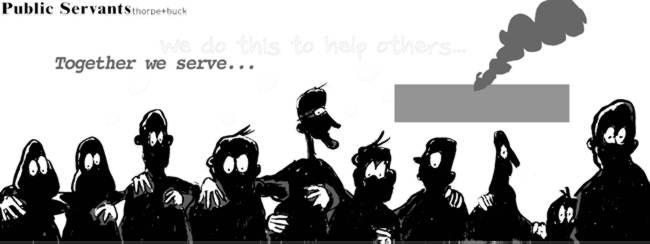
I had left the UK a week earlier. Before leaving I had written two new scripts for my comic strip Public Servants. This appears on the back page of the eponymous fortnightly magazine for senior public managers.
I sent them to the artist, Matt Buck, to draw.
When I returned to the UK, on July 11, he had drawn them. But the second had to be hastily rewritten and redrawn, because it had turned out to be terribly prescient, and its meaning had changed completely.
This item is about the script and how it changed.
The first version was as follows:

Gerhardt talking with Nigella

1. Gerhardt: The department needs to be more public-facing and customer oriented.

2. An alarm goes off, startling them.
Gerhardt: Oh my god! It's a security alert!
Nigella: Could be a terrorist! What do we do?

3. Maurice sticks his head round the door.
Maurice: It's alrght, it's just a member of the public got in the building.

Matt drew it with a big explosion effect, and had the characters jumping under the table. This is shown.
Clearly, the meaning had now completely changed, and this was now unacceptable, and the editor, needlessly, asked for a change.
My initial reaction was to change the last two panels to the one finally used the following issue, yet to be published. This has them standing in the foyer of the building, now bristling with security measures, and saying "The only trouble is the public can't get in."
This undemocratic effect of security measures was an irony that couldn't yet be appreciated, however, so Matt suggested a more sympathetic tone.
We went through a couple of variations, illustrated, and ended up with the one finally used.
We tried to avoid being mawkish, a common error by cartoonists in a situation like this, by using the silhouettes, and the ambiguity of linking arms - for solidarity, or to keep people out, or in, or what?
Do you think we have succeeded?
Let us know.
In the meantime, you can view more Public Servant cartoons at www.cyberium.co.uk and links.

Wednesday, July 20, 2005

Resonant sympathy

This blog created 35th anniversary of the 1st moon landing... when I was 15 and on holiday with my parents in Cornwall.
I recall that at that point I was working on a draft of a novel based on Marvel superheroes.
How much has changed?
Now I am working on the second draft of a novel also in the fantasy sphere, called Hybrids. In all this time I still haven't had a novel formally published by a bona fide publisher.
The Moon looks on in sympathy, and I have sympathy for the Moon, which must look down upon our human vanities and manic activities with a tolerance borne of its long vigil as a witness to events on earth.