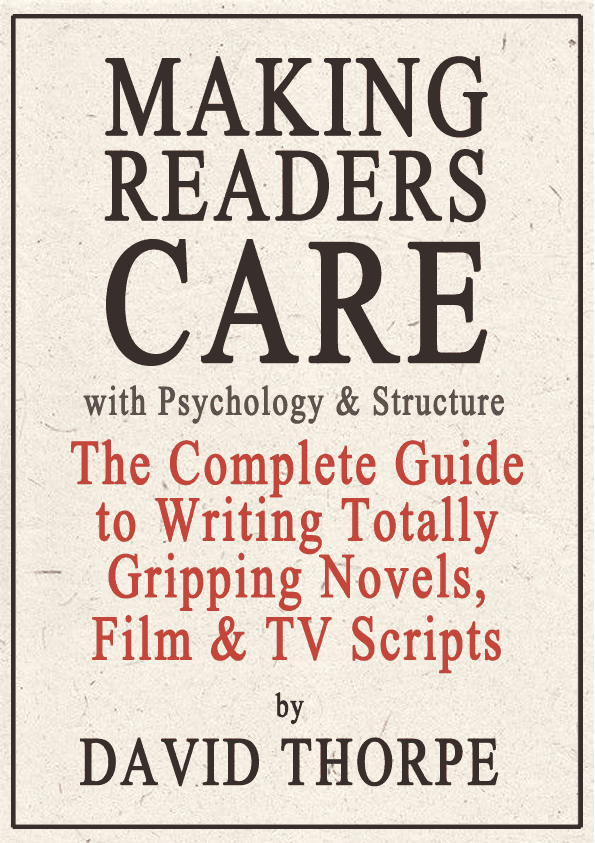
My new book will be published towards the end of February as an e-book, price £4.50. Watch this space!
It is for anyone who wants to write a ‘page-turner’ – a compelling narrative that readers ‘can’t put down’ with characters that ‘jump off the page’. These phrases in inverted commas are frequently used by editors, producers and agents to describe what they are looking for.
The way to achieve this result is by making readers care what happens to your characters, regardless of whether they are likeable or not.
My aim is simply to help you get the best from your own story, whatever it is; to uncover inside it the seed of the perfect narrative just waiting to be discovered and guide you in making it as gripping as possible.
I have taught many hundreds of hours of scriptwriting and creative writing classes, during which its content has been developed and refined from feedback with students.
It concentrates especially on two things: human psychology and structure. It provides a methodology.
Many readers, and many beginner writers, think writing is just about inspiration. Of course inspiration plays a part. But discipline and method, ruthlessness and determination contribute the rest.
Film, TV, publishing: they are highly competitive industries. Millions of dollars are at stake. To succeed you need to be working at a top professional standard.
This book contains the secrets of success for writers in these industries. The only other things you will need are your time and hard work.
Contents:
Introduction 13
The nature of storytelling 13
How to use this book ... 14
10 steps to a first draft! ... 14
SECTION A: PREPARATION
1. Choosing the right idea ... 17
Research the market 17
Exercise 1: Finalise the idea 17
2. The four basic plot types ... 19
How to decide your story’s plot type 19
1. Conquering the Monster ... 19
2. Rags to Riches ... 19
3. Voyage and Return ... 19
4. Rebirth ... 20
Exercise 2.1: What's the plot type? ... 20
So are there really only four plots? ... 20
Exercise 2.2: Practice the plot type ... 21
Exercise 2.3: Your plot type ... 21
3. The challenge of creating compelling characters ... 22
Be honest 22
Exercise 3.2: Know your characters ... 23
Exercise 3.3: Practising honesty 23
Issue-based characters ... 23
4. How to create characters that jump off the page 24
Exercise 4.1: Make a basic character sheet ... 24
Hear their voices ... 24
Complexity ... 24
Exercise 4.2: Creating complexity ... 24
Inner conflict 25
Ways of creating inner conflict 25
Exercise 4.3: Life scripts and inner conflicts 27
5. The ‘but’ equation ... 28
Upping the stakes ... 28
Exercise 5.1: Write a 'but' equation ... 28
What’s at stake? ... 28
Exercise 5.2: What's at stake? ... 29
How do conflicted characters behave? 29
Exercise 5.3: Plot goals ... 29
Make mistakes ... 29
6. The really interesting thing about superheroes ... 31
7. The story writing map ... 32
8. The four story endings ... 33
Exercise 8.1: How does it end? ... 33
Story arcs ... 33
Exercise 8.2: Check the ends ... 33
9. The three act structure and the sentence summary 34
The three act structure ... 34
The three sentence summary ... 35
Exercise 9.1: Analyse a story ... 36
Exercise 9.2: Write your three sentence summary ... 36
10. Loglines ... 37
How to write a logline ... 37
Exercise 10.1: Write a logline for another story ... 38
Exercise 10.2: Write a logline for your story ... 38
11. Research 39
How to do research ... 39
How to use the research ... 39
12. Themes and subplots ... 40
The use of subplots ... 40
More than one theme ... 41
Exercises 12: ... 41
13. The Hero’s Journey ... 42
Too formulaic? ... 43
Exercise 13.1: Look out for the plot points ... 44
Exercise 13.2: Map your hero's journey 45
14. Fleshing out the story ... 46
15. Character development ... 47
You are what other people think of you ... 47
Making an attitude table ... 47
Exercise 15.1: Make an attitude table ... 48
Stakes ... 48
Exercise 15.2: Sharpen the stakes 49
16. More on psychology and dramatic storytelling ... 50
The shadow self ... 50
Exercises 16.1: What is the shadow self? 50
Life scripts ... 50
Exercises 16.2: What are the life scripts? 51
People have ‘parts’ ... 51
Triggers 52
Exercises 16.3: What are the triggers? ... 53
17. The Storyline ... 54
Weaving yarns ... 54
The Storyline ... 54
Exercise 17.1: Make a storyline 55
Things to look for: ... 55
Exercise 17.2: Plant the plants ... 56
Exercise 17.3: Plant the props ... 56
Exercise 17.4: Perfect the storyline ... 56
18. The scene cards system ... 57
The scene cards ... 57
Exercise 18: Make your scene cards ... 59
19. The synopsis ... 60
Exercise 19: Check for plot holes ... 61
20. What is suspense? ... 62
Three ingredients of suspense 62
Levels of suspense ... 62
Ways to increase and vary suspense: ... 62
The payoff ... 62
Timescales ... 63
Layer your anticipations ... 63
Be aware of pacing ... 63
Relation to story structure: ... 63
Exercise 20: Monitor the suspense ... 63
21. Flashbacks and framing devices ... 65
Framing devices ... 65
22. Interlude: Imagination, inspiration and in-betweens ... 66
Empathy and imagination 66
Courting the unexpected ... 66
Breathing space ... 67
Exercise 22: Tap your subconscious ... 67
SECTION B: WRITING THE FIRST DRAFT
23. Writing the first draft ... 69
A suggested work pattern 69
How many drafts should you write? ... 69
How long should your novel be? ... 69
Assemble your tools 69
24. Honesty and writing ... 71
25. Choosing the point of view ... 72
Exercise 25: ... 72
26. Present or past tense? ... 73
Exercise 26: Play with tense ... 73
27. On Dialogue 74
Exercise 27.1: Plan a scene ... 74
Exercise 27.2: Dialogue vs. silence ... 75
28. More on dialogue ... 76
1. Intention ... 76
2. Pauses and attributions ... 76
3. Multiple topics in a conversation 77
4. Long speeches ... 77
5. Grammar ... 77
6. Phonetic spellings 77
7. Don’t use characters’ names too often 78
8. Don’t have long stretches of dialogue only ... 78
9. Reported speech ... 78
Exercise 28.3: Showing not telling ... 78
29. How to plan a scene (1) ... 79
The definition of a scene ... 79
Exercise 29: Prepare to write a scene ... 79
30. Transactional analysis of a relationship ... 80
31. How to plan a scene (2) ... 82
Exercise 31: Make the scene grip the reader ... 82
32. Suspense and structure ... 84
Exercise 32: ... 84
33. 20 tips on scene writing ... 85
34. Beats and how they work ... 86
Exercise 34.1: List the beats ... 86
Exercise 34.2: Check the beats ... 86
The relationship with adjacent scenes ... 87
Exercise 34.3: Check the scene ... 87
35. How to keep it simple and fast-paced ... 88
Tense and sentence structure ... 88
Exercise 35.1: Active-passive ... 88
Word choice ... 88
Use short chapters or segments ... 88
Cliffhangers ... 88
Jump cuts ... 89
The secret of good storytelling 89
Exercise 35.2: Cliffhangers 89
36. Pacing ... 90
What is pacing? ... 90
When to slow down ... 90
When to speed up ... 90
Exercise 36.1: Speed check ... 90
Exercise 36.2: Overwriting check ... 90
Action scenes ... 90
Cliffhangers and pacing ... 91
Summaries ... 91
Extending the dramatic scenes 91
Jump cuts ... 91
Short chapters ... 91
Word choice and sentence structure ... 91
Exercise 36.3: Read it out ... 92
37. Set-pieces ... 93
Exercises 37: ... 93
38. Show, don’t tell ... 94
Exercise 38.1: Noticing 'telling' ... 94
Exercise 38.2: Read and critique ... 94
39. Scene setting and the reliability of the narrator ... 96
Exercise 39: ... 96
40. Everything is particular: the art of writing descriptive prose ... 97
Exercise 40: ... 98
41. The extended metaphor ... 99
Cold Comfort Farm ... 99
Exercise 41: ... 100
42. Using humour ... 101
Types of humour ... 101
Types of humour in relation to character type or to genre ... 101
Narrative forms and humour ... 102
Types of verbal humour ... 103
Sample list of humorous books with types of humour ... 104
Other notes ... 104
Exercises 42: 104
SECTION C: EDITING
43. Editing your work ... 106
Seeing it afresh ... 106
Exercise 43.1: Overview ... 106
Exercise 43.2: Settings check ... 106
Exercise 43.3: Style check 107
Exercise 43.4: Chapter or scene level checks ... 107
This is about making the reader care 108
Show don’t tell ... 108
Transitions ... 108
Making it flow ... 108
Exercise 43.5: Copy-editing ... 109
Exercise 43.6: Proofreading ... 109
44. Openings ... 110
Things that a beginning needs to do ... 110
How to do this ... 110
Exercise 44: ... 111
45. Notes on formatting ... 112
For the manuscript ... 112
46. Jokes for editors and writers 113
Explanations for the jokes ... 113
SECTION D: SUBMITTING
47. Agents and editors ... 118
48. What to send ... 119
Cover letters when submitting to agents/editors ... 119
Synopses ... 119
49. How to grab the attention of an editor or agent ... 120
50. How to deal with rejection and feedback 121
How to respond to feedback ... 121
51. To self publish or not? ... 122
Self-publishing and publishers’ services ... 122
Acknowledgements ... 123
Showing posts with label scriptwriting. Show all posts
Thursday, January 24, 2019
Monday, January 14, 2013
How to make a musical in ten days
In December my wife, Helen Adam, and I were lucky enough to be hired to run a music and drama workshop during the winter holidays at Vijay International School on the island of Praslin in the Seychelles.
This is what happened.
I say winter, but it was 31°C most of the time and 90% humidity. The word 'winter' does not occur in their vocabulary! There were 16 children and the age range was demanding: from 6 to 15.
All of them spoke English, some of them French, and all of them spoke Creole.
The aim was to create a musical drama from scratch. What we weren't prepared for were the paucity of materials and lack of musical instruments, not to mention the fact that the children had never done anything like this before, nor even seen a theatrical performance.
The expectations of the staff were correspondingly fairly low as to what the children would be able to achieve in just 10 days.
What happened completely surprised everyone. The result was a 45 minute musical, called The Fire in the Forest, which included five songs, which they wrote themselves, displaying the huge talent of these students.
My job was to guide them through creating the storyline and the script, and Helen's to do the same with the music and songwriting. My friend and the school's headmaster, Martin Kennedy, supported them in creating the masks, props and sets.
Everyone worked hard, from eight in the morning to three in the afternoon.
In the first week, we explored ideas, plot structure, morals, musical elements, how to collaborate, then wrote the plot, script, lyrics and music.
In the second week we rehearsed and learnt about stagecraft and musical and dramatic performance. Every single one of the students contributed an equal amount to the final work, which is the sum of many small parts.
The process of creating and shaping the work was as important as the final result, to help them learn collaboration and partnership.
It was a truly intense experience; we got to know them all very well and they became our friends.
Helen put them in a trance and guided them to find their own spirit animals.
They split into four groups to each come up with characters and a story. Each group then pitched their story to the rest.
I then combined all four stories into one story, and gave it to them for their approval.
We then split the story into 11 scenes. The group divided into pairs or individuals, who each then wrote a scene. I typed them up into the script.
The songs were written in a similar way. A theme or subject was decided upon for that point in the narrative. Each child then wrote a single line. They then ordered the lines into verses and chorus. Helen helped them come up with the tunes.
So, by the end of the fourth day we had a script! We also had four of the five songs. This was a stage we hadn't expected to reach until the beginning of week two. On the fifth day we had a read-through and cast the parts.
They spent the weekend learning their lines. The first four days of week two were spent rehearsing and creating their masks for their spirit animals.
The final performance was on the afternoon of the 10th day. All of the parents, some teachers and school governors attended.
Everyone was completely amazed at what these children had achieved, ourselves included.
It was so successful that we were immediately invited back for the following year, except that the next time the outcome will be a short film instead of a performance.
For Helen and I, it shows what children are capable of when given the chance.
In their feedback, most of the children commented on how much the experience had increased their self-confidence and spirit of cooperation, which is surely the point. Some of them now want to learn musical instruments, which is difficult as there are no music teachers on the island of Praslin.
Their parents remarked on how, unlike on school days when they had to be dragged out of bed, they were up in plenty of time to get to school!
Helen and I cannot wait to go back next year.
This is the story they came up with:
The sleepy village of Waverley guards the Peace Forest, on which all other forests of the world depend. It is led by two wizards, Ricky and Jack, and blacks and whites live together equally.
Then, the evil Smilekiller and his soldiers come. With magic claws he puts the villagers under a spell, where the blacks must dominate the whites. Then he uses a magic crystal to burn the forest.
Only the villagers’ three pets can save the forest, but first they must get magic fan leaves from a tree guarded by a werewolf, to put out the fire in the crystal.
The villagers manage to transform into their spirit animals, when they are free from the spell. They challenge Smilekiller, who changes into his own spirit animal, the king of the beasts. They win the struggle, but the tyrant’s soldiers put the villagers in gaol.
The three pets succeed in putting out the fire, but one of them, the toucan Findicesa, dies.
Victoria, whose spirit animal is a dove, can escape, however. She overhears that Smilekiller is evil because he was bullied. She sings a song that charms and calms his heart.
Smilekiller relents and releases the villagers. The surviving pets return with the crystal, which Smilekiller agrees to throw away because it is too dangerous for anyone to own. The villagers celebrate victory with a song: We Are Proud.
Waverley Village inhabitants
Charlotte Vanacore, a Wizard, Jack
Rasiki Devi Pillay, a Wizard, Ricky
Linnea Huechenne, a villager, Bella
Phin Phinehas, a villager, Johnny
Aliette Vidot, a villager, Victoria
Hlo Moyo, a villager, Brendan
Vanilla-Lou Labiche, a villager, Jacob
Alysa Payet, a pet dog, Miki
ChloƩ Verlaque, a pet cat, Carlisle
Candice Harter, a pet toucan, Findicesa
Others
Brigitte De Charmozhadlache – Smilekiller
Perry Pointe – Smilekiller’s soldier
Wendy Danielle – Smilekiller’s soldier
Simon Allisop, a mad monkey
Ishah Figaro, a werewolf
Animal Rap
No One (Lament for Findicesa)
Time To Change Your Heart
We Are Proud
This is what happened.
I say winter, but it was 31°C most of the time and 90% humidity. The word 'winter' does not occur in their vocabulary! There were 16 children and the age range was demanding: from 6 to 15.
All of them spoke English, some of them French, and all of them spoke Creole.
The aim was to create a musical drama from scratch. What we weren't prepared for were the paucity of materials and lack of musical instruments, not to mention the fact that the children had never done anything like this before, nor even seen a theatrical performance.
The expectations of the staff were correspondingly fairly low as to what the children would be able to achieve in just 10 days.
What happened completely surprised everyone. The result was a 45 minute musical, called The Fire in the Forest, which included five songs, which they wrote themselves, displaying the huge talent of these students.
![]() |
| At the start, the happy villagers of Waverley are sharing food and a game. |
My job was to guide them through creating the storyline and the script, and Helen's to do the same with the music and songwriting. My friend and the school's headmaster, Martin Kennedy, supported them in creating the masks, props and sets.
![]() |
| ... but then the evil Smilekiller comes with his soldiers. |
In the first week, we explored ideas, plot structure, morals, musical elements, how to collaborate, then wrote the plot, script, lyrics and music.
In the second week we rehearsed and learnt about stagecraft and musical and dramatic performance. Every single one of the students contributed an equal amount to the final work, which is the sum of many small parts.
![]() |
| He makes the blacks turn the whites into slaves. |
The process of creating and shaping the work was as important as the final result, to help them learn collaboration and partnership.
It was a truly intense experience; we got to know them all very well and they became our friends.
How was this possible in just nine days?
We were completely surprised ourselves. After some introduction to the four basic plots, and story structure, the children decided on the themes, which were spirit animals and equality/discrimination.Helen put them in a trance and guided them to find their own spirit animals.
![]() |
| By transforming into their spirit animals they are able to free themselves of this spell... |
They split into four groups to each come up with characters and a story. Each group then pitched their story to the rest.
I then combined all four stories into one story, and gave it to them for their approval.
We then split the story into 11 scenes. The group divided into pairs or individuals, who each then wrote a scene. I typed them up into the script.
![]() |
| Meanwhile, it is up to the villagers' three pets to save the world by putting out the fire in the forest created by Smilekiller.... |
![]() |
| ... With the help of a Mad Monkey! |
The songs were written in a similar way. A theme or subject was decided upon for that point in the narrative. Each child then wrote a single line. They then ordered the lines into verses and chorus. Helen helped them come up with the tunes.
So, by the end of the fourth day we had a script! We also had four of the five songs. This was a stage we hadn't expected to reach until the beginning of week two. On the fifth day we had a read-through and cast the parts.
They spent the weekend learning their lines. The first four days of week two were spent rehearsing and creating their masks for their spirit animals.
The final performance was on the afternoon of the 10th day. All of the parents, some teachers and school governors attended.
![]() |
| They manage to put out the fire. |
Everyone was completely amazed at what these children had achieved, ourselves included.
It was so successful that we were immediately invited back for the following year, except that the next time the outcome will be a short film instead of a performance.
![]() |
| But one of them dies. How sad.... (Cue a lament!) |
For Helen and I, it shows what children are capable of when given the chance.
In their feedback, most of the children commented on how much the experience had increased their self-confidence and spirit of cooperation, which is surely the point. Some of them now want to learn musical instruments, which is difficult as there are no music teachers on the island of Praslin.
Their parents remarked on how, unlike on school days when they had to be dragged out of bed, they were up in plenty of time to get to school!
Helen and I cannot wait to go back next year.
![]() |
| Back in the village, the spirit animals fight the spirit animal of Smilekiller, but are thrown into gaol. |
The Story
This is the story they came up with:
The sleepy village of Waverley guards the Peace Forest, on which all other forests of the world depend. It is led by two wizards, Ricky and Jack, and blacks and whites live together equally.
Then, the evil Smilekiller and his soldiers come. With magic claws he puts the villagers under a spell, where the blacks must dominate the whites. Then he uses a magic crystal to burn the forest.
![]() |
| The Dove manages to escape. |
Only the villagers’ three pets can save the forest, but first they must get magic fan leaves from a tree guarded by a werewolf, to put out the fire in the crystal.
![]() |
| She finds a way to charm Smilekiller. |
The villagers manage to transform into their spirit animals, when they are free from the spell. They challenge Smilekiller, who changes into his own spirit animal, the king of the beasts. They win the struggle, but the tyrant’s soldiers put the villagers in gaol.
The three pets succeed in putting out the fire, but one of them, the toucan Findicesa, dies.
Victoria, whose spirit animal is a dove, can escape, however. She overhears that Smilekiller is evil because he was bullied. She sings a song that charms and calms his heart.
![]() |
| ... who releases the villagers from his spell by giving them each one of her magic claws. |
Smilekiller relents and releases the villagers. The surviving pets return with the crystal, which Smilekiller agrees to throw away because it is too dangerous for anyone to own. The villagers celebrate victory with a song: We Are Proud.
![]() |
| We Are Proud! |
The Cast
Waverley Village inhabitants
Charlotte Vanacore, a Wizard, Jack
Rasiki Devi Pillay, a Wizard, Ricky
Linnea Huechenne, a villager, Bella
Phin Phinehas, a villager, Johnny
Aliette Vidot, a villager, Victoria
Hlo Moyo, a villager, Brendan
Vanilla-Lou Labiche, a villager, Jacob
Alysa Payet, a pet dog, Miki
ChloƩ Verlaque, a pet cat, Carlisle
Candice Harter, a pet toucan, Findicesa
Others
Brigitte De Charmozhadlache – Smilekiller
Perry Pointe – Smilekiller’s soldier
Wendy Danielle – Smilekiller’s soldier
Simon Allisop, a mad monkey
Ishah Figaro, a werewolf
Songs
I Am Who I AmAnimal Rap
No One (Lament for Findicesa)
Time To Change Your Heart
We Are Proud
Subscribe to:
Posts (Atom)


