It does seem almost miraculous that a man of African descent should become President of the United States of America, the son of a Kenyan immigrant and the grandson of a man who was tortured by the British for his part in the Mau-Mau rebellion.
There are many explanations as to why the American people elected him; undoubtedly much credit is due to his highly impressive moral character.
But as a storyteller, I believe some value arises from the archetypal narrative type which the Obama story represents, one that is at the heart of the American dream: the rags to riches story. This story form is dear to Americans because many of them still believe that it is possible for anyone to become their president, no matter how humble their background. The Obama story epitomises the democratic ideal perfectly.
In its classic form, the rags to riches story has five stages:
The first stage is the 'call', where the hero is in a low state, perhaps unhappy, usually in an impoverished home. For Obama, this might be as a child in Hawaii, or it might be in New York, 1982, when he lived in an apartment in a sixth-floor walkup on East 94th Street, "a drug-ridden neighborhood filled with gunshots". At this stage something happens which calls the hero to the wider world that could lift him out of his miserable state. In the Cinderella story, it's when she gets her invitation to the ball. It's debatable if there was a specific moment when Barack Obama felt the call to serve - his was more a gradual evolution. It might have begun in his second year at Occidental College, Los Angeles, when he began to heed his mother's warning that he shouldn't be partying too much; prompting him to leave for New York. It might have been during his time there, from 1982-1985, where he studied and thought a great deal. Or it might have been in Chicago where he threw himself into the task of helping disadvantaged black people get what was theirs by right at the Calumet Community Religious Conference. His boss, Gerald Kellman, later said: "He wanted to make it from the grass roots and he wanted to learn". It was while there that he became convinced that the most serious problems he confronted couldn't be solved on the local level. So perhaps the real call was here, when he changed course again, for Harvard to study law, a path which many an aspiring politician was supposed to follow.
The second stage is when, out in the world, there is initial success. Cinderella gets to dance with the Prince. Aladdin finds his magic lamp. Our hero becomes a Senator in Illinois.
But in the third stage there is always a setback. Cinderella has to return home when her chariot becomes a pumpkin again at midnight. Dick Whittington is forced to leave London. David Copperfield's child-wife dies. The Sorceror tricks Aladdin's Princess out of his magic lamp. And in The Gold Rush, Charlie Chaplin loses his girl and fails to find gold. In Obama's case it was in the year 2000, when he lost a Democratic primary run for the US House of Representatives. As setbacks go, it wasn't a big one, but it taught him a necessary lesson. He still had more to learn, and remained at that level for a further four years.
The fourth stage of the rags to riches is when the hero has victory in his sights but must face his final ordeal. Undoubtedly, this point in the Obama story comes when, after becoming only the fifth African-American Senator in U.S. history, and the third to have been popularly elected, he decided to run for president. This campaign set numerous fundraising records, but before he could win the ultimate prize he had to defeat his most fearsome and implacable enemy. In a sense, this was not a Republican, John McCain, but two Democrats - the Clintons. Boy, would she not give up. But the reason why ultimately Hilary and McCain lacked the spontaneous popular support expressed by ordinary people for Obama, is because the Obama story is so much more appealing and inspiring than the story arc represented by either of them, which have, let's be honest, more in common with tragedies (after all, there are very few victims of Obama's pursuit of power, but one can think of more than a few metaphorical corpses littering the McCain and Clinton wakes).
The Obama story is inspiring precisely because of its resonance as an archetypal narrative, because it is the story we want to believe. It's one that we all remember from the tales told to us at bedtime in our younger years. Not just Cinderella, but Dick Whittington, Puss in Boots, Aladdin, Moses, and Joseph. Then as we grew older in the forms of adult stories such as Moll Flanders, David Copperfield, Great Expectations and in modern times Rocky, Citizen Kane, Scarface, JK Rowling's personal story, The Pursuit of Happiness, Charlie Chaplin in The Gold Rush, and this year, Slumdog Millionaire. Rags-to-riches is even the basis of many hugely popular reality television shows such as Big Brother, The Apprentice, American Idol and Joe Millionaire (in the States).
The Democrat demagogues knew of its power. It's why, in the 2008 Convention, they requested all speakers to deliver a rags-to-riches story.
Obama's enemy fought till the bitter end. She would not let up until way beyond anyone else would have conceded. It was, like all good stories, nail biting till the final moment. But of course he was victorious -- his followers and fans would say that virtue won out, for once in politics, against absolute lust for power.
In classic rags to riches stories, the fifth and final phase is purely and simply success. The hero gets his princess, or vice versa, and wins the kingdom. Everyone lives happily ever after. The hero's inner virtue has been recognized by everyone at large. The slipper fits Cinderella because she deserves it - being humble and pure, unlike the ugly sisters, McCain and Hilary Clinton. In some versions of the story, the hero himself has to undergo an inner transformation for his virtue to manifest. In other versions, her previously hidden virtue is finally acknowledged by everyone.
Because of this, the reign of the heroine or hero over their kingdom, or city in Dick Whittington's case, is fair and benign. And here is where this narrative form achieves its greatest resonance and attractiveness to people at large, especially the underclasses. So much hope is invested by people all over the world, not just in America, that Obama will make their problems go away, or at least lighten their burdens.
It is almost scary. From Pashtuns to Pakistanis, and Afghans to Africans, we want him to dissolve the war on terror, save us from climate change, enervate the economy and propel us from poverty. He is, sadly, not from a fairy story, wreathed in magic. Remember how we felt when Tony Blair was elected. Remember how it fell apart. We want it to be different this time because that's what the story tells us it's going to be like.
We can only wait and hope that this time, in some way, history really has delivered us the best possible leader for these, the worst of times. We hope that Obama's success will enrich us all.
Monday, January 19, 2009


Tuesday, December 30, 2008
Welcome to the New Year
I wish you a New Year
more beautiful than you are now
more rewarding than the darkness foretold.
A New Year with no comparison to any gone before
(full of bad experiences perhaps, lost opportunities or wasted time)
Not a New Year that is painted up, glossed over, made up, made over
But one rebuilt from the inside out,
reconstructed from the roots of your being.
Not a New Year of hollow laughter and ignorant abandon
There is no need to drink in excess
to wish health for others or rose-tint your view.
There is no need to make a list
Of good intentions and file them away.
There is no need to cry
and regret the past, consumed by guilt.
From January, change things. Make them light.
Reward justice, fairness, truth and honesty.
See clearly, feel spontaneously.
Taste what you eat, savour whom you touch.
Greet the morning with a smile and hope.
Begin with your right to live with gusto.
To win a New Year that deserves this name,
you, my friend, you have to earn it. You have to try again.
I know it's not easy, but try, try hard
and when you fail try again, because you will fail
but this is life and there is only one.
It is within you that the New Year begins
and hope, and new life forever expectant.
(With thanks to Laurinha and Carlos Drummond de Andrade)
more beautiful than you are now
more rewarding than the darkness foretold.
A New Year with no comparison to any gone before
(full of bad experiences perhaps, lost opportunities or wasted time)
Not a New Year that is painted up, glossed over, made up, made over
But one rebuilt from the inside out,
reconstructed from the roots of your being.
Not a New Year of hollow laughter and ignorant abandon
There is no need to drink in excess
to wish health for others or rose-tint your view.
There is no need to make a list
Of good intentions and file them away.
There is no need to cry
and regret the past, consumed by guilt.
From January, change things. Make them light.
Reward justice, fairness, truth and honesty.
See clearly, feel spontaneously.
Taste what you eat, savour whom you touch.
Greet the morning with a smile and hope.
Begin with your right to live with gusto.
To win a New Year that deserves this name,
you, my friend, you have to earn it. You have to try again.
I know it's not easy, but try, try hard
and when you fail try again, because you will fail
but this is life and there is only one.
It is within you that the New Year begins
and hope, and new life forever expectant.
(With thanks to Laurinha and Carlos Drummond de Andrade)
Thursday, December 11, 2008
Calling all childrens writers in Wales
All other regions of the UK have local branches of the Society of Childrens Book Writers and illustrators, who meet regularly fdor crit groups and socialising, except for Wales.
See the website britishscbwi.jimdo.com/networks/
I've taken on the job of being the Wales coordinator. Ideally we'll be mid-Wales, meeting in Aberystwyth, and I'd like to see people come forward to coordinate in NBorth and South Wales.
Academi is the Welsh agency supporting writers. I have posted an appeal for any writers - published or not - to join the Welsh branch of SCBWI at
academi.org/opportunities/i/133697/
They can also contact me directly.
The Academi website is also worth a browse for competitions etc.
See the website britishscbwi.jimdo.com/networks/
I've taken on the job of being the Wales coordinator. Ideally we'll be mid-Wales, meeting in Aberystwyth, and I'd like to see people come forward to coordinate in NBorth and South Wales.
Academi is the Welsh agency supporting writers. I have posted an appeal for any writers - published or not - to join the Welsh branch of SCBWI at
academi.org/opportunities/i/133697/
They can also contact me directly.
The Academi website is also worth a browse for competitions etc.
Friday, December 05, 2008
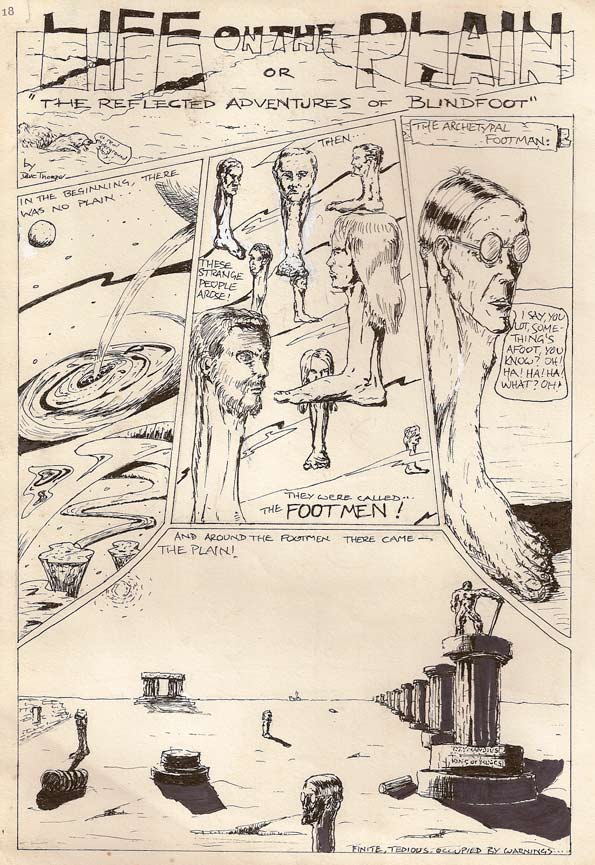
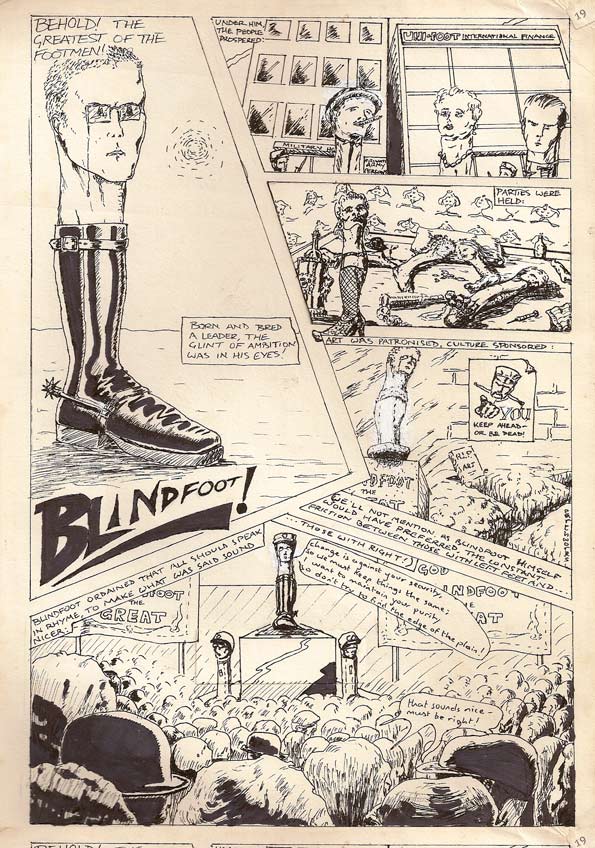
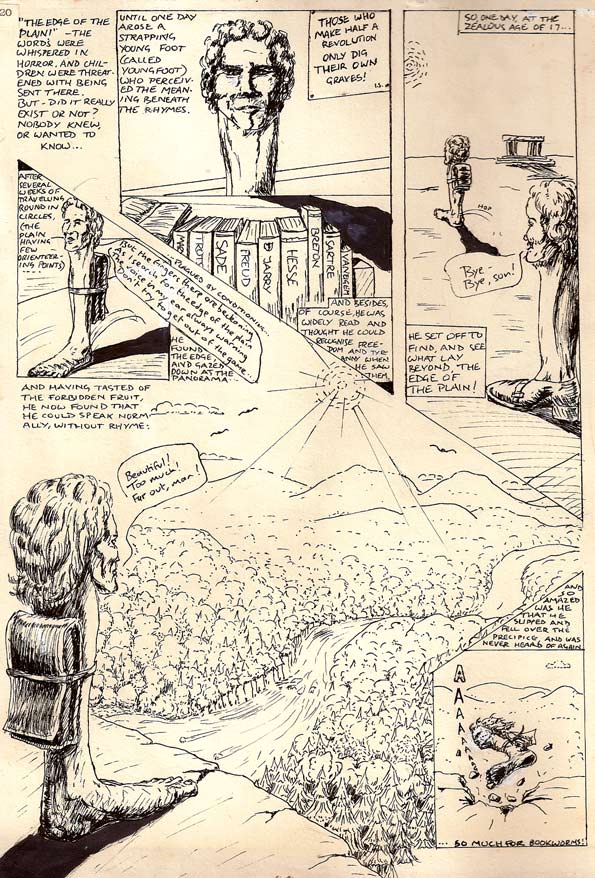
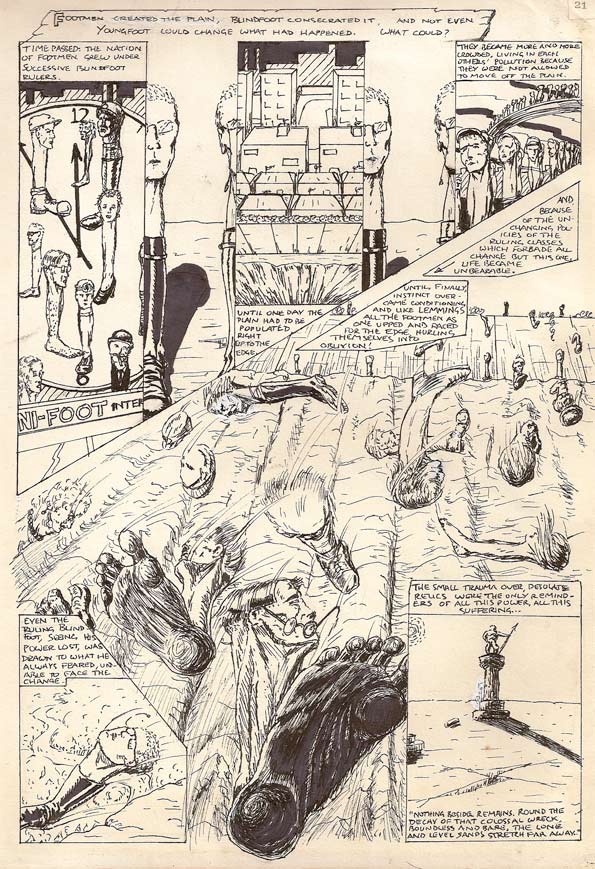
Before Watchmen - Footmen!
 I have moved - this time more permanently, please universe. For the first time in three years all my stuff is in the same place. I've lost count of how many times I've moved my pillow in that time.
 I am putting my life back together like a jigsaw and seeing the picture that emerges. I found a piece two nights ago: the only comic strip I ever wrote AND drew. Four pages. Click and be awed. It is unbelievably dumb.
page 1
page 2
page 3
page 4
I want to meet an illustrator who can develop the character concepts with me into a totally different book series proposal, if they're crazy enough.
Thursday, November 20, 2008
Evidence that the recession is biting publishers
Evidence that the recession is biting publishers: a new rejection letter today for my latest novel We Can Improve On You, begins, as always, by praising it - "a really interesting and provocative idea, and very clever", then goes on to say "We are being quite careful about what we acquire at the moment, as we are to put more effort and financial investment behind fewer books", which the editor admits is "depressing to hear, I know, but essential in the current trading conditions".
Anecdotal evidence from other writers suggests a similar trend is occurring elsewhere.
Rejection letters come in many forms, but few as bizare as another I received this week - from an agent, who wrote that despite thinking "both these books could well be published" ... "I just feel that your connection with cyberspace would fall on ignorant and rather unreceptive ears!"
This means that an agent for children's literature is admitting she feels unqualified to market material the content of which is key to the experience of many kids today - social networking sites and the like. This is also, alas, not uncommon - many agents of maturing years began their career in a former time when publishing was a more genteel profession.
One feels that the publishing world is moving so fast that agents are struggling and most writers have a diminishing chance. The pyramid of the 'pyramid model', whereby only a few authors receive most of the marketing, is becoming narrower at the base: you either write fully commercial best-sellers that will ship by the barrel-load in Tesco's or don't get published at all.
Anecdotal evidence from other writers suggests a similar trend is occurring elsewhere.
Rejection letters come in many forms, but few as bizare as another I received this week - from an agent, who wrote that despite thinking "both these books could well be published" ... "I just feel that your connection with cyberspace would fall on ignorant and rather unreceptive ears!"
This means that an agent for children's literature is admitting she feels unqualified to market material the content of which is key to the experience of many kids today - social networking sites and the like. This is also, alas, not uncommon - many agents of maturing years began their career in a former time when publishing was a more genteel profession.
One feels that the publishing world is moving so fast that agents are struggling and most writers have a diminishing chance. The pyramid of the 'pyramid model', whereby only a few authors receive most of the marketing, is becoming narrower at the base: you either write fully commercial best-sellers that will ship by the barrel-load in Tesco's or don't get published at all.
Wednesday, November 12, 2008


Tuesday, October 21, 2008
Wales for Africa - Stories of Success

I've had the privilege of meeting many selfless, inspiring people while researching this - including Wales' only black fair trade producer, Martha Musonza Holman of Abergavenny, and Angela Gorman, who has saved many lives of pregnant mothers in Chad.
The 12 case studies will be published by Cynnal Cymru - Sustain Wales next month, in print and on their web site.
Friday, October 17, 2008
Satirica is out!
 I have two stories in this hardback collection of satirical speculative fiction published by Cowboy Logic in the States. They are Perfection, and a Doc Chaos story - The Last Laugh.
Perfection is a cautionary allegory about addiction, glamour and politics.
The Last Laugh contemplates the end of civilisation - and imagines the glee of Doc Chaos as we fell prey to the lies we wanted to believe.
You can buy it on Amazon for around £9 - for 24 hardcore tales.
I've also just finished working on a book of case studies - 'Wales 4 Africa' for the Welsh Assembly Government - and meeting totally inspiring people!
Thursday, September 18, 2008
Let's run the banks like e-Bay and Wikipedia
Let’s not despair that human nature always causes ruin just because the banks are collapsing. Individuals can make a fantastic difference, and together, given a leap of imagination, can find a solution to global financial inequality in an unexpected place.
In a week when capitalism's Goliaths have fallen so swiftly, not by the action of many Davids, but because they were made rotten to the core by their own rapacity, I have been gleaning potential solutions to some of the world's most pressing economic problems from a quite different quarter.
I am researching a book on links between individual and communities in Africa and Wales. This means I am travelling around Wales talking to people who are changing the lives of others thousands of miles away, and whose lives themselves are being transformed in the process. Individuals like Angela Gorman, who, just because she saw a BBC documentary in 2005 about women dying in Chad during childbirth for want of a simple and cheap compound, has given up her job to raise money to help them, and as a result slashed the mortality rate from 17% to under 2.5%, exceeding a Millennium Development Goal. These drugs cost just 60p a pop, and a woman would need five to seven of them. Yet they had, until her straightforward intervention, been dying by the hundred. In short she has achieved in a year what the United Nations failed to, so much so that they have asked her to repeat her success in neighbouring Liberia. [http://www.hopeforgracekodindo.org/]
On Wednesday I met Denise Lord from Pen-y-Craig, in the Rhondda, an ex-coal-mining area classed as 'deprived' in the lexicon of EU or government grant-dispersing bodies, and which has had millions poured into it in an attempt to help its children. Although Denise says the kids she runs workshops for are "materially rich, with their mobile phones and Sky boxes" compared to those she has visited in the slums of Cape Town, the problem is that compared to the Cape Town kids they are "spiritually poor, while the Cape Town kids are spiritually rich and materially poor". [http://www.valleyskids.org/news_details-13198.html]
I asked her to explain. "We have so much to learn from these people," she replied, "And I think among the most important is humility. The kids there have to struggle to get to school so they value it. The kids here take it for granted, so they don't. They bunk off and think it's cool to drop out and get into trouble."
'We have so much to learn from these people' is a phrase I've heard from every one of these extraordinary-yet-ordinary individuals I have talked to so far. But Martha Musonza Holman is one apart. She left her two sons, aged 9 and 12, behind when she fled Zimbabwe in 2001 to come to Wales, where she now resides running a fair trade business called, appropriately, I Love Zimbabwe [http://ilovezimbabwe.co.uk]. She and her partner David struggle to import crafts made by people from her community back there to sell here, so she can send the profit back.
It might be easier to trade in hedge funds. To start with she has to contend with officials in Zimbabwe who demand a cut which puts the price up. "You may think they're corrupt," she says, "like some financial traders. But they're just trying to survive themselves in the worst of economic conditions. However we have a consignment of ceramics that has been sitting in a port for three months and we can't bring it here to sell."
The bankers on Wall Street and in the City, who paid themselves billions of dollars in bonuses, don't have the excuse that they were just trying to survive.
"The last consignment we received cost us £1130 to bring here, but I can only sell it for £1200," she complains. Furthermore, sometimes she sits in the Abergavenny market all day and sells nothing. "People in Zimbabwe think it's simple. We are all rich in the West, they believe, so it's easy for me to sell their crafts. But it is not!" The market decides what sells. If no one buys, or if the profit is miserable, her people back home will starve, fair trade or not.
Here is a clear case where the market needs intervention, to help the poorest. That is exactly why the Welsh Assembly Government has commissioned me to write this book and help Martha and all the others to find a bigger market.
Fair Trade is about transparency. Those who pay can see, should they choose, that their money benefits the community where the producers live, and that the producers receive a fair wage. Should not all trade be fair? Should not all banks be transparent? Why do we expect one system to apply to one type of financial transaction, and another, of supposedly far greater import, to be shrouded in secrecy and occluded by hopelessly obscure rules?
The few exceptional people I am meeting are passionate, inspirational, hard-working and often unpaid, as they try in every way they can to help people so far away. Why do they do it? Because their own spirits are enriched and their lives gain meaning by doing so - without the need for religion.
I struggle to understand human nature when I compare their generosity to the insatiable greed of the equally exceptional few bankers who have sucked dry the trough that millions, also far away, are now unable to feed from.
So what is the solution I am advocating, besides transparency, fairness and humility? I believe that it is glaringly obvious. It's a solution dreamed up by ordinary people and millions use it every day. It is a model which others have proselytised for other spheres of human endeavour but few have dared suggest could equally apply to the financial world. When I suggest it you will doubtless laugh. You will snort. But after you've done that, consider it further with me.
We all know that a lack of regulation has brought the crisis upon us. We all know that this has encouraged human greed. I believe that particular aspects of human nature, multifarious as it is, are manifested in different environments purely as a result of what is acceptable in that environment. If you approve excess, excess is what you get. If you reward honesty, then that is what you get.
Every day, millions of people use e-Bay and Amazon and other online marketplaces, buying and selling to other invisible individuals whom they will never meet. They do so with trust and faith because they can clearly see their trading history. Bad deals get bad feedback, and we can all read it. Yes, sometimes scams occur, and sometimes people get ripped off because they don't bother to check the trader's history. But compared to the majority of transactions these are rare.
If, thirty years ago, I had told you that in the future people would trade to this extent with others whom they would never meet and, by and large, have faith that they would not be defrauded, you would have called me hopelessly idealistic. You would have said that such a thing was only possible in a small community where everyone knew everyone else and the high probability of repercussions for bad behaviour would help to curb it. Yet here we are, and, thanks to simple rules, effective monitoring, and modern technology, it happens all the time and millions of dollars change hands every day.
Furthermore, Credit Unions [http://en.wikipedia.org/wiki/Credit_Unions] and community banks trade cash and help individuals and communities bootstrap themselves up without recourse to high interest rates or rapacious moneylenders. In these constituted environments individuals or groups invest money, and other individuals or enterprises borrow it, in a transparent way. They are owned and controlled by their members. The average U.S. credit union has $93 million in assets versus $1.53 billion in assets for the average U.S. bank, so they are commonly smaller - not a bad thing, since if one fails it is not the end of the world.
So here is my horribly naive, simplistic and obvious solution, in outline, to the problem of global financial ineqality and the dark side of capitalism. Here is my mad plan to render these monstrous predatory dinosaurs of banking and insurance extinct once and for all. Here is the route to allow small and medium sized traders - everyone in the world, eventually - access to capital fairly and in confidence: use modern technology, e-Bay type rules and checks and balances, transparency and fairness, to apply a credit union style model to mutual one-to-one exchanges.
Even if those traders be large concerns, they must still follow the same rules of transparency. Everyone's credit history will be visible to all. And if you can see your own history so plainly, would you not be more prudent yourself?
The same rules would apply to everyone, not one set of rules for us and another for the bankers. As with peer-to-peer networking, file-sharing, and indeed Wikipedia-style collaborations of any sort, we would all be bankers, whether lenders or borrowers. If millions of otherwise unconnected people working together can build something as essential and huge as Wikipedia or e-Bay, why can't they build lending institutions, independent of banks? I am not an accountant, or a banker. I can't work out the nitty-gritty of how it would work. i don't need to. I believe in human nature - someone else will, or a crowd of people working together.
If this were done then maybe, just maybe, we might learn some spiritual wealth and humility; by doing things the slightly harder way - and following some simple rules that we collaborate on to make up.
In a week when capitalism's Goliaths have fallen so swiftly, not by the action of many Davids, but because they were made rotten to the core by their own rapacity, I have been gleaning potential solutions to some of the world's most pressing economic problems from a quite different quarter.
I am researching a book on links between individual and communities in Africa and Wales. This means I am travelling around Wales talking to people who are changing the lives of others thousands of miles away, and whose lives themselves are being transformed in the process. Individuals like Angela Gorman, who, just because she saw a BBC documentary in 2005 about women dying in Chad during childbirth for want of a simple and cheap compound, has given up her job to raise money to help them, and as a result slashed the mortality rate from 17% to under 2.5%, exceeding a Millennium Development Goal. These drugs cost just 60p a pop, and a woman would need five to seven of them. Yet they had, until her straightforward intervention, been dying by the hundred. In short she has achieved in a year what the United Nations failed to, so much so that they have asked her to repeat her success in neighbouring Liberia. [http://www.hopeforgracekodindo.org/]
On Wednesday I met Denise Lord from Pen-y-Craig, in the Rhondda, an ex-coal-mining area classed as 'deprived' in the lexicon of EU or government grant-dispersing bodies, and which has had millions poured into it in an attempt to help its children. Although Denise says the kids she runs workshops for are "materially rich, with their mobile phones and Sky boxes" compared to those she has visited in the slums of Cape Town, the problem is that compared to the Cape Town kids they are "spiritually poor, while the Cape Town kids are spiritually rich and materially poor". [http://www.valleyskids.org/news_details-13198.html]
I asked her to explain. "We have so much to learn from these people," she replied, "And I think among the most important is humility. The kids there have to struggle to get to school so they value it. The kids here take it for granted, so they don't. They bunk off and think it's cool to drop out and get into trouble."
'We have so much to learn from these people' is a phrase I've heard from every one of these extraordinary-yet-ordinary individuals I have talked to so far. But Martha Musonza Holman is one apart. She left her two sons, aged 9 and 12, behind when she fled Zimbabwe in 2001 to come to Wales, where she now resides running a fair trade business called, appropriately, I Love Zimbabwe [http://ilovezimbabwe.co.uk]. She and her partner David struggle to import crafts made by people from her community back there to sell here, so she can send the profit back.
It might be easier to trade in hedge funds. To start with she has to contend with officials in Zimbabwe who demand a cut which puts the price up. "You may think they're corrupt," she says, "like some financial traders. But they're just trying to survive themselves in the worst of economic conditions. However we have a consignment of ceramics that has been sitting in a port for three months and we can't bring it here to sell."
The bankers on Wall Street and in the City, who paid themselves billions of dollars in bonuses, don't have the excuse that they were just trying to survive.
"The last consignment we received cost us £1130 to bring here, but I can only sell it for £1200," she complains. Furthermore, sometimes she sits in the Abergavenny market all day and sells nothing. "People in Zimbabwe think it's simple. We are all rich in the West, they believe, so it's easy for me to sell their crafts. But it is not!" The market decides what sells. If no one buys, or if the profit is miserable, her people back home will starve, fair trade or not.
Here is a clear case where the market needs intervention, to help the poorest. That is exactly why the Welsh Assembly Government has commissioned me to write this book and help Martha and all the others to find a bigger market.
Fair Trade is about transparency. Those who pay can see, should they choose, that their money benefits the community where the producers live, and that the producers receive a fair wage. Should not all trade be fair? Should not all banks be transparent? Why do we expect one system to apply to one type of financial transaction, and another, of supposedly far greater import, to be shrouded in secrecy and occluded by hopelessly obscure rules?
The few exceptional people I am meeting are passionate, inspirational, hard-working and often unpaid, as they try in every way they can to help people so far away. Why do they do it? Because their own spirits are enriched and their lives gain meaning by doing so - without the need for religion.
I struggle to understand human nature when I compare their generosity to the insatiable greed of the equally exceptional few bankers who have sucked dry the trough that millions, also far away, are now unable to feed from.
So what is the solution I am advocating, besides transparency, fairness and humility? I believe that it is glaringly obvious. It's a solution dreamed up by ordinary people and millions use it every day. It is a model which others have proselytised for other spheres of human endeavour but few have dared suggest could equally apply to the financial world. When I suggest it you will doubtless laugh. You will snort. But after you've done that, consider it further with me.
We all know that a lack of regulation has brought the crisis upon us. We all know that this has encouraged human greed. I believe that particular aspects of human nature, multifarious as it is, are manifested in different environments purely as a result of what is acceptable in that environment. If you approve excess, excess is what you get. If you reward honesty, then that is what you get.
Every day, millions of people use e-Bay and Amazon and other online marketplaces, buying and selling to other invisible individuals whom they will never meet. They do so with trust and faith because they can clearly see their trading history. Bad deals get bad feedback, and we can all read it. Yes, sometimes scams occur, and sometimes people get ripped off because they don't bother to check the trader's history. But compared to the majority of transactions these are rare.
If, thirty years ago, I had told you that in the future people would trade to this extent with others whom they would never meet and, by and large, have faith that they would not be defrauded, you would have called me hopelessly idealistic. You would have said that such a thing was only possible in a small community where everyone knew everyone else and the high probability of repercussions for bad behaviour would help to curb it. Yet here we are, and, thanks to simple rules, effective monitoring, and modern technology, it happens all the time and millions of dollars change hands every day.
Furthermore, Credit Unions [http://en.wikipedia.org/wiki/Credit_Unions] and community banks trade cash and help individuals and communities bootstrap themselves up without recourse to high interest rates or rapacious moneylenders. In these constituted environments individuals or groups invest money, and other individuals or enterprises borrow it, in a transparent way. They are owned and controlled by their members. The average U.S. credit union has $93 million in assets versus $1.53 billion in assets for the average U.S. bank, so they are commonly smaller - not a bad thing, since if one fails it is not the end of the world.
So here is my horribly naive, simplistic and obvious solution, in outline, to the problem of global financial ineqality and the dark side of capitalism. Here is my mad plan to render these monstrous predatory dinosaurs of banking and insurance extinct once and for all. Here is the route to allow small and medium sized traders - everyone in the world, eventually - access to capital fairly and in confidence: use modern technology, e-Bay type rules and checks and balances, transparency and fairness, to apply a credit union style model to mutual one-to-one exchanges.
Even if those traders be large concerns, they must still follow the same rules of transparency. Everyone's credit history will be visible to all. And if you can see your own history so plainly, would you not be more prudent yourself?
The same rules would apply to everyone, not one set of rules for us and another for the bankers. As with peer-to-peer networking, file-sharing, and indeed Wikipedia-style collaborations of any sort, we would all be bankers, whether lenders or borrowers. If millions of otherwise unconnected people working together can build something as essential and huge as Wikipedia or e-Bay, why can't they build lending institutions, independent of banks? I am not an accountant, or a banker. I can't work out the nitty-gritty of how it would work. i don't need to. I believe in human nature - someone else will, or a crowd of people working together.
If this were done then maybe, just maybe, we might learn some spiritual wealth and humility; by doing things the slightly harder way - and following some simple rules that we collaborate on to make up.
Wednesday, September 10, 2008
Campaign for the book Charter 2008
A few days ago i mentioned this campaign, described by Alan Gibbons at the Children’s Writers and Illustrators Group of the Society of Authors conference last month. It is about to be formally launched and already has 245 signatories including Michael Rosen, Philip Pullman, Anne Fine, Sue Palmer, Beverley Naidoo. Malorie Blackman and David Almond.
But why have such a campaign? The 2008 Year of Reading has been a great success. There have been many exciting initiatives such as the Boys into Books campaign. In many ways, reading has never been more popular. Millions of books are bought and devoured by a huge reading public. Many authors are major figures in public life.
These successes can disguise very serious problems, however which are undermining the place of the book and reading for pleasure in national life. Here are some of the challenges we face:
Given the present economic difficulties, many of these challenges are likely to become more pressing.
We, the signatories of this Charter commit ourselves to campaigning for the following:
Supporters of the Campaign for the Book do not see themselves as competitors with professional associations, trade unions and existing library or school campaigns. We seek to create a national network to help coordinate the efforts of all who want to protect the status of the book and reading for pleasure. We will offer our support to local campaigns and initiatives.
It is time to stand up for reading.
It is time to campaign for the book.
For further information contact Alan Gibbons at: aagibbons@blueyonder.co.uk.
Alan took paprt in a debate on the writers' and publishers' podcast show Litopia. You can listen to it by accessing: http://podcast.litopia.com/?p=212.
But why have such a campaign? The 2008 Year of Reading has been a great success. There have been many exciting initiatives such as the Boys into Books campaign. In many ways, reading has never been more popular. Millions of books are bought and devoured by a huge reading public. Many authors are major figures in public life.
These successes can disguise very serious problems, however which are undermining the place of the book and reading for pleasure in national life. Here are some of the challenges we face:
- public library closures- sixty last year and more planned
- a loss of professional library staff- down 13% between 1995 and 2005
- more untrained volunteers instead of qualified library staff
- fewer books in schools, (according to one report, a 15% reduction while there has been 28% rise in spending on education)
- a shift from books to computer services
- the closure of school libraries to make way for ICT suites
- the sacking or down grading of both public and school librarians
- the closure of school libraries
- the marginalisation of reading for pleasure and the reading of whole books in many schools as teaching to the test replaces the pleasure of acquiring knowledge for its own sake
Given the present economic difficulties, many of these challenges are likely to become more pressing.
We, the signatories of this Charter commit ourselves to campaigning for the following:
- The central place of reading for pleasure in society
- A proper balance of book provision and Information Technology in public and school libraries. We welcome the integration of new technologies but believe that they must not erode the key place of books and the need for a healthy and expanding book stock
- The defence of public libraries and librarians from attempts to cut spending in a ‘soft’ area
- An extension of the role of the school librarian and a recognition of the school library as a key engine of learning. All staff employed in school libraries to have access to appropriate and adequate support and training
- The recruitment of more school librarians. It is a national scandal that less than a third of secondary schools has a trained librarian
- The defence of the professional status of the public and school librarian. We oppose downgrading. In some places this has reduced librarians’ salaries by up to half
- The promotion of reading whole books in school rather than excerpts
- A higher profile for reading for pleasure in schools, including shadowing book awards, inviting authors and illustrators to visit, developing school creative writing magazines
- To support the sustainability and future development of Schools Library Service provision nationally.
Supporters of the Campaign for the Book do not see themselves as competitors with professional associations, trade unions and existing library or school campaigns. We seek to create a national network to help coordinate the efforts of all who want to protect the status of the book and reading for pleasure. We will offer our support to local campaigns and initiatives.
It is time to stand up for reading.
It is time to campaign for the book.
For further information contact Alan Gibbons at: aagibbons@blueyonder.co.uk.
Alan took paprt in a debate on the writers' and publishers' podcast show Litopia. You can listen to it by accessing: http://podcast.litopia.com/?p=212.
Friday, September 05, 2008
A gathering of authors
I don't know if there is a collective noun for a gathering of authors, but last weekend I went to the Society of Authors conference for children's writers and illustrators in Cambridge. There were certainly a lot of them.
I enjoyed meeting a lot of people I had only either read or chatted to online, as well as some old friends.
Highlights were:
- William Nicholson's extremely funny account of his life and writing career -- how he started off wanting to be Proust, and ended up writing Gladiators and Shadowlands
- Philip Pullman's tub thumping, a barnstorming speech against age banding in which he said that if we allow it to go ahead all of civilisation will grind to a halt and the earth will turn to a desert. This won riotous applause. We all then felt terribly sorry for the publisher from Scholastic who had to get up and follow him and speak in defence of age banding. At the end of it most of us were still against age banding, and the publisher apologised that they never consulted all the writers before going ahead with it, and promised that no writers will have to suffer age banding on their book covers without consultation. Of course this does not necessarily mean that it will not go ahead....
- Alan Gibbons launched his campaign in support of reading, as lots of libraries are being closed by local authorities and schools seeking cutbacks, and they are also not appointing qualified chartered librarians to fill vacancies. Writers who sign up to the campaign -- and I will post the website later -- as well as teachers, local authority staff, librarians themselves, and anybody else, will be asked to sign petitions against specific closures that we find out about, and perhaps speak at a public meetings.
- Michael Rosen, who lamented the fact that kids nowadays can go through the whole of their school years without reading a whole book, just extracts, and are not taught to enjoy reading for pleasure merely reading functionally and to help them fit into the job-centred world.
- Malorie Blackman, who is lovely and immensely approachable.
- David Almond, ditto. He spoke with Polly Dunbar about his collaboration with her on My Dad's a Birdman
Thank you to everybody who organised it, in particular Enid Stephenson.
I enjoyed meeting a lot of people I had only either read or chatted to online, as well as some old friends.
Highlights were:
- William Nicholson's extremely funny account of his life and writing career -- how he started off wanting to be Proust, and ended up writing Gladiators and Shadowlands
- Philip Pullman's tub thumping, a barnstorming speech against age banding in which he said that if we allow it to go ahead all of civilisation will grind to a halt and the earth will turn to a desert. This won riotous applause. We all then felt terribly sorry for the publisher from Scholastic who had to get up and follow him and speak in defence of age banding. At the end of it most of us were still against age banding, and the publisher apologised that they never consulted all the writers before going ahead with it, and promised that no writers will have to suffer age banding on their book covers without consultation. Of course this does not necessarily mean that it will not go ahead....
- Alan Gibbons launched his campaign in support of reading, as lots of libraries are being closed by local authorities and schools seeking cutbacks, and they are also not appointing qualified chartered librarians to fill vacancies. Writers who sign up to the campaign -- and I will post the website later -- as well as teachers, local authority staff, librarians themselves, and anybody else, will be asked to sign petitions against specific closures that we find out about, and perhaps speak at a public meetings.
- Michael Rosen, who lamented the fact that kids nowadays can go through the whole of their school years without reading a whole book, just extracts, and are not taught to enjoy reading for pleasure merely reading functionally and to help them fit into the job-centred world.
- Malorie Blackman, who is lovely and immensely approachable.
- David Almond, ditto. He spoke with Polly Dunbar about his collaboration with her on My Dad's a Birdman
Thank you to everybody who organised it, in particular Enid Stephenson.
An interview in Brazil
The Brazilian version of Hybrid Nation has just published an interview with me. For those of you who can't speak Portuguese, here it is in English:
1- How Hybrids was born? Does your work as an environmental journalist influenced your writing in this book?
Hybrids was born alive and kicking in a nest made from all my obsessions! Some of its roots lie in an earlier work, Doc Chaos, some in a postcard I picked up on holiday in Barcelona in 1984, while others are to do with my disability -- I have mild cerebral palsy -- and my interest in comics and the work of Philip Pullman. I try to keep out most of my environmental knowledge, except in my description of the landscape around the Centre for Genetic Rehabilitation, and the swollen snake of the River Thames which has flooded part of London due to global warming. Hybrids is about our obsession with technology and the human, emotional and political repercussions of fear of plague. Some of this comes from a work by Susan Sontag called Illness as Metaphor. In an earlier version of the story set in the Hybrids story world, it was a comics script called the Gene Police, and Major Winter was the main character if you can believe that! I sold options to Marvel comics and to Eclipse comics but neither actually published it. That was in the 1990s. There is much more in some 2007 posts on my Sympathy For The Moon blog. I talk about the difference between a hybrid, a mutant, an android and so on.
2- Some people say that great novel transports the reader and it's like watching a movie. Hybrids can evoke that same experience and maybe one of the reasons is the book's structure that seems wrote to be easily adapted to the silver screen. Do you agree with this and if so, was it something intentional?
Yes this is completely intentional. The turning point for me as a writer was when I did a course in scriptwriting for film and television. I have written TV and film scripts, and plenty of comics which I have also edited. I see things in my mind's eye and write them down. I try to keep the suspense going. However I am not too specific -- it's best to let the reader make their own images in their minds.
3- I'm curious in how exactly Creep works. In Hybrids we have people with guns and musical instruments attached to their bodies. How low the technology can be to "merge" in a human body?
Creep can only work in connection with a gadget that works on electricity. Some guns have electronic parts, at least they do in my future, and this is what Thom Gunn has. The musical instruments are electric guitar and electric bass. Later on in the projected Hybrids series, as scientists discover more about how Creep works, this is related in the narrative. We already know from volume 1 that it is to do with nanotechnology.
4- What was your reaction when you knew that Hybrids would have a Portuguese translation and be published in Brazil?
Absolutely delighted! I have just received a package with the book in and all the publicity material and it looks fantastic. I can use my English and Portuguese editions side by side now to try and learn Portuguese! I think Brazil is a fantastic country of many contrasts and a vibrant culture, and I love much of the films and television that I've seen from your country.
5- Do you have plans to visit Brazil someday?
I can't wait to visit you. It's also an amazing coincidence that the artist I have been working with on adapting Hybrids to comics, Felipe Cunha, lives near Sao Paulo and I will take the opportunity to meet him for the first time as well. I would also like to go and see some rainforest and visit Curitiba.
6- What can you tell us about the sequel?
Books two and three are plotted out. The climax is amazing. Something happens to Johnny and Kestrella that as far as I know has never been put in a book for teenagers before! The journey is full of surprises. The plot thickens and gets much darker with much more at stake. I can't give any details away however.
1- How Hybrids was born? Does your work as an environmental journalist influenced your writing in this book?
Hybrids was born alive and kicking in a nest made from all my obsessions! Some of its roots lie in an earlier work, Doc Chaos, some in a postcard I picked up on holiday in Barcelona in 1984, while others are to do with my disability -- I have mild cerebral palsy -- and my interest in comics and the work of Philip Pullman. I try to keep out most of my environmental knowledge, except in my description of the landscape around the Centre for Genetic Rehabilitation, and the swollen snake of the River Thames which has flooded part of London due to global warming. Hybrids is about our obsession with technology and the human, emotional and political repercussions of fear of plague. Some of this comes from a work by Susan Sontag called Illness as Metaphor. In an earlier version of the story set in the Hybrids story world, it was a comics script called the Gene Police, and Major Winter was the main character if you can believe that! I sold options to Marvel comics and to Eclipse comics but neither actually published it. That was in the 1990s. There is much more in some 2007 posts on my Sympathy For The Moon blog. I talk about the difference between a hybrid, a mutant, an android and so on.
2- Some people say that great novel transports the reader and it's like watching a movie. Hybrids can evoke that same experience and maybe one of the reasons is the book's structure that seems wrote to be easily adapted to the silver screen. Do you agree with this and if so, was it something intentional?
Yes this is completely intentional. The turning point for me as a writer was when I did a course in scriptwriting for film and television. I have written TV and film scripts, and plenty of comics which I have also edited. I see things in my mind's eye and write them down. I try to keep the suspense going. However I am not too specific -- it's best to let the reader make their own images in their minds.
3- I'm curious in how exactly Creep works. In Hybrids we have people with guns and musical instruments attached to their bodies. How low the technology can be to "merge" in a human body?
Creep can only work in connection with a gadget that works on electricity. Some guns have electronic parts, at least they do in my future, and this is what Thom Gunn has. The musical instruments are electric guitar and electric bass. Later on in the projected Hybrids series, as scientists discover more about how Creep works, this is related in the narrative. We already know from volume 1 that it is to do with nanotechnology.
4- What was your reaction when you knew that Hybrids would have a Portuguese translation and be published in Brazil?
Absolutely delighted! I have just received a package with the book in and all the publicity material and it looks fantastic. I can use my English and Portuguese editions side by side now to try and learn Portuguese! I think Brazil is a fantastic country of many contrasts and a vibrant culture, and I love much of the films and television that I've seen from your country.
5- Do you have plans to visit Brazil someday?
I can't wait to visit you. It's also an amazing coincidence that the artist I have been working with on adapting Hybrids to comics, Felipe Cunha, lives near Sao Paulo and I will take the opportunity to meet him for the first time as well. I would also like to go and see some rainforest and visit Curitiba.
6- What can you tell us about the sequel?
Books two and three are plotted out. The climax is amazing. Something happens to Johnny and Kestrella that as far as I know has never been put in a book for teenagers before! The journey is full of surprises. The plot thickens and gets much darker with much more at stake. I can't give any details away however.
Tuesday, August 26, 2008
Johnny Online launches Hybrids in Brazil
Hybrids - Hibridos in Portuguese - was launched last week at the Sao Paulo bookfair. They hired an actor to play Johnny Online - here are some great pictures!


Terrific DCL editor Camile Mendrot with Johnny Online:
Terrific DCL editor Camile Mendrot with Johnny Online:
Friday, August 08, 2008
Now Brazil has a Hybrid Nation!
Now, Johnny Online fans have started a Portuguese version of his blog, Hybrid Nation: nacaohibrida.com. and, if you use the social networking tool of choice in South America, Orkut, you can be his friend! He has his own profile here.
Tuesday, July 22, 2008
Meet Johnny and Kestrella at the São Paulo bookfair!
Hybrids is to be published in Brazil next month, by Editora DCL. It will be their lead title and will be heavily promoted at the 20th International Book Biennial of São Paulo between 14-24 August.
Events promised so far include a "Johnny Online" and a "Kestrella" walking around the Bookfair to talk about the book (an actor and an actress dressed like the characters with make-up and hybrid add-ons to make the characters alive)!
They will give away a vacuum packaged bunch of goodies including the book previews with a label or a tag informing that the contents are free of any virus and is safe to touch and read!
More later...
Events promised so far include a "Johnny Online" and a "Kestrella" walking around the Bookfair to talk about the book (an actor and an actress dressed like the characters with make-up and hybrid add-ons to make the characters alive)!
They will give away a vacuum packaged bunch of goodies including the book previews with a label or a tag informing that the contents are free of any virus and is safe to touch and read!
More later...
Friday, July 04, 2008
Genre and Literature
I have written this in response to an interesting post by Juliet Marillier on her blog Writer Unblocked. She is discussing whether genre fiction is 'literature' or not. One comment on her blog argues that 'literature' is a genre as well, and I would agree. But my discussion below, argues that all of this is irrelevant.
As I've written earlier, I begin with JG Ballard's assertion that science fiction is the only literature (yes, I'm calling science fiction literature) which has accurately reflected what has happened in the 20th century. Of course he is talking about a particular kind of science fiction, the kind that Star Trek fans would not recognize. His work was often marketed as science fiction and still is, even though everybody knows that it is JG Ballard, basically, and not "proper" science-fiction. In the end, he has succeeded in defining his own genre, kind of in the way that William Burroughs did, an author also originally marketed by Pan as science fiction.
My novel Hybrids was promoted as science fiction by HarperCollins, but for me it was not. Just because it had people merging with bits of electronic commodities didn't make it science fiction for me, although you might call me naive as a result. It was the themes that counted.
I've gone down this road even more with my latest work, and the touchstone which I am using is Kazuo's Ishiguro's Never Let Me Go. There has been much written about whether this is science fiction or literature, and everybody generally agrees that although the subject matter -- cloning and breeding people for operations and spare parts -- is in the ballpark of science fiction, the treatment of it is not. And the reason is -- and this contradicts what Juliet says -- that it does not present a consistent storyworld.
A science fiction writer would normally create a whole self consistent world and describe its features. Kazuo doesn't do this because he is interested in the emotional lives of the characters, not explaining the wider world in which they find themselves. We already know what our 'real world' is like, we don't need to be told. We accept the 'real world' whether it is self consistent or not (and some would argue that is you not)! So you wouldn't stop the narrative of a 'work of literature' to explain how a mobile phone works when a character starts using one. And yet science fiction writers do sometimes stop the narrative to explain something about their story world for readers.
Whatever label you put on a book defines its readership to an extent until the writer is sufficiently well known that people will follow his/her work. S/he will break out of the genre. Terry Pratchett is Terry Pratchett. Interestingly, the Raw Shark Text, by Steven Hall, although arguably fantasy, was marketed as non-genre by Canongate Books, presumably in order to maximise its potential readership.
Then again there is the old chestnut of whether someone like Franz Kafka or George Orwell would be marketed as science fiction nowadays.
It doesn't really matter -- they are unique, and perhaps what we should all be doing as writers is concentrating on finding our unique voice and not worrying about genre.
As I've written earlier, I begin with JG Ballard's assertion that science fiction is the only literature (yes, I'm calling science fiction literature) which has accurately reflected what has happened in the 20th century. Of course he is talking about a particular kind of science fiction, the kind that Star Trek fans would not recognize. His work was often marketed as science fiction and still is, even though everybody knows that it is JG Ballard, basically, and not "proper" science-fiction. In the end, he has succeeded in defining his own genre, kind of in the way that William Burroughs did, an author also originally marketed by Pan as science fiction.
My novel Hybrids was promoted as science fiction by HarperCollins, but for me it was not. Just because it had people merging with bits of electronic commodities didn't make it science fiction for me, although you might call me naive as a result. It was the themes that counted.
I've gone down this road even more with my latest work, and the touchstone which I am using is Kazuo's Ishiguro's Never Let Me Go. There has been much written about whether this is science fiction or literature, and everybody generally agrees that although the subject matter -- cloning and breeding people for operations and spare parts -- is in the ballpark of science fiction, the treatment of it is not. And the reason is -- and this contradicts what Juliet says -- that it does not present a consistent storyworld.
A science fiction writer would normally create a whole self consistent world and describe its features. Kazuo doesn't do this because he is interested in the emotional lives of the characters, not explaining the wider world in which they find themselves. We already know what our 'real world' is like, we don't need to be told. We accept the 'real world' whether it is self consistent or not (and some would argue that is you not)! So you wouldn't stop the narrative of a 'work of literature' to explain how a mobile phone works when a character starts using one. And yet science fiction writers do sometimes stop the narrative to explain something about their story world for readers.
Whatever label you put on a book defines its readership to an extent until the writer is sufficiently well known that people will follow his/her work. S/he will break out of the genre. Terry Pratchett is Terry Pratchett. Interestingly, the Raw Shark Text, by Steven Hall, although arguably fantasy, was marketed as non-genre by Canongate Books, presumably in order to maximise its potential readership.
Then again there is the old chestnut of whether someone like Franz Kafka or George Orwell would be marketed as science fiction nowadays.
It doesn't really matter -- they are unique, and perhaps what we should all be doing as writers is concentrating on finding our unique voice and not worrying about genre.
Thursday, July 03, 2008
Hybrid Nation - Johnny Online's own blog
Unbelievable - Johnny Online has started his own blog - just like in the book, Hybrids. It is here, at Hybrid Nation
Saturday, June 07, 2008
The kids are alright, Hail Lewisham, publish Hybrids 2, and stop age banding!
 There's such a lot of great work going on to encourage children to read widely.
I was down in Lewisham and Forest Hill School last Thursday where they presented me with a lovely trophy for winning the Lewisham Book Award.
 Then they got me asking questions at their annual books quiz. There were teams of three or four Year 9 children from each of seven schools in the area. There were seven rounds of 10 questions each, along the lines of who wrote what book, which book does this character belong in, and which book is this the first sentence of? There was a very wide range of books covered, and not all children's literature or contemporary. I would say Roald Dahl was the most frequently cited author.
There was even a section on So You Think You Know Shakespeare, which was one of the highest scoring rounds - they do know him alright. I'm not going to say who the winner was, because all the kids did extremely well and I was really impressed with how widely they read and their enthusiasm.
The campaign to persuade HarperCollins to publish Hybrids 2
Oh, yes, and that the kids, teachers and librarians in Lewisham all like Hybrids so much, that they are writing to Gillie Russell, the head of children's books for older readers at HarperCollins, to ask her to commission the next books in the series.If any of you want to see this happen too, far be it from me to suggest that you write to Gillie Russell yourself as well... It wouldn't be such an awful mistake for them, as the first book's so popular, would it?
No one can understand why they're so far refusing to publish it.
No To Age Banding
I've also added my name to Philip Pullman's campaign No To Age Banding, to stop publishers age banding books. Books choose their readers and readers choose their books, they don't need marketing people telling them what to read or not to read.It's patronising and condescending and doesn't help anybody, in my humble opinion. If you agree, sign up yourself on that web site.
Tuesday, May 13, 2008
Ribbon cutting and techno-addictions
I felt very honoured to be asked to open a new school library at St Matthew Academy, London, last week. This is another brand new Academy building, a bit weird in the contrast between its corporate grey steel-and-glass scale and some of the kids who are as young as 3!

So I had to cut a ribbon and then had a very interesting discussion with a lot of Year 7 and 8 kids on young peoples' attitudes to computers, mobile phones and their technology use, some of the themes of Hybrids.
Nearly all said they themselves thought they used technology (PCs, mobiles) too much. This contrasted with just one third of the group (140 kids) I'd asked the same question of in Sefton borough, Merseyside, where Hybrids is shortlisted for another regional award.

I'd been there the previous day and met 140 kids from ten schools, signing in two days about 150 books. The event was in the Crosby Civic Centre, which is near the beach where Anthony Gormley's Another Place sculptures stare out blankly at a new windfarm out to sea. People were sunbathing.
I put the difference in response between the two groups down to the perceived danger of being on the streets in south London - where a teenager was killed just a mile away two days later. They said they didn't know what else to do with their time.
When I modestly suggested "read" this was a weird idea for some! They thought this was probably due to the addictive nature of technology use and - as pointed out by one girl who'd recently arrived in the UK - because the technology is so cheap, that everyone owns it and uses it to communicate with everyone else.

I have been invited back to Lewisham to formally receive the Lewisham Schools Book Award and host a quiz for the kids on June 5 at Forest Hill School, Dacres Road, London, SE23, at 1.30pm. I'm so looking forward to this, as i love meeting the kids and hearing their viewpoints!
The Sefton SuperReads award is announced on June 21.
So I had to cut a ribbon and then had a very interesting discussion with a lot of Year 7 and 8 kids on young peoples' attitudes to computers, mobile phones and their technology use, some of the themes of Hybrids.
Nearly all said they themselves thought they used technology (PCs, mobiles) too much. This contrasted with just one third of the group (140 kids) I'd asked the same question of in Sefton borough, Merseyside, where Hybrids is shortlisted for another regional award.
I'd been there the previous day and met 140 kids from ten schools, signing in two days about 150 books. The event was in the Crosby Civic Centre, which is near the beach where Anthony Gormley's Another Place sculptures stare out blankly at a new windfarm out to sea. People were sunbathing.
I put the difference in response between the two groups down to the perceived danger of being on the streets in south London - where a teenager was killed just a mile away two days later. They said they didn't know what else to do with their time.
When I modestly suggested "read" this was a weird idea for some! They thought this was probably due to the addictive nature of technology use and - as pointed out by one girl who'd recently arrived in the UK - because the technology is so cheap, that everyone owns it and uses it to communicate with everyone else.
I have been invited back to Lewisham to formally receive the Lewisham Schools Book Award and host a quiz for the kids on June 5 at Forest Hill School, Dacres Road, London, SE23, at 1.30pm. I'm so looking forward to this, as i love meeting the kids and hearing their viewpoints!
The Sefton SuperReads award is announced on June 21.
Thursday, May 01, 2008
On the road - in Merseyside and London next week
Next week I'm coming out of my hermit's cave in deep mid-Wales and hitting the road.
On Wednesday 7th May I'll be making two appearances at the Civic Hall in Sefton, Merseyside, answering questions from kids from the local schools and anyone else who cares to drop in (at 11.15am and 2.15pm) and signing copies of Hybrids.
Then it's off to London where that evening I'll be at a Children’s Book Circle event 'Are Series Books Ruling The Shelves?' at Penguin Books on the Strand.
The following day, 8th May, I'm opening a new library at the brand new St Matthew Academy, St Joseph's Vale, Blackheath (11am) (I must sharpen my scissors for the ribbon-cutting!), and again there's a signing.
If you're in the neighbourhood, consider dropping in!
On Wednesday 7th May I'll be making two appearances at the Civic Hall in Sefton, Merseyside, answering questions from kids from the local schools and anyone else who cares to drop in (at 11.15am and 2.15pm) and signing copies of Hybrids.
Then it's off to London where that evening I'll be at a Children’s Book Circle event 'Are Series Books Ruling The Shelves?' at Penguin Books on the Strand.
The following day, 8th May, I'm opening a new library at the brand new St Matthew Academy, St Joseph's Vale, Blackheath (11am) (I must sharpen my scissors for the ribbon-cutting!), and again there's a signing.
If you're in the neighbourhood, consider dropping in!
Subscribe to:
Posts (Atom)