Tuesday, December 10, 2013

Doris Lessing, Graphic Novel Writer

The great Doris Lessing died last month. Amongst the many eulogies and obituaries I've seen no reference to the book I commissioned from her, written for older children: Playing the Game. So, in memory of her, I'd like to share the story of how it came to be, and how I met her.

She was a beautiful, exceptional person. The few hours I spent with her are extremely special in my memory. She invited me into her home, we shared meals, we looked at artwork, and all the time her viewpoints were surprising and incisive. Above all, she displayed a constantly fearless, enquiring and self-critical mind.

Playing the Game is a graphic novel. For her the ideal audience was young adolescents just beginning to step out into the world. It's an allegory, a call to adventure. 'The Game' in question is a metaphor for life.

Did she think she was "writing down" by writing a comic book or for children? Quite the opposite: "Playing the Game is one of my best ideas" she said.

The book formed part of a series of literary graphic novels I put together, the rest of which were never published. This was the first to be commissioned. The fact that Doris was so enthusiastic about writing a graphic novel meant that many other outstanding literary authors agreed to be part of the series.

She urged many of her friends, including Salman Rushdie, Martin Amis, Jenny Diski (whom she described as her ‘protegé’) and Angela Carter, to get on board, so open was she to the concept that I had pitched to her, initially via my friend Nick Webb.

This all took place between 1991 and 1995. I had been taken on by the publisher Macdonald-Futura to put together this list, which I now consider forms a lineup of the most beautiful works of literature never published.

The concept I came up with was to match formidable literary talents with the cream of international comics artists for a line of original graphic novels. Besides Doris' friends other authors who did respond positively to my invitation included Peter Greenaway, Kazuo Ishiguro, Lisa Alther and Brian Aldiss. The books would be awesome.

I have a signed, handwritten postcard from JG Ballard. It reads: “Thank you for the invitation, but graphic novels are not for me.”

I have a similar letter from Martin Amis. But he adds: “Should [writing a graphic novel] ever seem like a good idea, I’ll keep you in mind”.

Salman Rushdie’s agent also declined the invitation, as did Douglas Adam’s assistant, giving the excuse “he is at present heavily involved in writing his novel Mostly Harmless.”

But Doris Lessing was more than enthusiastic.

The first time I went round to her house in West Hampstead was with a pile of different graphic novels so that she could choose an artist. We spent a happy hour going through them. I was gobsmacked by her first choice: the Heavy Metal artist of 2000 A.D.'s ABC Warriors and Slaine, Simon Bisley. I knew Simon - he was an iron-pumping bike-riding working-class lad who had a big fan base in Hell's Angels.

His artwork was bursting with macho energy, imaginative and attention grabbing. It just jumped out of the frame. That she picked him was a measure of her understanding of the power and appeal of the genre. He was a hot and upcoming artist.

When I put the proposal to him he rejected it outright. He'd never heard of Doris Lessing and the fact that she was a Nobel prizewinner cut no ice whatsoever.

Her next choices were artists with a similar virtuoso dramatic style: Duncan Fegredo and Daniel Vallely. They too had never heard of her, didn't like the script and rejected the offer.

I was beginning to see the problem: these working class artists were mostly anarchic types whereas Doris Lessing's appeal was to quite a different audience. It says a lot about her wide-ranging tastes that she was enthusiastic about them - but it was unfortunate that the feeling was not reciprocated.

From these artists' point of view there was also a problem with the script, for she initially had not written a conventional comics script, which is broken down into pages and panels, but something looser, leaving room, she said, to allow the artist freedom to interpret. This freedom, they felt, demonstrated a lack of understanding of the medium. I don't believe it did for a minute. She understood the medium very well. But we refined the script as follows:

Page 4 of her typed script:


What she had written was essentially a libretto for an aria for an opera and she talked passionately about wanting her friend Philip Glass to write the music for it.

She invited me round for dinner. As her son, Peter, for whom she cared most of her life, hovered in the background, a constant presence, we talked about her disillusionment with Communism and what it was really like in Brixton during the riots. Under questioning, I conveyed why my anarchist friends, including those who were 'slumming it' from higher up the social strata (just as in her novel The Good Terrorist), thought that the portrayal of the terrorist was unrealistic, and she listened without a trace of defensiveness. Always her voracious non-judgemental mind sought out new information.

Both the series and this book had a chequered history in eventually being published, which is outlined below. In the end HarperCollins, who had just bought up the rights to all of her work, said they were keen on publishing Playing the Game.

I ultimately succeeded in finding an artist, Charlie Adlard, who had cut his teeth on a few minor Marvel Comics titles, to agree to to draw it. His style was much milder than the artists Lessing originally chose, which was a disappointment to us both. By this time I had moved from London with my family to mid-Wales. Charlie lived in Shrewsbury. We would meet in Shrewsbury pubs and he would come down the Cambrian Line to Wales, to discuss the progression of the artwork.

HarperCollins appointed a desk editor for the title. Sadly she had absolutely no experience of comics or graphic novels. The book came out in 1995. I must confess I was never happy with its final form, which I don't think did the story justice. It did not garner rave reviews; but what do critics know?

A page of inked artwork:


The same page as it appeared in the book having been coloured:


Two pages that did not appear in the finished book in the same form:


More about the series

In 1991 I was a freelance commissioning editor and writer. I had already been working for a decade as a comics writer and desk editor of UK editions of such titles as Watchmen by Alan Moore, Frank Miller’s Dark Knight Returns, Dave McKean and Neil Gaiman’s Violent Cases, plus European bandes desinées like The Magician's Wife by French comics creators François Boucq and Jerome Charyn.

Nick Webb was then MD of Macdonald-Futura. I had initially won the support of John Jarrold, now a science fiction literary agent, but then editor of the Orbit SF imprint, for my project. He got Nick excited and off we went.

The full list included, at one point, film director Peter Greenaway matched with the seminal (and very edgy) Judge Dredd artist Brian Bolland (they had long admired each others’ work, unbeknownst to one another), a work by Brian Aldiss called Her Toes Were Beautiful In the Water, to be illustrated by Italian artist Lorenzo Mattotti, and Uh-Oh City by Jonathan Carroll and Dave McKean, who had also, until I introduced them, only admired each other from afar. Dave went on to design book covers for Carroll.

You might wonder why this series did not appear other than for Doris' title.

Here is where this tale enters the realm of the gothic farce. The publishing house Macdonald, with its office near Holborn, was, like Fleetway, publishers of 2000AD, part of the vast, serpentine publishing empire owned by Robert Maxwell, then the neo-socialist arch-rival of über-capitalist Rupert Murdoch, whose own vast serpentine empire included HarperCollins. Maxwell was publisher of the Daily Mirror, which was head-to-head with Murdoch's The Sun.

On 5 November 1991, Maxwell famously slipped over the side of his luxury yacht, the Lady Ghislaine, off the Canary Islands, and his body was later found bobbing in the Atlantic Ocean. His empire imploded in a financial firestorm. Time Warner eventually bought Macdonald, but they didn’t want my series.

This situation wasn’t helped by a report from Macdonald's sales department, which was overwhelmingly negative and is worth quoting from, because the situation is so different today. They said “Reaction has ranged from disinterest to hostility...” the sales force has “a sour taste" following the “failure of Fleetway’s graphic novels”.

Fleetway's series consisted of collections of strips like Judge Dredd from 2000AD, which I had edited for Titan Books, and which were apparently overpriced for their teenage market - so were anecdotally the most shoplifted volumes on the market. “All major wholesalers have been apprised of the nature of the forthcoming list,” said the report, “and have not been interested”, even though a BBC documentary was promised covering the making of the series.

Undeterred, for several months I hawked the list around publishers both British and foreign. These expensive books largely required co-editions setting up with publishers abroad in order to make it financially possible to pay the authors and artists a reasonable fee, and the production and printing costs, and I worked hard at trade shows trying to secure these.

Editors were enthusiastic but could not make it work financially. Eventually HarperCollins, owned by Maxwell’s old rival Rupert Murdoch, accepted Playing the Game.

One of the most interesting potential titles for me was Angela Carter’s Gun for the Devil, a retelling on the Mexican-US border of the plot of Carl Maria von Weber's opera Der Freischütz (The Freeshooter). Angela and I lived not far from each other; she in Clapham and I in Dulwich. We met in her favourite tea house on Clapham Common, at the time when she already knew she didn’t have much longer to live. It was very poignant.

She didn't look ill, but radiant. She told me she wanted as much of her work published as possible, in order to provide royalties for her surviving husband and son. A version of Gun for the Devil was eventually published after her death in an anthology, American Ghosts and Old World Wonders. The version I have is a treatment.

Kazuo Ishiguro’s story was The Gourmet (a fabulous ghost story that was not original alas, but an adaptation of a tv drama), which Dave McKean also agreed to illustrate.

Iain Banks was keen to be part of the series but his agent demanded too high a fee; he and Belgian artist François Schuitten, who drew the visionary Citées Obscures series of graphic novels which I love, would have been a perfect match, and François was certainly up for it.

American writer Lisa Alther was also very enthusiastic when we met in a café in central London, and sent a magical story about how all large inland lakes with lake monsters, like Loch Ness, are connected by underground water-filled tunnels, based on a monster she had seen in one of the Great Lakes which bordered her home.

Other onboard contributors to the series included science fiction writers Chris Fowler (paired with John Bolton), Patrick Tilley, Alan Dean Foster (who with Colin MacNeil would produce a book in his Spellsinger series), Grant Morrison (a piece called W to be illustrated by Bill Koeb), and a three-book series by Shaun Hutson.

My trawl of the literary scene also landed me in fascinating encounters with William Burroughs, Jeanette Winterton, Frank Herbert, Ben Elton, Jenny Diski, Faye Weldon, Sue Townsend, Umberto Eco and Terry Pratchett.

I would still love to see this series see the light of day. Nowadays, 20 years on, the market for graphic novels is very different. I believe it would welcome a list like this. I still have files of scripts or synopses in my drawers.

© David Thorpe

Wednesday, August 07, 2013

The threat of Hybrids increases as people use more gadgets

In my 2008 novel, Hybrids, I envisaged a virus called Creep, that causes teenagers to merge with frequently used technology like mobile phones, computers and game machines.

The threat of this occurring in reality is increasing as more and more homes are filling with gadgets and households become dependent on technology.

The average household has filled up with consumer gadgetry such as flat screen televisions, tablets, iPods and smartphones in the last decade, as new and cheaper technology plus high-speed internet access has made affordable many items that were once seen as luxuries.

I'm just as guilty as anyone else of using gadgets; I even used software, called Grammarly, to check this post for spelling and punctuation.

However, the rise of technology has changed habits, meaning many families spend less time together, something else warned about near the beginning of Hybrids.

According to a leading UK auction website, a family household could easily have over a dozen electronic devices, including multiple versions of the same item for each family member, which would have been unaffordable just a few years back.

According to figures from various UK authorities, the proportion of British households with the following technologies is:

• Mobile phone: 94%

• Flat screen TV: 65%

• Digital TV recorder: 49%

• Broadband router: 76%

• Laptop computer: 66%

• Tablet computer: 22%

• Digital radio: 42%.

Statistics from Emarketer show that whereas 2.8% of British households had tablet devices in 2010, the number is now 22%, and expected to reach a third of homes within two years.

The rise of new technology has changed family habits.

While over a third of televisions sold in the UK in 2012 were super-large sized flat screens according to Ofcom, the emergence of digital recorders and catch-up services mean that households now spend less time watching TV together.

According to figures by TV Licensing, British households will soon have an average of three rooms with televisions, meaning that teenagers are now more likely to watch TV in their bedrooms than with the rest of their families.

Technology is changing the family unit. There are fewer face-to-face conversations now as families converse via text message, and there is a new social ‘crime’ of using a mobile phone at the dinner table.

TV viewing is discussed over social media as viewers 'second screen' while watching, instead of talking to those people who are in the same room as them.

We have sacrificed family life to keep up with technology. The big question is: how will families adapt to it?

Friday, July 05, 2013

BookViewTV interview about Hybrids

I recently had the pleasure of being interviewed by the charming and generous host of the new literary YouTube channel BookView TV, Denis Campbell.

The interview took place on Skype, with me in my studio, and Denis in his, making it very easy.

I talk about the genesis of my HarperCollins YA novel and planned series Hybrids; the characters, like Johnny Online, Kestrella Chu and their parents, Malcolm Winter and the Gene Police; what the novel means to me; the process of writing; and my hopes for the future of the series and a television/film project.

It's in three parts:

 Part One


 Part Two


 Part Three


Wednesday, June 26, 2013

Regaining confidence

Writers find it easy to lose confidence. I know I do.

Maybe because of a bad review, rejection of work by editors or agents, writer's block... there are 1000 reasons why this can happen.

How do you get it back?

It's been inspiring recently to witness the openness with which Matt Haig has talked about his crises of confidence and depression on his Facebook profile.

Matt was someone who had his first children's book published more or less at the same time as mine.

The Humans by Matt Haig book cover
Whereas I have subsequently not had a single other children's book published, despite having brilliant reviews for Hybrids, he has had a succession of books published and the latest one, The Humans, has been sold in numerous territories abroad, and he is to write the screenplay for a film adaptation.

He ought to feel on top of the world, but he doesn't always. I alternate between feeling on top of the world, and feeling, probably, well, average I guess. I occasionally have bad days. But not as bad as I used to.

As Matt says about The Humans: "It is personal. I put absolutely everything I had into it so if people don’t like it then they don’t like me".

I did the same with Hybrids. Perhaps that's why the first volume was such a success, but my subsequent two novels have not yet sold.

I didn't put so much of my vulnerability into them. Or maybe it's just because they aren't such earthshaking ideas. Maybe they will sell one day. Who knows? I think they're alright.

Hybrids by David Thorpe book cover
Anyway, people think Hybrids is a science fiction novel and I suppose it is. It's about teenagers merging with frequently used technology like computers and mobile phones.

But SF wasn't how I saw it while I was writing it. For me, it was about disability and feeling different from everyone else. It was a metaphor.

Because I have cerebral palsy. Okay, not a severe kind, but it still affects me and I was bullied when younger.

Since a few years ago, it has caused me to walk with a limp and drag my right foot.

I tell my leg to move and it doesn't obey me. Every step I have to concentrate on. I hate the fact that I wear out my right shoe every couple of months and have to buy a new pair. I hate the fact that I probably look stupid. People stare. I hate the fact that there's something that, no matter how much I concentrate and practice, I cannot improve about myself.

But most of the time I laugh at it. I compare myself to the Ministry of Silly Walks. It's just me and I'm okay.

There's a crucial scene in Hybrids, where Bruce Lee, who lives on in main character Johnny Online's head, encourages him to look at himself naked in front of the mirror in order to come to terms with his own body self-image.

After he's done that, he gets the confidence to carry on.

That passage, together with a dream sequence about a rhinoceros, are crucial parts of the book for me.

Writing the book was partly about trying to give other kids confidence about themselves, no matter how they feel about the way they look or how they behave.

There are two other books in the Hybrids trilogy all plotted out, waiting to be published. I want them to be published more than anything else. So do the many readers who have written to me.

But so far, nobody has published them.

Myself and colleagues are actively trying to get Hybrids turned into a TV series or film.

I believe in it, because I believe in talking about these emotions.

If you can't face up to it, if you can't be honest about your feelings, you can't be a writer and expect to succeed. Your characters will be hollow and uninteresting.

I want to thank Matt for sharing his vulnerabilities with us.

You know, you find that if you open up to people, they open up to you. Similarly, if you open up to emotions, writing comes.

That's how I regain confidence. I'm not saying it's easy, because it isn't. But who said it had to be?

Monday, January 14, 2013

How to make a musical in ten days

In December my wife, Helen Adam, and I were lucky enough to be hired to run a music and drama workshop during the winter holidays at Vijay International School on the island of Praslin in the Seychelles.

This is what happened.

I say winter, but it was 31°C most of the time and 90% humidity. The word 'winter' does not occur in their vocabulary! There were 16 children and the age range was demanding: from 6 to 15.

All of them spoke English, some of them French, and all of them spoke Creole.

The aim was to create a musical drama from scratch. What we weren't prepared for were the paucity of materials and lack of musical instruments, not to mention the fact that the children had never done anything like this before, nor even seen a theatrical performance.

The expectations of the staff were correspondingly fairly low as to what the children would be able to achieve in just 10 days.

What happened completely surprised everyone. The result was a 45 minute musical, called The Fire in the Forest, which included five songs, which they wrote themselves, displaying the huge talent of these students.
At the start, the happy villagers of Waverley are sharing food and a game.

My job was to guide them through creating the storyline and the script, and Helen's to do the same with the music and songwriting. My friend and the school's headmaster, Martin Kennedy, supported them in creating the masks, props and sets.

... but then the evil Smilekiller comes with his soldiers.
Everyone worked hard, from eight in the morning to three in the afternoon.

In the first week, we explored ideas, plot structure, morals, musical elements, how to collaborate, then wrote the plot, script, lyrics and music.

In the second week we rehearsed and learnt about stagecraft and musical and dramatic performance. Every single one of the students contributed an equal amount to the final work, which is the sum of many small parts.

He makes the blacks turn the whites into slaves.

The process of creating and shaping the work was as important as the final result, to help them learn collaboration and partnership.

It was a truly intense experience; we got to know them all very well and they became our friends.

How was this possible in just nine days?

We were completely surprised ourselves. After some introduction to the four basic plots, and story structure, the children decided on the themes, which were spirit animals and equality/discrimination.

Helen put them in a trance and guided them to find their own spirit animals.

 By transforming into their spirit animals they are able to free themselves of this spell...

They split into four groups to each come up with characters and a story. Each group then pitched their story to the rest.

I then combined all four stories into one story, and gave it to them for their approval.

We then split the story into 11 scenes. The group divided into pairs or individuals, who each then wrote a scene. I typed them up into the script.

 Meanwhile, it is up to the villagers' three pets to save the world by putting out the fire in the forest created by Smilekiller....
... With the help of a Mad Monkey!

The songs were written in a similar way. A theme or subject was decided upon for that point in the narrative. Each child then wrote a single line. They then ordered the lines into verses and chorus. Helen helped them come up with the tunes.

So, by the end of the fourth day we had a script! We also had four of the five songs. This was a stage we hadn't expected to reach until the beginning of week two. On the fifth day we had a read-through and cast the parts.

They spent the weekend learning their lines. The first four days of week two were spent rehearsing and creating their masks for their spirit animals.

The final performance was on the afternoon of the 10th day. All of the parents, some teachers and school governors attended.
 They manage to put out the fire.

Everyone was completely amazed at what these children had achieved, ourselves included.

It was so successful that we were immediately invited back for the following year, except that the next time the outcome will be a short film instead of a performance.

But one of them dies. How sad.... (Cue a lament!)

For Helen and I, it shows what children are capable of when given the chance.

In their feedback, most of the children commented on how much the experience had increased their self-confidence and spirit of cooperation, which is surely the point. Some of them now want to learn musical instruments, which is difficult as there are no music teachers on the island of Praslin.

Their parents remarked on how, unlike on school days when they had to be dragged out of bed, they were up in plenty of time to get to school!

Helen and I cannot wait to go back next year.


 Back in the village, the spirit animals fight the spirit animal of Smilekiller, but are thrown into gaol.

The Story


This is the story they came up with:

The sleepy village of Waverley guards the Peace Forest, on which all other forests of the world depend. It is led by two wizards, Ricky and Jack, and blacks and whites live together equally.

Then, the evil Smilekiller and his soldiers come. With magic claws he puts the villagers under a spell, where the blacks must dominate the whites. Then he uses a magic crystal to burn the forest.

 The Dove manages to escape.

Only the villagers’ three pets can save the forest, but first they must get magic fan leaves from a tree guarded by a werewolf, to put out the fire in the crystal.
 She finds a way to charm Smilekiller.

The villagers manage to transform into their spirit animals, when they are free from the spell. They challenge Smilekiller, who changes into his own spirit animal, the king of the beasts. They win the struggle, but the tyrant’s soldiers put the villagers in gaol.

The three pets succeed in putting out the fire, but one of them, the toucan Findicesa, dies.

Victoria, whose spirit animal is a dove, can escape, however. She overhears that Smilekiller is evil because he was bullied. She sings a song that charms and calms his heart.
... who releases the villagers from his spell by giving them each one of her magic claws.

Smilekiller relents and releases the villagers. The surviving pets return with the crystal, which Smilekiller agrees to throw away because it is too dangerous for anyone to own. The villagers celebrate victory with a song: We Are Proud.

We Are Proud!

The Cast


Waverley Village inhabitants
Charlotte Vanacore, a Wizard, Jack
Rasiki Devi Pillay, a Wizard, Ricky
Linnea Huechenne, a villager, Bella
Phin Phinehas, a villager, Johnny
Aliette Vidot, a villager, Victoria
Hlo Moyo, a villager, Brendan
Vanilla-Lou Labiche, a villager, Jacob
Alysa Payet, a pet dog, Miki
Chloé Verlaque, a pet cat, Carlisle
Candice Harter, a pet toucan, Findicesa

Others
Brigitte De Charmozhadlache – Smilekiller
Perry Pointe – Smilekiller’s soldier
Wendy Danielle – Smilekiller’s soldier
Simon Allisop, a mad monkey
Ishah Figaro, a werewolf

Songs

I Am Who I Am
Animal Rap
No One (Lament for Findicesa)
Time To Change Your Heart
We Are Proud

Monday, December 03, 2012

What's the best thing about being a writer?

What's the best thing about being a writer? Apart from seeing your new book come out, that is?

We spend so much time closeted away in secluded isolation, locked into our own worlds like inmates of a virtual institution, that sometimes even seeing other real people seems slightly miraculous.

Going into schools, and meeting our readers, is even more like a dream come true, to find that the worlds we created have blossomed in other people's minds.

But every so often comes along an opportunity even better than this.

I am now in the Seychelles, with my wife, in the International School on Praslin.

students at the International School on Praslin, Seychelles
Students at the International School on Praslin, Seychelles
After a short period of acclimatisation, we will be running a two-week holiday workshop for children aged between 9 and 14.

I'll be teaching story-making and scriptwriting, and Helen will be conducting the music workshops.

The children, with our help, will devise the characters, theme, idea, story, for a half hour performance. They will write and rehearse the songs and, by the end of the fortnight will put on the show, which will possibly be filmed.

Our role is just to be facilitators; they are the creative geniuses who will come up with all the ideas, debate them, sift them, synthesise and develop them, eventually producing their own minor masterpiece.

Giant tortoise on Praslin
The school pays for the airfare, and we will be put up in hotels that are owned by one or two of the school governors. And maybe we'll find time to explore the beaches and meet some of the giant tortoises the island is famous for!

It's the second time I have worked in an International School. The last time was four years ago in São Paulo, Brazil.

That time, there were two, much bigger schools and they worked me really hard. But, while there, I was able to meet my Brazilian publisher and some fans. That was terrific.

I got the idea for applying to International Schools from Alan Gibbons, who quite often does such gigs.

They regularly employ writers, either as part of the term time curriculum or during holidays sessions, to conduct workshops with the children.

For them, having real writers come all the way from the United Kingdom to their spot of the world is in itself exotic. You will be treated like Queens and Kings!

If you fancy such a trip yourself, to a remote part of the world, or even somewhere closer to home, the best place to start is to search online for international schools in an area which you would like to visit, and write to them.

There is no real clearinghouse or centralised network for them, although many teachers who work in such places spend their lives moving from one exotic city to another.

The rather interesting shaped fruit of the coco de mer plants!
So, if you can't think of any other way you're ever going to get to a destination where there are white sundrenched beaches fringed with palms and dotted with turtles, coral reefs in bright blue sea that is 27°C, and is listed as a World Heritage Site because of its massive coco de mer plants (right) and black parrots, you can do worse than to start searching for international schools now.

Especially as we're approaching the middle of another cold, dark winter!

Friday, October 26, 2012

Getting it covered – books that is

It's a little-known fact, but every now and then people ask me to design a book cover for them. Here is the most recent one:


Most of them are books for grown-ups. But earlier this year I did one for young adult girls. Here it is:


I really enjoy designing book covers. Surfing Through Minefields is a realistic story (no vampires) about a young girl who moves to an old coalmining area and gets into a spot of trouble.

You could say that there's trouble at t'pit, but I won't because that's corny.

Bel was very specific about what she wanted. There had to be a dog, the girl, and a coal mine.

Oh yes, and she had to have a skateboard, hence the title.

How do you aim a book at a particular kind of reader? How do you attract their attention and make them pick it up?

My approach was to think: if I put a really cool girl on the cover, then it looks like the book is aimed at that type of reader.

I made her sassy and confident, too: she's got attitude. Just, I hope, like a lot of girls aged 11 to 13 like to think they are.

Bel said she was really pleased with it anyway.

How did I do it? Sorry, that's a trade secret. I'll have to keep it under cover.

There was a print version and an e-book version. For the print version I had to design the spine and the back cover as well.

I also copy edited the blurb for her and the publisher.

Doing something like this makes me think a lot more about writing the content of my own books, and how they are aimed at particular kinds of readers.

But I wouldn't design covers for my own books. It's hard enough writing them.

Wednesday, October 17, 2012

How I nearly died in the 1987 hurricane

25 years ago today I woke up in South London to find my bed surrounded by 1 metre deep rubble.

Only the bed wasn't affected; the rest of the room was piled with the remains of the roof, ceiling, rafters, bricks and slates.

It was 5 in the morning; the noise was deafening and above us wasn't the ceiling - it was the sky.

I had no idea what had happened. According to Michael Fish, the weather was to be fine. The previous evening it was calm with a clear sky.

My girlfriend and I had cycled back to my home in Camberwell from the pub on Clapham Common.

We had no idea what was going on. This was the time of the Cold War. Had the policy of Mutually Assured Destruction finally resulted in an exchange of nuclear missiles?  Was this The End?

We couldn't get out of the room because the bricks were against the door.

The cat, which had been on our bed, had scampered up a fallen rafter onto the roof next door.

Eventually we made ourselves heard to my fellow tenants downstairs. With their help, we got the door open and escaped.

There was only one problem. We had no clothes.

Fortunately there were some in the bathroom, and the tenants lent us theirs.

The Fire Brigade came. It was only then that we found out that it was a hurricane that has caused this.

They told us to get out immediately as the weight of the bricks and slates might cause all of the floors to give away.

We got into the car, to drive to my girlfriend's place in East Dulwich. But every road we drove down had fallen trees across it. It took ages to find the way through.

It was the worst case of damage in London that I heard about. We never reported it to the media. We were too shocked and pleased to be alive.

Later, I rescued my few reclaimable belongings. That's how I moved in with my girlfriend - she later became my first wife.

The money from the insurance helped to finance my first novel, this one, which I just reissued as an e-book!

You can buy it on Amazon, here.

Other formats available here: http://davidthorpe.info/bookshop.htm#DC.

It's great to be alive.

Monday, October 15, 2012

Top Ten Tips for Manuscript Revision (How to Deal with Rejection)

There is no writer alive who has never received a rejection slip. Or, probably, dead for that matter.

This is the test of fire; one you have to undergo time and time again. Because for every “Yes! We'd love to publish your book and give you a squillion pounds advance!" There are 100, or possibly 1,000 “Thank you for sending us your manuscript, but I am afraid it does not suit our requirements. We wish you the best of luck elsewhere".


There are several possible reactions to receiving a rejection letter:

Suicide:


Retiring to a monastery:

Falling into despair:

Taking the same manuscript around every agent and publisher in the world:


Looking again at the manuscript:


By the way, this is a page from the edited manuscript of George Orwell's 1984. Now there's a book I wish I had written.

Of the above options, my personal recommendation is for the fifth. I have tried two of the other four, but I'm not telling you which ones.

This is because, as everyone knows, persistence is the handmaiden of luck, which is the catalyst for success.

But being able to appraise and revise your own work objectively is a skill, and probably the most difficult part of writing.

Even more difficult than appearing on chat shows.

So here are my top ten tips for revising a novel. (And by the way, I am talking mostly about novels for young adults.)

1. Go through it and look to see if your viewpoint is consistent. If we are not following the action through one particular character's point of view, there must be a very good reason why. If you dart into another character's head or perspective, or find that you are giving your own description of a scene, during the same scene, steer it back to the primary viewpoint.

2. Are we as close as possible to the feelings of the character? Are their feelings reported and described, or evoked and given? This is the difference between "She felt a jolt of shock" and her shouting: "How dare she?" Don't distance the reader from the action and emotion; maximise the effect you are after.

3. Put it through a cliché strainer. Hang the manuscript up in a net so that everything falls through the holes except the clichés. We all write clichés; they're a kind of shorthand put in at the first draft when you want to get on with the plot. Then, we don't always notice them later. Here's a list of some cliches I strained out of a recent novel:
‘makes a beeline for’ p8, ‘spot it a mile away’ p21, ‘stand out a mile’ p98, ‘head is reeling’ p22, ‘mouth falls open’ p22, ‘cold as ice’ p25, ‘knows it like the back of her hand’ p34, ‘coast is clear’ p109, ‘dead to the world’ p41.

What do you replace them with? Inspired images!

4. Apply a similar filter for speech words. Really, the modern reader doesn't want to be held up in their appreciation of the plot by a variety of inappropriate speech verbs. Here is another list of mine, that you won't find in the latest draft of a novel:
‘trilled’ p9, ‘croaks’ p24 & p42, ‘breathes’ p45, p52, p88, p90 & p114, ‘laughs’ p46 & p89, ‘gushes’ p50, ‘giggles’ p71, ‘grins’ p76, p79 & p151, ‘weeps’ p82, ‘growls’ p88, ‘muses’ p94, ‘wheedles’ p111, ‘blurts’ p169 and ‘starts’ on p173.

5. Check the pacing. If it feels like it's dragging, or you feel a bit bored at any point when you're reading it, cut it down. Be ruthless. Sometimes you find you have rushed where you should have taken your time to paint the scene a little. Throw in some nice imagery. Evoke that sense of place or person using all of the senses.

6. Check the transitions. These are how a chapter ends and the next chapter begins. Each chapter should end with a cliffhanger of some sort to keep your reader up until four in the morning because they can't bear to put it down. In some way there should be a link with the beginning of the next chapter, but vary what kind of link it is. This could be a word echoed, or an image subverted. It could be similar in mood or theme, or violently contrasting. After a period of high tension, you probably want a light moment of humour, or take the opportunity to insert some vital information.

7. Add emotion. Scare me. Shock me. Make me fall on the floor laughing. If there is any dramatic moment, make sure you have made the most of it. If there is any interesting concept, make sure you have explored it. But always do it from the point of view of your characters.

7. When you've done everything you can yourself, pay an editorial critique service to do a professional job. It may cost £300 or so, but the business that does not invest in itself will lose out to one that does. And you are a business. You are serious about your success. Think you want to spend the money on a nice weekend at a writers' retreat? Or a glitzy conference where you rub shoulders with the famous? Fine, but do this first. You will learn far more from the detailed, specific, personal attention that you will get. Even if you disagree with it. And, you probably won't.  Choose the service based on recommendation from other writers.

8. Rewrite the beginning, then the end, then the beginning again, then the end again. Make sure that you match up the themes that you establish at the beginning at the end. Use similar imagery, for example. Make sure the opening is as arresting, direct, and suspenseful as possible.

I have learnt a lot by reading the opening three pages of bestsellers, and analysing how they achieve their effects.

9. Print it out. Read it out loud. Reading it out loud will show up things you won't notice otherwise. Apply the spelling filter and the grammar filter at the same time. Don't rely on spell checks, do it properly yourself.

10. Give it to someone else again to read. One more eye never hurts.

This is just my top 10. This list is by no means exhaustive although it might be exhausting. The perfect manuscript is an elusive creature that requires much patient nurturing to tame and train.

Of course, you will always think you did all of these things before you sent it away in the first place. The fact that you found loads of things to change means, quite simply, that you were wrong. And the reason is: you needed some time to get a fresh perspective.

Conspicuous in its absence on my list is:

11. Take seriously any hints or advice contained in the rejection letter (if you were lucky enough not to get a standard letter).

This kind of goes without saying. But then again, I find that these letters are often written in haste, or perhaps not by someone who is particularly qualified, or contain only a general impression, not anything that is necessarily useful. Sometimes the reason given for the rejection is just an excuse thrown in and the real reason is totally different. In other words, it's not a technical response.

If, after all the above, your next draft is still rejected, then at least you will know that it's simply because the agent or editor concerned does not go for this particular type of work, or their list is already full for this category. It's not that it's not perfect!

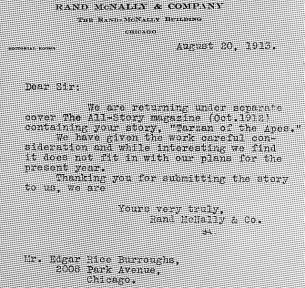
Here is an extract from one rejection letter I had recently which illustrates just this approach:

“Should you write a comedy or another piece that has a little more light in the darkness, we'd be happy to consider it. You can clearly write."

Good luck. And by the way, if you want to compare the edited with the original version of 1984 have a look here.

May Big Brother always ignore you and your manuscript avoid Room 101.


www.davidthorpe.info

Wednesday, October 03, 2012

Fame at last.....

Those nice people at Headline Environment have done a short interview with me!

From the intro: 
 "'Low Carbon Kid' blogger, speculative novelist, comic-book writer, freelance journalist, environmental author and news editor of Energy and Environmental Management, David Thorpe reveals some of his secrets, not least his super-powered plate-spinning abilities. From photovoltaic business briefings to futuristic 'hybrids', it's all about keeping the mind open and the windows shut..."

Sunday, September 16, 2012

Children's publishing is growing - the message from the Children's Writers and Illustrators Group Conference

I thoroughly enjoyed yesterday at the Children's Writers and Illustrators Group Conference.

It was nice to meet old friends and to make new ones, and reassuring to hear that children's book sales are up, albeit more in e-books than print. Someone who went to the session on ‘Mid-list crisis’, reported the statistic that children's book sales had doubled in recent years, great news, although there was no detail on which sectors or whether it was just down to top-selling series like the Hunger Games.

Talking of which, there was much discussion over the extent to which series like this distort the market for other authors and types of book. In the session on ‘What shall I put in my book?’, the most popular of all the breakout sessions on Saturday, authors were told to keep one eye on the market, but with the rest of our body and soul to write with passion, conviction and originality, the greatest story we possibly can.

At least that advice doesn't change!

Roz Asquith had the audience in stitches during her morning presentation of her illustrious career, complete with us sneak preview of her early (i.e., age 15) magazine try-out ‘Horse Magazine’ – "the magazine by horses for horses, complete with 'horse of the day', and a 'horoscope'".

Her character Doris featured largely, and she told a hilarious anecdote. Doris (ex- of the Guardian newspaper) is an unassuming cleaner, who never speaks, but whose sensible thoughts we are allowed to share, which always cut through her employers' pretensions.

The story goes that she was visiting a convicted thief in prison, who said he loved Doris because it reminded him of his mother, who was a cleaner. As a child she would take him along to work, and he would sit in the corner while she cleaned rich people's houses. He told Roz, “I couldn't wait to grow up so I could rob them".

There seemed to be an awful lot of authors writing for young adults at the conference. Reassuringly, there are more markets for this kind of work. New publishers are starting up with business models more appropriate for the ongoing publishing revolution, like Hot Key, and some of the companies are at last learning to understand the new markets, like HarperCollins with their Voyager project.

Also, there are more collective blogs for authors promoting their young adult writing like UKYA and The Edge.

Especially good as speakers were Roz Asquith, Patrick Ness, Charlie Higson, Joe Godwin (BBC Children's),  and John Dougherty, whom it was good to meet for the first time, as he helps to run the Awfully Big Blog Adventure to which I contribute.

Joe, who has the most desirable job in the world, programming all of the best of children's television in Britain, proudly said that of the 35 children's television channels that there are in the UK for its 12 million children, CBeebies and CBBC have the highest viewing figures, the latter having an audience of 1.8 million.

50% of productions are made in-house, and the BBC has 400 employees working on them with a budget of £80 million a year. Making top-quality, diverse children's television is one of the corporation's top five priorities, and all programmes have high production values with a mission to create “unforgettable content".

Although CBBC is intended for 6 to 12-year-olds, Joe said that actually children as old as 15 watch some of the dramas. A new series, Wolfblood, is aimed at teenagers, and another from the same team that produces the Sarah Jane Adventures, Wizards versus Aliens, is in the pipeline. Sounds fantastic.

I particularly like the long version of the story that Charlie Higson gave of how he got to write the young James Bond novels. He was taken by the owners of the Ian Fleming estate to a secret hideout underneath a volcano, where all the other competing writers were sitting in a circle. He pulled a lever and the rest of them fell into the boiling lava below. Including Anthony Horowitz.

I'd like to thank Charlie for signing a copy of The Enemy for my stepson Sam, whose birthday was also yesterday, and dedicating it to ‘Big Sam’. For those who haven't read the book, the main character is called ‘Small Sam’. He was absolutely delighted!

Patrick Hess was also inspiring. I particularly liked his advice to writers to exceed expectations and astound readers, not to 'give them what they want' but to ‘make them want what you give’.

Thanks to all of the speakers and all the organisers!

Oh, yes, and it was nice to see my book Hybrids sold out in the bookshop, too! I had to give them my own copy to sell!

And I'll leave you with this awesome video, by John Dougherty, shown at the start of the day. It speaks for itself!

Thursday, August 23, 2012

'We Can Improve On You'

I've just had a standard rejection from a well known children's publisher for a novel (with the above title) I submitted over a year ago.

Conventional publishing sometimes seems self-destructively inefficient, and unable to respond quickly to events and to changing demand; why is it so hard for them to change?

Publishers are debating how they are going to move forward and adapt. Simultaneously they are struggling to cope with the weight of received manuscripts from authors.

This is why, of course, most of them have stopped taking unsolicited manuscripts. Writers therefore need agents to approach these publishers, and agents are struggling too.

I think it should be possible for authors to be part of the debate that publishers & agents are having amongst themselves.

For example, one of my new commercial publishers for my non-fiction work, Do Sustainability, is adopting an entirely new business model.  I am currently writing my second e-book for them.

Both Cambria, the publisher of my recent ebook, and this publisher have the advantage that they can move quickly and respond to a new market demand, or process manuscripts, more cheaply and faster.

I believe that traditional publishers should be looking at doing the same thing.

Is it any wonder, if publishers are taking so long as a year to respond, that more and more authors are turning to self-publishing, through e-books or print-on-demand?

Tuesday, August 14, 2012

Let’s see this Olympic spirit change politics for the better


The world's greatest athletes have packed and gone home after the most inspiring and emotional of Olympic Games.

The spirit that they generated throughout most corners of this motley land has infused in it a renewed sense of optimism and self-confidence, channeled by Sebastian Coe into his hope that it will inspire a generation.

Galen Rupp's act of self-sacrifice so that his training partner, Mo Farah, could win his second gold medal and enter the history books, exemplifies this spirit, and the best of human nature.

Everybody now wants a share of this Olympic spirit. If they could bottle it, it would sell by the tanker load.

David Cameron hoped that some of this euphoria and excitement would rub off to the economic benefit of the country; this was the motivation behind UK Trade and Investment's business summits held concurrent with the Olympics.

It is also the motivation behind the Downing Street Hunger Summit, which Cameron hopes will secure sufficient commitments from leaders and multinational firms to help improve the nutrition of 25 million children by the time of Rio's 2016 Olympic Games.

This has been backed by many Olympic stars. They have urged the prime minister to go further and make alleviating hunger the top priority for the UK's presidency of the G8 next year.

Mo Farah, whose story is perhaps the most inspiring of many inspiring and humbling stories to emerge from the Games, has lent his support. He has already set up his own Foundation to give aid to the Horn of Africa. Merely by tweeting about its first fundraising ball on 1 September to his many new followers, he caused the server that hosts its website to crash.

It does make you wonder why a similar sense of global togetherness and teamwork cannot come together at other times; like the Rio+20 sustainable development summit, or the annual United Nations efforts to find a global agreement on ways to limit climate change.

Anyone who has attended these gatherings as a campaigner immediately senses a similar coming together of thousands of people from all over the world, and their enthusiasm for a common cause, and knows full well the origins of the blocks to attaining these goals.

The Olympic opening ceremony, depicting coal-smoke belching factories functioning with the indentured labour of millions of workers, reminded us all that Britain began the industrial revolution, thus inaugurating the process of climate change.

Mo Farah's campaign to combat famine in Africa should also bring to our minds that it is this continent which stands to suffer the most from climate change.

The closing ceremony, in turn, by having a children's choir sing John Lennon's Imagine, attempted to make us think that if we all come together we really can save the world. As the song goes: “it's easy if you try".

It may be easy if you try, but as every medal winner at London 2012 will tell you, it's the trying that is hard: years of painful effort. But the result is worth it, even for those who do not succeed; they will cherish forever the joy of participating.

So, if the Hunger Summit succeeds, why not, in four years time, when we are back at Rio de Janeiro, home of the Sustainable Development summits, be even more ambitious?

If we do not have a global agreement by then to tackle the most pressing problem facing all life on earth, then we should use the opportunity, the euphoria and optimism, to force world leaders to sign up to one: an Olympian pact to limit emissions.

Never mind how, or who gives the most. Cease this useless bickering and destructive posturing. Show us the same generosity of spirit we have witnessed in East London.

We need from our world’s politicians displays of teamwork, cooperation within competition, and self-sacrifice, like those that have mesmerised us this last fortnight.

Olympic competitors have stunned us with their world-beating achievements that have exceeded our wildest expectations of what human beings are capable of. We expect it of our athletes.

How much more should we demand it of our political servants?

Monday, August 06, 2012

How I made my first e-book


Are you e-experienced? Until a week ago I wasn't. But, in the last three weeks I have made and published my first e-book.

It feels a bit like giving birth to, I don't know, some kind of strange mutant mongrel beast, some hybrid child whose destiny is unknown, who may grow up to mock me, betray me, give me glory (but only by leave of the wayward capriciousness of viral flukeiness) or, even worse, disappear completely without trace in the infinitely absorptive sponginess that is the e-thernet.

Anyway, for what it's worth, I thought I would share my experience. Some of you may be teetering on the edge of this mysterious pool of brave new publishing opportunities, debating whether to take the plunge. I expect many of you already are e-experienced swimmers with Olympian credits. If so, you can poke fun at my ineptitude.

I kindled thoughts of these waters for a long while. Some of my books had been converted into ebooks by my publishers, but they were like the offspring of alcohol-obscured one night stands; unknown and unclaimed. The publishers didn't even tell me they had been born, I only found out by accident, and I don't have a clue about sales figures.

In a tentative way, I had previously offered PDF downloads of one or two stories or chapters for sale through my websites, but they had languished as forlorn and undownloaded as an unfertilised dandelion in a meadow of opium poppies.

I own no e-reader; nothing I cannot read in a bath without fear. Every work of fact or fiction in my library looks dissimilar from every other, and I like it like that.

What persuaded me to dip my sceptical toe in these waters was partly the persistent encouragement of a local publisher, Cambria Books, whose manager, Chris Jones, is passionate about their new business model.

OK, I said. But I wasn't sure what content to offer first. Then, an old colleague and the series editor of some of my non-fiction, suggested that I republish an old novella of mine. (Thank you, Frank.) This seemed a perfect way of testing out the market, since I knew it would have an existing audience, and that there'd be a new one to which I wanted to introduce it. All I would have to do was find those readers. (The expected readership, by the way, is YA, most likely readers interested in humour, politics, science fiction, and comics/graphic novels.)

I still am sceptical, so I'm going to be watching sales with interest.

The whole process of preparing the content from start to finish took two weeks, which itself is very attractive: contrast this with the swimming-through-jelly tempo of traditional publishing - two years start to finish?

Here are the stages it went through:
One of the illustrations, by Rian Hughes
  1. Scanning in the original book using OCR (optical character recognition) software. I used ABBYY. The software is remarkably accurate but does need a bit of an eagle eye for spotting 1s that should be Is and Os that should be 0s.
  2. Scanning in the 12 illustrations, which different comics artists from Dave McKean to Simon Bisley had contributed to the original edition. This was the fun bit.
  3. Designing the cover, which included colourising in Photoshop a black-and-white illustration that had been on the inside. That was fun too.
  4. Adding a short story on the same theme to give extra value, that had been published elsewhere in another collection but not widely seen.
  5. Writing a new afterword. This involved a nostalgic and enjoyable expedition into overgrown verges along the side of my personal memory lane. I took my butterfly net for effect (a butterfly effect) to catch those extra special chaotic moments.
  6. Completing the whole thing in Word. Word, the software, is not my friend, although Word, the archetypal personification of language, is. But sometimes you have to dance with the Devil, since the e-book conversion process requires a Word file. How did Microsoft sew that one up?
  7. Making sure all the prelims were hunky-dory and accurate. That included researching and writing up short biographies of all the artists, updating them from the previous edition, and making sure I thanked everyone.
  8. Then I thought I ought to add some adverts for some of my other books at the back that readers might be interested in. Why not? 70-90 years ago, most books had adverts in the back - and the front, sometimes, just like magazines. Perhaps this is the way to go to finance this new form of publishing? Interactive ads for acne-banishing face creams in the back of YA novels, anyone?
  9. Then I got carried away and added a real ad from the 1940s for a chemistry set for boys that included real uranium! Most people don't believe that I didn't make this up.
I sent the file to the publisher, who checked it over, made more corrections, added the ISBN and converted it into the .mobi format, which Amazon likes.

I chose to go with Cambria Books, but there are many other companies offering similar deals. It may be worth shopping around, but I didn't bother. Some of them offer print-on-demand as another option. This may be worth considering as well. If you want to get reviews you should have a few print copies to send to reviewers. Also, if you don't think you will sell more than 1000 print copies, print-on-demand is generally cheaper than a conventional print run. Over this number, you should go down the conventional printing route.

The publisher then sent the e-book file back to me to check. I was horrified. I had designed it in Gill Sans font, which I love, and it came back in a frankly disgusting, evil, serifed font. All my lovely formatting was strewn about like weatherboard in a hurricane, and my unique work was reduced to the same common denominator as everything else that you see on a Kindle.

I had to resign myself to the fact that there is little you can do about this, except to control where some page breaks go. It's a bit like designing for the web, except you have even less control. That's the nature of this homogenising beast.

Then, holding a stiff drink, I muttered: “Go!" The publisher uploaded the file to Amazon and it was live - for sale - in less than 24 hours! Wow.

However, I didn't just want to sell it through Amazon and merely contribute to their increasing domination of the market. I wanted people to be able to read it on something other than a Kindle.

So the nice publisher also gave me a version in the .epub format, which works with other e-readers.

Cambria Books also made a Facebook page and a webpage on their company website for the title, to promote it alongside all of their other titles. For all of this Cambria charged £200, which includes £50 for the ISBN. The book is for sale at £1.84. So, I need to sell, bearing in mind the cut that Amazon takes, just 125 copies to get my money back.

I could also have chosen to do all of this myself, but I'm lazy, and I figured that it's worth it, especially since this was my first time.

But I wasn't finished yet.

I then chose to make the files available on my own website. I already sell books on my website through PayPal. Selling e-books is slightly different, because there isn't a physical product to ship, and you need to create a place where buyers can download the file, after PayPal has checked that they have paid for it successfully.

This place has to be completely inaccessible to search engines, otherwise people will just grab the files for nothing.

Here's what I did:
  • I made the webpages holding the downloads, one for each format, which just need to be very simple, and put them together with the files in a folder on the server. At the top of the web pages is this text: <meta name="robots" content="noindex" />.
  • Just to be safe, I also uploaded a text file to the folder named robots.txt, which simply contains the following:
    User-agent: *
    Disallow: /
  • Both of these little tricks should prevent search engines from indexing and making public the content of this folder.
  • The next thing to do is to get an account with PayPal, if you haven't already got one, and, once logged in, go to the Buy Now Button-making page (if you can't find it just type those words into the search function), which allows you to create a button for a single item purchase.
  • All you need to do here, is to put in the name of the e-book, a product code that you make up, and its price. There is, of course, no shipping cost. You probably want to check the button that says “Track profit and loss".
  • Then you come to Step 3, subtitled “customise checkout pages". This is the important bit. Answer the questions the following way:
  1. “Do you want to let your customer change order quantities?" No, because they won't order one more than one e-book.
     
  2. "Can your customer at special instructions in a message to you?" No, there's no need for that.
     
  3. "Do you need your customer's shipping address?" No, because messages will go to their PayPal e-mail address.
     
  4. Check the box saying “take customer to a specific page after checkout cancellation" and type or paste in the full website address for your shop page.
     
  5. Check the box saying “Take customer to a specific page after successful checkout". Here is the really, really important bit: type or paste in the full website address for the page they go to download your e-book. Make sure this is right! This is the complete address for the page that you made earlier and uploaded, the one at the otherwise secret place.
  • All you have to do now is click “create button" (don't worry, you can go back and change things if you made a mistake, as I did), and, when happy, copy the code and paste it on your page exactly where you want the button to be.
  • Save your page and upload it to your website.
That's it!

The things writers have to do these days.

But I still hadn't quite finished. I had to write a news item publicising the e-book for the front page of my website, in which I included a link not just to the page where people can buy my books, but to the exact part on the page where they can buy that e-book, to make it super-easy for them.

On that page, I include all the options for them to make the purchase: a link to the Amazon page, because most people will be comfortable doing that; and the two buttons for both formats that I made using PayPal.

You can see the news item on the front page of my website here.

I then wrote a post on my blog promoting the book, which you can read here.

Of course, I also had to promote it on Facebook, on both my own page and the page made for the book itself, and on my Twitter account.

And, I launched the e-book at what was billed as the UK's first festival for e-books, in Kidwelly last weekend. My publisher had a stand there.

Unfortunately, this event was poorly promoted and badly attended (having it in a more accessible place would have helped), but there were many excellent speakers, not to mention, for children, our own Anne Rooney, plus Simon Rees and Mary Hooper, Clive Pearce and Nicholas Allan.

Several speakers told their own experiences of publishing e-books. Notable for me was Polly Courtney, who confessed her lamentable experiences with HarperCollins that made her realise that self-publishing was a far better route than being with one of the big five, and Dougie Brimson, who has sold over one million self-published e-books, because he knows his audience really well.

Listening to the speakers gave me confidence that it really is okay to do it yourself and publish ebooks. It doesn't mean you have to give up working with mainstream publishers. You can do both. But given that we all nowadays have to spend at least 25% of our time marketing ourselves and our books, in practice it is not that much more work.

As one of the speakers said, most readers don't care who the publisher is, as long as the book is good.

Did I leave anything out? Is there a better way of doing this? Perhaps some of you will share your experience. After all, I'm just a beginner, but at least I'm no longer an e-book virgin.

Wednesday, August 01, 2012

Doc Chaos - "a comedy of terrors" - lives again

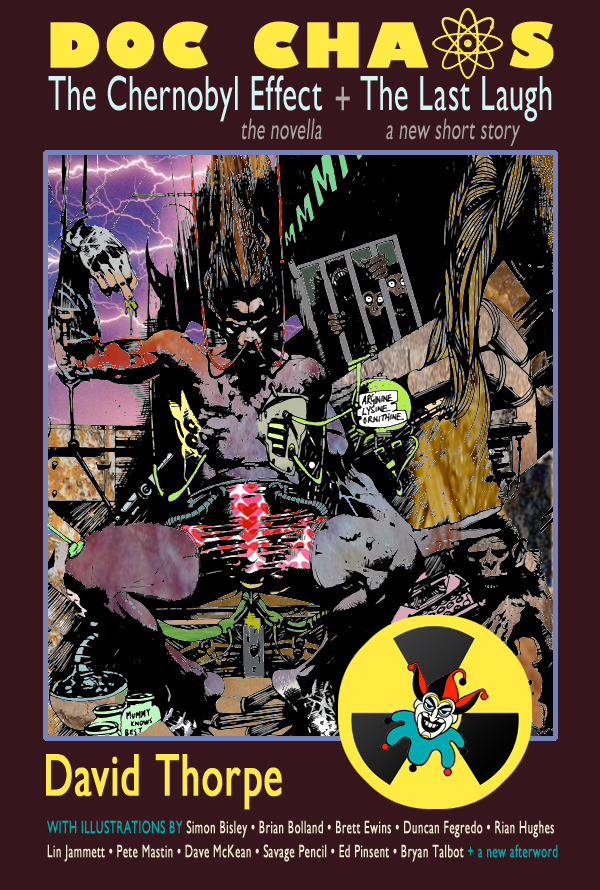
David Thorpe Doc Chaos: The Chernobyl Effect & The Last Laugh coverCambria Books and Hooligan Press have published a new ebook version of my 1988 novella, Doc Chaos: The Chernobyl Effect. 

I love the tag line:

Inside a nuclear reactor, no one can hear you scream - with pleasure.

"DOC CHAOS is one of the most exciting and refreshing pieces of graphic literature I've seen in a long time." said Alan Moore very kindly in his introduction to the original comic series.

As a love story, it makes Fifty Shades of Grey look like kindergarten games...

Doc Chaos, the scientific prodigy who sold the promise of nuclear power to the most gullible, power-mad people in the world - politicians - did so not just because he likes seeing humanity "trip on its own banana skins" (as Graeme Basset put it), but for a much darker, more erotic reason... to reach the ultimate climax.

David Thorpe Doc Chaos: The nuclear jokerThis new edition, (available here),  contains 12 illustrations that were specially created by prominent stars of the comics art world:

Simon Bisley (who did the cover, which has been coloured for this edition) ~ Brian Bolland ~ Brett Ewins ~ Duncan Fegredo ~ Rian Hughes ~ Lin Jammett ~ Pete Mastin ~ Dave McKean (who did the illustration on the right) ~ Savage Pencil ~ Ed Pinsent ~ Bryan Talbot.

It also contains a new short story, The Last Laugh, completing the Doc Chaos narrative at the coming apocalypse, and a new Afterword by me, which sets the two pieces in their creative context.

Doc Chaos by Dave McKean
I believe DOC CHAOS takes the literary genealogy of doctors Frankenstein, Faustroll and Benway into the nuclear age and beyond.

The tragic Chernobyl nuclear disaster, the world’s worst, happened in 1987, and, having campaigned against nuclear power for twelve years, while living under the threat of Mutually Assured Destruction during the Cold War, the absurdity of civilisation’s perverted fixation on this doubled-edged technology seemed to me to be a good fit for the story of the Bad Doctor.

Written in a post-modern frenzy, it provided me with a lot of fun, especially when I mixed in elements of my own personal narrative, which those who know me recognise without necessarily knowing where truth ends and fiction begins.  It seems obvious to me that there is a macho, psycho-sexual element in mankind’s love affair with nuclear power.

A special word of thanks to the artists who contributed original illustrations to this edition. Each of them was given a copy of the manuscript and invited to draw anything they liked based on a particular episode or scene. Every single one of them responded marvelously, getting totally under the skin of the project. Brian Bolland even contributed two pictures, in the style of the Mr Mammoulian strip he was sporadically producing at the time.

What amazes me is how each artist has their unique vision for Doc Chaos, but all of them encapsulate its spirit. I like every one of them. They really make this book come alive.

The virus that began in a 1981 journal, mutating to continue its survival, is still on the loose.

As the bad doctor says: “You can’t keep a good disease down.”

Wednesday, June 20, 2012

Hate profiteering water companies, banks and utilities? Let’s mutualise the lot!


With one shining exception, water companies are making huge profits on the backs of hard-pressed householders, with deteriorating performance and rocketing prices.

There is a better way, it's working right now in this country, and I believe we would be better served if all water companies, and even all banks and utilities were to be run this way.

Why this system doesn't work

There was outrage last week as Thames Water's CEO Martin Baggs, already the best-paid water company boss, was awarded an annual bonus of £418,359 on top of his £425,000 salary. This was despite a fall in profits and ‘deteriorating’ satisfaction rates among its 8.8 million customers. He also took home £1.67m in 2010/11.

Of course, he's paid not so much for the service he gives to customers but for continuing to maintain a good cash flow back to shareholders. Investors like water companies and other utilities, because they provide a cast-iron guarantee of cash flow.

Thames Water is owned by Australian investment bank Macquarie, with 12% owned by Chinese investors. They took £179.5m profit from British householders out of the country last year. That's our cash and it will not be reinvested here.

As I have noted before, Thames Water increased its prices to consumers by 6.7% in April, way above the rate of inflation. Other privatised companies increased prices by 8.8%.

The national officer for the water workers' union, the GMB, slammed Baggs’ bonus since it comes from “the hard-earned income of hard-pressed householders" and said the current hosepipe ban was evidence of a long-term failure of management at the company.

I won't go on. There's been enough about this subject in the mainstream press.

The system that works better

Instead, let's praise success. Over in Wales yesterday, Dwr Cymru (Welsh Water) announced a reduction in cost to its customers, and that it will invest £1 billion over the next three years in infrastructure projects across Wales, Deeside and Herefordshire.

Average household bills will be £30 a year lower (before inflation) by 2015, probably the only area in the country where this will happen.

The business plans to reduce its day-to-day running costs by 20%, while further improving its operational and environmental performance.

Its Chairman, Bob Ayling, said the investment package was possible due to its owner Glas Cymru's unique "not-for-profit" business structure.

He said: "The Glas Cymru model means our first priority is to our customers and looking after Dwr Cymru's extensive infrastructure for future generations.

"At a time when many companies and public bodies are cutting back on investment, this investment programme is employing some 10% of the construction sector in our region with more than 50% of spend going to local companies in the supply chain, supporting some 1,500 jobs."

In its new annual report it says it has invested over £1.5bn during the last five years, equivalent to more than £1,000 for every household in its area.

It was also able to pay a customer dividend of £22 each, bringing the total paid to customers in the last seven years to over £150m, because, like the Co-operative, it gives dividends to all of its customers, who are its members.

It's a genuine, not-for-profit, social enterprise that works, superbly.

The social model pays off

Do you need any more evidence before writing to David Cameron and Vince Cable urging them to implement this model as widely as possible?

Then take the oldest co-op in the book. The Co-operative Banking Group goes back to 1867. It has made a profit doing the whole of the recession so far, with comparatively small write-offs of toxic investments and bad loans.

It is lending to small and medium-sized enterprises at an increasing rate: up 31% during 2010 and 33% last year, and is now about to increase lending.

It attributes this success to the fact that it follows the instincts and values of its members, who own it. “Sustainability is in the DNA of the business," says its acting chief executive Barry Tootell.

In 1974, it was the first bank to offer free banking to those in credit. In 1992, it introduced an ethical policy, refusing to do business with the groups it considered unsavoury like heavy polluters and arms traders. Since 1994, customers have voted to choose the charities their spending should help fund via the Co-op Bank. Since then it has donated £3 million to more than 80 charities.

The bank backs wind and solar power. The CIS Tower in Manchester, the tallest office building outside London in the UK, is decked out in solar panels. “We are investing £1 billion in renewable energy and £700 million has been committed already," Mr. Tootell says.

The Co-op prioritises young people, it offers banking services to prisoners on the basis that if they learn to manage money inside they fare better when they return to the community. And the bank is growing; it wants to buy 630 branches from Lloyds Banking Group.

It works, superbly. It is sustainability in practise.

Let's apply this model more widely

So here you have it: sustainable social enterprises, owned by members, doing better than their counterparts in the fully private sector and, what's more, continuing to recycle their profits back into other UK businesses, as well as providing better value for customers.

Now, imagine all water companies and energy companies run this way. Not to mention banks. It wouldn’t be a case of ‘us’ and ‘them’, but just ‘us’.

Would David Cameron love this? What about Vince Cable?

When the Prime Minister looks at the water companies as a whole, he understandably regards them as a success because of the profits made for their owners, regardless of the fact that most of them are abroad.

He wants to apply this same model to finance other infrastructure, particularly Britain's roads. In March, he said in a speech: "Why is it that other infrastructure — for example, water — is funded by private sector capital through privately owned, independently regulated utilities, but roads in Britain still call on the public finances for funding?"

You know it would be a disaster if British roads were owned by Chinese or Australian investors. Just imagine paying through the nose to get to work after another toll hike, while the potholes aren't getting mended because head office in Beijing hasn't given the go-ahead.

What a potty idea. Yet Mr. Cameron is aware of the value of co-ops and social enterprises. He has even backed a bill, the Co-operatives Bill, that supports this business model. But he is not prioritising it. In January, Number 10 said that it "will be put before parliament before the next election", but currently there is no schedule for it.

The Postal Services Act 2011, which paves the road for the privatisation of the Post Office, does contain provision for the possible mutualisation of the Post Office, i.e., turning it into a co-op. Some individual branches of the Post Office are already owned by mutuals, such as Lincolnshire Co-operative.

Ed Mayo, the secretary general of Co-operatives UK, supports both the Co-operative Bill and the mutualisation of the Post Office, calling it the ideal business structure to best benefit the public.

So come on, David Cameron. If you really want to give value for money to hard-up householders and increase the chances of water and other utility companies and essential services revitalising the British economy, then study and learn from the success of Welsh Water and the Co-operative Bank, and encourage others to follow suit.