Wednesday, August 01, 2012

Doc Chaos - "a comedy of terrors" - lives again

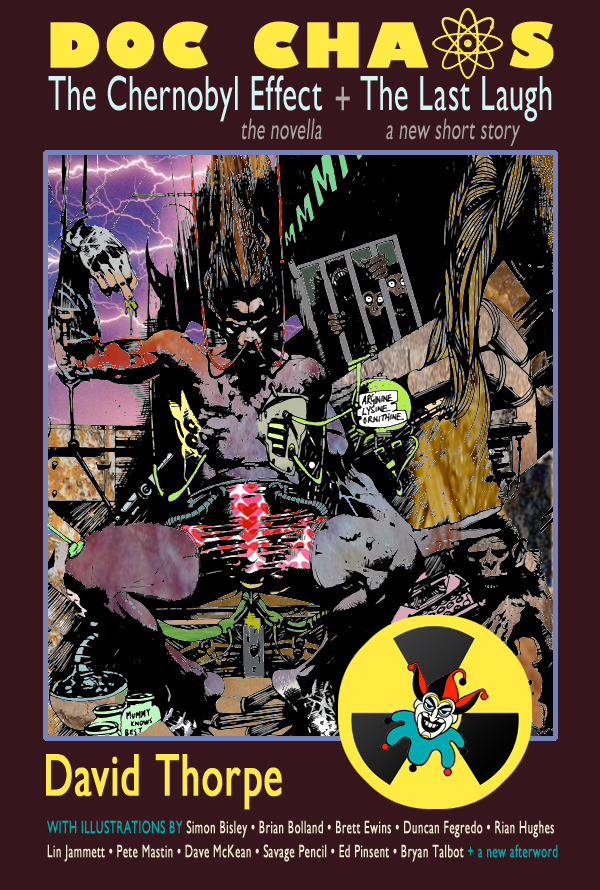
David Thorpe Doc Chaos: The Chernobyl Effect & The Last Laugh coverCambria Books and Hooligan Press have published a new ebook version of my 1988 novella, Doc Chaos: The Chernobyl Effect. 

I love the tag line:

Inside a nuclear reactor, no one can hear you scream - with pleasure.

"DOC CHAOS is one of the most exciting and refreshing pieces of graphic literature I've seen in a long time." said Alan Moore very kindly in his introduction to the original comic series.

As a love story, it makes Fifty Shades of Grey look like kindergarten games...

Doc Chaos, the scientific prodigy who sold the promise of nuclear power to the most gullible, power-mad people in the world - politicians - did so not just because he likes seeing humanity "trip on its own banana skins" (as Graeme Basset put it), but for a much darker, more erotic reason... to reach the ultimate climax.

David Thorpe Doc Chaos: The nuclear jokerThis new edition, (available here),  contains 12 illustrations that were specially created by prominent stars of the comics art world:

Simon Bisley (who did the cover, which has been coloured for this edition) ~ Brian Bolland ~ Brett Ewins ~ Duncan Fegredo ~ Rian Hughes ~ Lin Jammett ~ Pete Mastin ~ Dave McKean (who did the illustration on the right) ~ Savage Pencil ~ Ed Pinsent ~ Bryan Talbot.

It also contains a new short story, The Last Laugh, completing the Doc Chaos narrative at the coming apocalypse, and a new Afterword by me, which sets the two pieces in their creative context.

Doc Chaos by Dave McKean
I believe DOC CHAOS takes the literary genealogy of doctors Frankenstein, Faustroll and Benway into the nuclear age and beyond.

The tragic Chernobyl nuclear disaster, the world’s worst, happened in 1987, and, having campaigned against nuclear power for twelve years, while living under the threat of Mutually Assured Destruction during the Cold War, the absurdity of civilisation’s perverted fixation on this doubled-edged technology seemed to me to be a good fit for the story of the Bad Doctor.

Written in a post-modern frenzy, it provided me with a lot of fun, especially when I mixed in elements of my own personal narrative, which those who know me recognise without necessarily knowing where truth ends and fiction begins.  It seems obvious to me that there is a macho, psycho-sexual element in mankind’s love affair with nuclear power.

A special word of thanks to the artists who contributed original illustrations to this edition. Each of them was given a copy of the manuscript and invited to draw anything they liked based on a particular episode or scene. Every single one of them responded marvelously, getting totally under the skin of the project. Brian Bolland even contributed two pictures, in the style of the Mr Mammoulian strip he was sporadically producing at the time.

What amazes me is how each artist has their unique vision for Doc Chaos, but all of them encapsulate its spirit. I like every one of them. They really make this book come alive.

The virus that began in a 1981 journal, mutating to continue its survival, is still on the loose.

As the bad doctor says: “You can’t keep a good disease down.”

Wednesday, June 20, 2012

Hate profiteering water companies, banks and utilities? Let’s mutualise the lot!


With one shining exception, water companies are making huge profits on the backs of hard-pressed householders, with deteriorating performance and rocketing prices.

There is a better way, it's working right now in this country, and I believe we would be better served if all water companies, and even all banks and utilities were to be run this way.

Why this system doesn't work

There was outrage last week as Thames Water's CEO Martin Baggs, already the best-paid water company boss, was awarded an annual bonus of £418,359 on top of his £425,000 salary. This was despite a fall in profits and ‘deteriorating’ satisfaction rates among its 8.8 million customers. He also took home £1.67m in 2010/11.

Of course, he's paid not so much for the service he gives to customers but for continuing to maintain a good cash flow back to shareholders. Investors like water companies and other utilities, because they provide a cast-iron guarantee of cash flow.

Thames Water is owned by Australian investment bank Macquarie, with 12% owned by Chinese investors. They took £179.5m profit from British householders out of the country last year. That's our cash and it will not be reinvested here.

As I have noted before, Thames Water increased its prices to consumers by 6.7% in April, way above the rate of inflation. Other privatised companies increased prices by 8.8%.

The national officer for the water workers' union, the GMB, slammed Baggs’ bonus since it comes from “the hard-earned income of hard-pressed householders" and said the current hosepipe ban was evidence of a long-term failure of management at the company.

I won't go on. There's been enough about this subject in the mainstream press.

The system that works better

Instead, let's praise success. Over in Wales yesterday, Dwr Cymru (Welsh Water) announced a reduction in cost to its customers, and that it will invest £1 billion over the next three years in infrastructure projects across Wales, Deeside and Herefordshire.

Average household bills will be £30 a year lower (before inflation) by 2015, probably the only area in the country where this will happen.

The business plans to reduce its day-to-day running costs by 20%, while further improving its operational and environmental performance.

Its Chairman, Bob Ayling, said the investment package was possible due to its owner Glas Cymru's unique "not-for-profit" business structure.

He said: "The Glas Cymru model means our first priority is to our customers and looking after Dwr Cymru's extensive infrastructure for future generations.

"At a time when many companies and public bodies are cutting back on investment, this investment programme is employing some 10% of the construction sector in our region with more than 50% of spend going to local companies in the supply chain, supporting some 1,500 jobs."

In its new annual report it says it has invested over £1.5bn during the last five years, equivalent to more than £1,000 for every household in its area.

It was also able to pay a customer dividend of £22 each, bringing the total paid to customers in the last seven years to over £150m, because, like the Co-operative, it gives dividends to all of its customers, who are its members.

It's a genuine, not-for-profit, social enterprise that works, superbly.

The social model pays off

Do you need any more evidence before writing to David Cameron and Vince Cable urging them to implement this model as widely as possible?

Then take the oldest co-op in the book. The Co-operative Banking Group goes back to 1867. It has made a profit doing the whole of the recession so far, with comparatively small write-offs of toxic investments and bad loans.

It is lending to small and medium-sized enterprises at an increasing rate: up 31% during 2010 and 33% last year, and is now about to increase lending.

It attributes this success to the fact that it follows the instincts and values of its members, who own it. “Sustainability is in the DNA of the business," says its acting chief executive Barry Tootell.

In 1974, it was the first bank to offer free banking to those in credit. In 1992, it introduced an ethical policy, refusing to do business with the groups it considered unsavoury like heavy polluters and arms traders. Since 1994, customers have voted to choose the charities their spending should help fund via the Co-op Bank. Since then it has donated £3 million to more than 80 charities.

The bank backs wind and solar power. The CIS Tower in Manchester, the tallest office building outside London in the UK, is decked out in solar panels. “We are investing £1 billion in renewable energy and £700 million has been committed already," Mr. Tootell says.

The Co-op prioritises young people, it offers banking services to prisoners on the basis that if they learn to manage money inside they fare better when they return to the community. And the bank is growing; it wants to buy 630 branches from Lloyds Banking Group.

It works, superbly. It is sustainability in practise.

Let's apply this model more widely

So here you have it: sustainable social enterprises, owned by members, doing better than their counterparts in the fully private sector and, what's more, continuing to recycle their profits back into other UK businesses, as well as providing better value for customers.

Now, imagine all water companies and energy companies run this way. Not to mention banks. It wouldn’t be a case of ‘us’ and ‘them’, but just ‘us’.

Would David Cameron love this? What about Vince Cable?

When the Prime Minister looks at the water companies as a whole, he understandably regards them as a success because of the profits made for their owners, regardless of the fact that most of them are abroad.

He wants to apply this same model to finance other infrastructure, particularly Britain's roads. In March, he said in a speech: "Why is it that other infrastructure — for example, water — is funded by private sector capital through privately owned, independently regulated utilities, but roads in Britain still call on the public finances for funding?"

You know it would be a disaster if British roads were owned by Chinese or Australian investors. Just imagine paying through the nose to get to work after another toll hike, while the potholes aren't getting mended because head office in Beijing hasn't given the go-ahead.

What a potty idea. Yet Mr. Cameron is aware of the value of co-ops and social enterprises. He has even backed a bill, the Co-operatives Bill, that supports this business model. But he is not prioritising it. In January, Number 10 said that it "will be put before parliament before the next election", but currently there is no schedule for it.

The Postal Services Act 2011, which paves the road for the privatisation of the Post Office, does contain provision for the possible mutualisation of the Post Office, i.e., turning it into a co-op. Some individual branches of the Post Office are already owned by mutuals, such as Lincolnshire Co-operative.

Ed Mayo, the secretary general of Co-operatives UK, supports both the Co-operative Bill and the mutualisation of the Post Office, calling it the ideal business structure to best benefit the public.

So come on, David Cameron. If you really want to give value for money to hard-up householders and increase the chances of water and other utility companies and essential services revitalising the British economy, then study and learn from the success of Welsh Water and the Co-operative Bank, and encourage others to follow suit.

Could underground coal gasification save our coal industry?

Close the Coalhouse Door by Alan Plater

In April, I was lucky enough to witness the first night of a revival of Close the Coalhouse Door by Alan Plater, a joint production by Northern Stage and Live Theatre in Newcastle-upon-Tyne, before it went on national tour. I recommend it thoroughly: go see it if it comes near to you.

Plater gave rise to some of the country's best known plays and television series including the pioneering cop shows Z-Cars and Softly Softly, wrote The Beiderbecke Trilogy and a film adaptation of George Orwell's Keep the Aspidistra Flying, not to mention a television adaptation of Chris Mullin's novel A Very British Coup.

He was a working-class man from Jarrow who loved the north and the coal industry, and this play is a stunning attempt to tell the history of coal mining and the struggle of the miners for their human rights.

It's incredible to realise that 180 years ago children as young as six were forced to work down the mines seven days a week up to 16 hours a day. It took 150 years of campaigning for the mines to be nationalised and decent working conditions instituted.

Unlikely as it may seem given its subject matter, the audience was rolling in the aisles through its celebration of northern humour using songs and jokes; the production manages to make this narrative not only wonderfully entertaining but educational too – a kind of drama-documentary-musical-comedy.

The play was first produced in 1968, but it has been updated with a prologue and epilogue for this production by Lee Hall, best known as the writer of Billy Elliot.

Of course we all know what has happened to the coal industry since 1968, so the epilogue satirically suggests an alternative world in which the miners won the battle against Margaret Thatcher and the Conservatives and are right now controlling a socialist paradise.

In reality, there are now just 3,000 UK working miners, down from a peak of 1.25 million in 1920. Most of our coal is now imported and much of it that is home-produced comes from surface mining. The power of the labouring class has been destroyed.

But coal still forms an important part of our fuel mix, and its consumption rose by 9.3% last year.

The big difference between now and then is that now we know that burning coal is the biggest threat to global climate stability.

So we should stop using coal, right? It is the big evil. Leave it in the ground.

But what if we could find a way of burning coal without increasing greenhouse gas emissions?

After all, there is still a great deal of it in the ground. Three quarters of the coal in the north-east and in most of the other coalfields is still underground despite over 200 years of mining.

What if it could be used as a feedstock for refineries without damaging the atmosphere?

Prof. Paul Younger


There may be a way. I was unconvinced when I first heard about it, but after a director of Live Theatre, my brother-in law Jim Beirne, told me about the work of one of its committee members in Newcastle, Paul Younger, I am prepared to believe it could be.

Prof. Younger is the Director of the Newcastle Institute for Research on Sustainability and is a distinguished hydrogeologist and environmental engineer who is renowned for his pioneering research into community-based, remediation techniques for water pollution from abandoned mines and the man behind a project to source geothermal energy from under Newcastle for a district heating system.

Writing in the programme for Close the Coalhouse Door, Younger makes the case for a revival of the coal industry using underground coal gasification (UCG) with carbon capture and storage.

He says UGC “now appears to be economically viable" and is ripe for exploitation because the polluting side-effects of its combustion would remain “locked away hundreds of metres below ground, permanently unable to access our freshwater resources".

It works by leaving the coal deep underground where it already exists, turning it into gas by injecting oxygen and steam through one set of boreholes and extracting the gas from another set.

Building on the North East's experience of safely mining coal far out beneath the North Sea, he writes that we now know both how the voids created by the process will settle and what this will do to the overlying strata, and therefore how impossible it would be for any fluids in the settled zone to migrate to the surface.

His strategy is to reinject the carbon dioxide generated by burning the extracted gas back into those voids deep underground “where it can remain until kingdom come, safely out of reach of the atmosphere"; a form of carbon capture and storage.

He is convinced that the modelling his team has done proves that it is safe and will work. For the last two years they have been compiling a technical and business model for a venture, which they call Five-Quarter after the seam which lies beneath his house.

“We hope to break ground within a year or two of the curtain coming down on this play," he says, “and the jobs which will be created will be safe, clean and hi-tech," more like in a chemical plant than a traditional coal mine.

The business strategy includes pouring some of the profits into restoring the fortunes of the former mining communities of the Great Northern Coalfield celebrated in Alan Plater's drama, and into initiatives to accelerate the development and deployment of renewable energy that would employ the descendants of miners.

As an old North East miners' slogan, which Younger is fond of quoting, puts it: “the past we inherit, the future we build".

Perhaps the story is not yet over for coal and the no-hope North Eastern towns like Ashington and Easington still devastated by the closure of coal mines twenty five years ago. We shouldn't close the coalhouse door yet.

Thursday, December 29, 2011

Six things that must happen to reverse this headlong rush to an illiterate British generation

Halfway through 2011 came a horrifying National Literacy Trust survey of more than 18,000 children.

It listed the following staggering statistics:
  • one in four children is unable to read or write properly when they leave London's primary schools
  • three in ten live in households that do not contain a single book
  • one in six people in the UK have the literacy level expected of an eleven year old
  • in 2005, 1 in 10 of the children and young people surveyed said they did not have a book of their own at home; but by 2011 this figure had increased to an incredible 1 child in 3.
Why is this not seen as a national scandal?

I believe it's because we have two cultures in this country. Those of us who are educated and read all know other people like ourselves who encourage their own children to read.

For these statistics to be true, we must be outnumbered by those for whom reading books is virtually an unknown pasttime.

All my life, newspapers have been wringing their hands about the levels of childhood and adult literacy.

Successive education ministers of every political hue have experimented with different teaching methods.

And all this time the problem has been getting worse and worse.

I believe that it's a root problem of our British culture; a culture that is leading to the closing of so many libraries.

Library closures

I learned my love of books from my local library.

But the latest figures on closures are that 415 libraries (323 buildings and 92 mobiles) are currently under threat or closed/have left council control since the beginning of this financial year out of around 4612 in the whole country.

Librarian professional body CILIP forecasts are even worse: it says that 600 libraries are under threat (inc. 20% of English libraries).

This does not include school libraries. Here, as this article from the Guardian reveals:
  • school libraries are facing drastic funding reductions
  • many school librarians are being downgraded or even made redundant
  • School Library Services are closing
  • some children’s book awards have folded
  • book gifting schemes have had their funding reduced
  • some schools have postponed author visits.
Every month brings bad news: in December we learnt that Hertfordshire Schools Library Services, one of England’s largest and most respected Schools Library Services, is set to close in the New Year.

The latest library visitor figures, covering the year to March 2011, showed overall library visitor numbers down 2.3% to 314.5 million and book issues down 2.9% to 300.2 million.

Although this is a reduction, it is less than what you might expect given these closures.

In November, Alan Gibbons called for a moratorium on the closure of libraries.

Tackling illiteracy and library closures was also the subject of Patrick Ness's Carnegie Medal acceptance speech, which he won with Monsters of Men, the third of his Chaos Walking series.

Too often, writers are told by publishers (I was told myself this year) that teenage boys don't read books and so we can't publish your book.

What can we do?

As writers, we must join with Ness and Gibbons. We can no longer be complacent. Our livelihood is at stake.

Yes, we have to keep writing compelling books. But we also have to act.

Here are six things that need to happen:

  1. We must be prepared to occupy libraries faced with closure, just like the occupy movement.
  2. The government must stop closing libraries and encourage more children to read in every way possible; even if it comes to giving away books. This happens in developing countries where the level of literacy is higher than ours, for God's sake!
  3. Publishers must reconsider the pricing of books. Books are expensive compared to other media which children enjoy, much of which is free, like television, the Internet, radio, music and video games. There needs to be a range of cheap books aimed at less literate children to get them reading so they can later migrate to more difficult books for their age group.
  4. The pricing of e-books needs to be much, much cheaper (for the iPad etc.), with all kinds of promotional tools like the vouchers used by iTunes, which would be the modern equivalent of book vouchers.
  5. Reading books must be made more cool. Celebrities rated by children need to come out and encourage children to read.
  6. You should get involved in CILIP's advocacy work on school libraries and schools' library services, if you aren't already.
It's going to take a lot of effort to turn this devastating trend around. But for the sake of the next generation, we have to do it.

Monday, December 19, 2011

Welsh music is refreshed by a wind from the east...

Several Welsh bands are experimenting with the Eastern European Klezmer tradition and finding intriguing parallels.

Klezmer is a strong part of a musical tradition that originates with the Ashkenazic Jews of Eastern Europe. It is lively dance music, infectious and laden with emotion - both happy and bittersweet but ultimately lifting the spirit.

Like traditional Welsh music, it has been largely passed on from generation to generation by example rather than written down.

Several Welsh bands are now experimenting with playing Klezmer and, in one notable case, hybridising the style with Welsh music.

Cardiff's Klezmer Kollectiv are an eight-piece who play all around the Cardiff area. They employ the traditional instruments of clarinet, accordion, bass and guitar, but also add cello, sax, trombone and cajon (a box containing a snare for percussion) to give a full, romping sound.

Similarly the Llanidloes-based Klezmonauts, while gigging less often, are educating audiences in this infectious dance style.

Machynlleth-based ex-Ember member Rebecca Sullivan is also experimenting with Klezmer at the monthly Ceinws acoustic sessions.

South Wales duo Fiddlebox, however, are unique in trying to meld that tradition with the Welsh one, and in so doing to redefine the boundaries of Welsh traditional music.

Fiddlebox claim to have invented a new musical style, which they call 'Klezreig' - a synthesis of Cymreig and Klezmer that is proving highly popular with audiences everywhere.

The duo are fiddle-player Helen Adam and George Whitfield on accordion. They have just recorded their second important album, On The East Wind, and will be launching it on 30th November at a special concert at Burnett's Hill Chapel, Martletwy, Pembrokeshire, at 7.30pm.

Nowhere is the Klezreig style better exemplified than by a Klezmer version of the traditional song 'Machynlleth' which, by being played in a Klezmer scale, immediately gains emotional poignancy.

This version arose from an improvisation at a party in Machynlleth, between Helen and Tony Corden, the guitarist and organiser of the politics and music festival El Sueno Existe.

I interviewed them at George's house in Narberth, Pembrokeshire, and wanted to know first of all about the story behind the title.

Helen began her answer by referring to one of the album's key tracks, The Girl From The East: "The Girl From The East takes its starting point as an English folk song, The Girl I Left Behind Me. I wrote three variations on it... the first of the variations is written in the Klezmer style".

George has a more poetic attitude to the identity of the Girl From The East. "She's got her eyes on her own country in Eastern Europe, but is dancing in these green hills of Wales!" he smiles. "The Girl From The East is actually Helen!"

Helen Adam is a quarter Lithuanian Jewish, and a quarter German, on her mother's side, a part of her heritage of which she is increasingly aware. So you could say she arrived in Wales on the east wind.

A recent visit to the Jewish Museum in Berlin led her to reconnect to her Jewish heritage.

"My grandmother emigrated to Germany and converted to Buddhism to marry a German Buddhist writer!" she says. "Then she left him and came with my mother to England and became a Catholic. But she ended her life in a convent in North Wales! The Klezmer track Hora Dorothea on our first album called, simply, Fiddlebox, is about her."

If you didn't know Fiddlebox was a duo, at times you'd think there were four of them, especially since they both sing.

This is in many ways also due to George Whitfield's ability to make his custom-made accordion, which is vital to the unique Fiddlebox style, sound like two instruments at once.

George had his accordion specially constructed by a top craftsman, Claudio Beltrami, in Stradella, Italy. It employs a unique bass switching system, designed to his specification, with an electric midi on board (that he doesn't use for the purely acoustic Fiddlebox), three rows of bass buttons that permit more complex bass lines and four sets of hand made reeds.

Together these produce a big sound with chunky chords, that is usually only achieved with larger concert accordions.

The bellows have a short delay time enabling a punchy reverb effect, which George uses eerily to open his song Simply Fly.

Helen and George are both immigrants to Wales, where they met, but they have made it their home.

Helen is fluent in Welsh and has represented Wales at the International Celtic Congress. Fiddlebox are a regular at events at the National Botanic Gardens and the Royal Welsh Show.

So, the Girl from the East "is happy to be here, but remembers her country," says Helen. "She feels an interloper, but that's how I present the Welsh material we play because I don't think I can pretend to be Welsh."

"We are trying to channel Welsh music through the prism of our own identities."

George nods. "We are doing what no one else is doing. I think it's a shame that Welsh culture has a lack of extension outside Wales, unlike Irish culture which extends all over world. One of the reasons for this is that there is a perception that Welsh music is just scales and arpeggios and we are trying to say it's not true."

Helen attributes this to the point at which Welsh music was written down. In fact, its historical development up to date seems to have gone through two phases.

Firstly, before the advent of Methodist religion, Welsh music was highly social, just like Klezmer, and centred around community celebrations, both seasonal and familial. It was jolly and upbeat.

In the eighteenth century, however, Methodist ministers frowned on such profane practices and the music became more sombre, or overtly religious. There are stories of musicians' harps being stowed away and falling into disuse.

Secondly, there is a feeling amongst some historians of music, such as Phyllis Kinney, author of Welsh Traditional Music, that the scale in which Welsh music was originally played was the Dorian scale, which contains notes similar to those used in seventh and minor chords.

However, when it came to be written down, by collectors such as D. Emlyn Evans and Llewelyn Alaw, there was a tendency to regularise it to fit with accepted musical theory. For example, seven-bar phrases might become eight-bar, and Dorian might become minor. This is how it is now played.

A further change is that originally tunes were closely associated with the lyrics, and thus followed the stresses and cadences of the Welsh language. Often, the original words are now lost, and this has contributed to a further regularisation of the tunes.

Therefore, in the past, it is likely that Welsh music would have had more emotional depth or breadth than it does now, perhaps something like the blues and gospel music.

Fiddlebox's Helen Adam offers her own angle on this: "For me, Welsh music must be robust enough to stand it own against others, and not have too much preciousness about it," she says.

The implication is that we need to keep an open mind about how to present this material. A culture is not static, instead changing in reaction to the times. Just as it has been forced to change in the past, nowadays, as Wales opens up to welcome visitors from abroad, this is bound to influence its culture and its music.

But Fiddlebox's new album is not entirely Klezreig. George Whitfield cites his influences as rock, country, blues and folk, while Helen also is classically trained and practices contemporary composition.

Between them they offer the full emotional range and some very catchy tunes, from George's upbeat Simply Fly to an update of the gruelling traditional English song Pills of White Mercury which is about syphilis in the 18th century.

George observes, "On the whole album, nothing was recorded that wasn't played live first, and much of it was played live for 6 months beforehand to make sure we had it down".

Fiddlebox were insistent that they wanted no special effects like echo or distortion. It would all sound exactly as it would at a live gig (watch them playing live below).


The album was recorded in an old Welsh chapel by producer David Unlimbo. The chapel also contained nesting swallows, and the mikes picked up their chirruping songs. Listen closely to the album and you can hear them, deliberately left in.

The swallows are gone now, blown on the east wind far away for the winter. Perhaps they are like the Girl from the East, and dream of their homeland. Except Fiddlebox's girl has made Wales her home, and Welsh music is all the more enriched for it.

Friday, December 09, 2011

An e-book, Hybrids update and more...

Boulder TV logo Here's a round up of recent news! Besides moving into my own custom built eco-studio, which I designed, and where I can now work surrounded by all my books at the bottom of the garden and be lovely and toasty warm with the superinsulation, triple glazed windows and underfloorheating, I've been a bit busy on other stuff:

• Boulder Media has now started work on visualisations of Hybrids in preparation for the proposed TV series. We're very excited and can't wait to see them!

• I've been commissioned to write an e-book on solar photovoltaics by a new publisher, Sedition. This will be a pilot for a whole series of e-books on sustainability topics. It only has to be finished by the 1st week in January!

• I'mNew Welsh Review December issue cover in discussions with Earthscan/Taylor & Francis for a new non-fiction book to be written next year on solar architecture.

• I've written an article on graphic novels, called What Pencils Were Made to Create. It's in the current issue of the New Welsh Review.

• I've finally finished the latest draft of his novel Stormteller (this is a link to a special website I made about it) which, along with my other recently completed novel, We Can Improve On You, is currently being read by the excellent David Fickling books. Fingers crossed!

• I gave a talk on solar PV at last month's Solar Flair '11 conference.

Solar Technology, The Earthscan Expert Guide to Using Solar Energy for Heating, Cooling and Electricity by David Thorpe
• My new book Solar Technology, The Earthscan Expert Guide to Using Solar Energy for Heating, Cooling and Electricity is doing well, as the seminal introduction to all solar technologies and practices, and solar energy itself. It covers solar space heating, architecture, water heating, solar cooling, solar power stations and photovoltaic electricity. It's full of pictures, and easy to read!

• You can now buy copies of this and my other books direct from me on my website's bookshop page!

• Of course, I am still producing daily news and weekly opinion pieces for the Energy and Environmental Management website.

On discipline...

These days, writers are supposed to be a brazen brand - masters of mobile and internet wizardry; and magicians of marketing!

It's easy for the time required for the craft of writing to be squeezed, and this has led me to consider the nature of 'discipline'. (And I don't mean perverse sexual practices!)

"Discipline" is a frequent topic of questions in interviews, as in that awful one: "It must take a lot of self-discipline to write a novel/be a writer..?".

Well, no, we tend to answer patiently... self-discipline is not an issue. If you really want to be a writer, actually you can't help it. In fact, you go crazy if you DON'T get the time to write.

Like, when unable to write for prolonged periods, I get to feel that I will start scraping the wallpaper off with my fingernails or yelling something deeply regrettable if I can't get back to it very soon.

OK, others might call it a form of mental illness, but, as anyone will know who has read biographies of many top entrepreneurs (like Steve Jobs), scientists or artists, this kind of obsessive-compulsive behaviour goes with the job description in many fields.

This is not to be considered weird! 

Now, I'm one of the lucky people who make most of their living from writing. I have to do several different kinds of writing to survive rather than just write fiction (my favourite form), and I feel that I've worked hard to be in this place.

Discipline as craft
Another meaning of the word 'discipline' is craft or skill.

For the past year, my work pattern has changed, involving a new discipline, and this has had an interesting effect on my writing.

Every weekday morning, I have to write an article, as soon as possible and usually within two hours, of about 700-1000 words, and post it on a web site.

This is an enforced discipline, but one that pays off well in terms of developing the discipline of the craft.

Typically, I have no idea before I start what the subject will be, and have to research it as I write it.

This type of journalism, for a specialist, largely business, audience, demands many qualities apart from accuracy and readability.

In particular, there is an instinct for what people want to read that no one else is providing, which can only come from knowing the field intimately.

There is also the kind of fluency that comes from being able to trust oneself that the process of writing at speed will result in something that isn't completely unintelligible and is of great interest to my readers.

This is a very different process from writing a novel, partly because it operates on a totally different timescale. It is topical, and so consumed, like a meal, within hours of preparation, after which it is likely to be forgotten; although one hopes that it will have greater influence, just as a top chef's creation may be talked about for long after it has disappeared.

The self-editing process is therefore different. When writing a novel, one can leave a draft for a few weeks so that, when re-reading it, one may see it afresh and notice errors and omissions that were obscured by the afterglow of creation.

Since adopting this new work pattern, and because I cannot expect my editor to spot my errors, I have developed new techniques to force myself to both edit as I write and to see my work freshly as if I had left it for weeks, even though it was only minutes. These techniques have fed into the novel-writing process.

I continually edit as I write, checking that I've said what I meant to say. I write in a text editor, not a word processor, so I can concentrate on the words alone, not be distracted by how they look.

I re-read and correct it, then copy and paste it into OpenOffice. I do the same there. Then I copy and paste that into TextEdit (I use a Mac) and repeat the process. Both of these have spell-checks that notice different words (OpenOffice doesn't check American spellings).

Each time I paste it into different software, it looks different, and my eye is forced to notice different things.

So I'll have read and re-read, continually correcting, this blog copy several times this way before posting it. Even so, I won't be surprised if someone spots a mistake!

There we have it: two types of discipline. One, that is about finding the time to write; the other, that is about the development of the craft.

Monday, October 17, 2011

This blog post has no title

I have just changed the title of the novel I'm currently working on.

Again.

I just can't decide on the right title. I almost feel like letting the publisher decide.

Just think how important the title of a book is. A good one will not only be memorable but make potential new readers actively seek out the book.

It will resonate in your head like a tuning fork. Stick in the mind like stubborn egg stains. Have an emotional punch like Mohammed Ali.

A good title even becomes an icon or a touchstone in its own right.

Catch-22. 1984. Brave New World.

It can also signify the genre.

The Weirdstone of Brisingamen
could not be anything but fantasy.

The Unquiet has to be a thriller.

It can be eponymous, like Anna Karenina or Emma Bovary; or signify the theme, like Crime and Punishment or Pride and Prejudice.

Or it can be quirky, like The Curious Incident of the Dog in the Night-time, or The Knife of Never Letting Go.

And just silly and quirky, like Puckoon, or The Long Dark Tea-Time of the Soul.

At the same time as thinking about this I'm reading an autobiographical monograph by Haruki Murashami called What I Talk About When I Talk About Running.

People, he says, often ask him if, while running, he is thinking about the novel he is currently writing.

"No," is his answer. Actually, he is thinking about nothing. Or, as he puts it, The Void.

Now, here is an interesting place. I love The Void so much I have a room permanently reserved there.

The problem is, I often lose my way when trying to reach it.

The Void is variously also known as The Still Point of the Turning World (T.S. Eliot), The Supreme Point Where All Contradictions are Resolved (André Breton and the Surrealist Manifesto), and The Uncarved Block (Chinese Taoist Art training).

In a world drowning in a surfeit of words, to which we are all, writers par excellence, fatally addicted, the Void is reached by taking a Journey to the East - which is East of Eden - by jumping off Brighton Rock, following the Songlines along the Road to Wigan Pier, through the Heart of Darkness, crossing the Tropics of Cancer and Capricorn, at the end (where else?) of The Road Less Travelled.

Not enough people go there.

It's quiet: in The Void you can't even hear yourself think.

Here, you can try without trying, be without wanting, start without stopping.

All opposites are reconciled like identical poles of a magnet brought together as if they were north and south.

And here, as Pierre Reverdy said, is the place where the most successful poetic images are generated.

"The image is a pure creation of the spirit. It cannot emerge from a comparison, but from the coming together of two distant realities. The more the relations between those two realities are distant and right, the stronger the image will be - the more it will have emotive force and poetic reality."

Is not this also what we require from a successful book title?

So what, you're hopefully wondering, is the title I have settled on (at least until a better one comes along)?

In truth, it's not one I thought of myself. I have my fiancée, Helen, to thank.

She, being a musician and composer, knows the Void well, since music is another conveyance that transports to it the sympathetic mind.

The rejected titles were: The Drowning. The Essence. The Ending.

The new one: Stormteller.

Would you pick up a book with such a title?

Friday, August 12, 2011

How I write my novels

I'm going to share with you very quickly how I write my novels.

I did a workshop on some of this in my local writers' group and people really appreciated it so perhaps others may find it useful.

[Yes, I said novels. Okay, I know I've only had one and a half novels published, but I have written a few more, plus several unproduced screenplays and published and unpublished comics or graphic novels, and have two novels in manuscript form ready for publication. So I live in hope that at least one more will be published one day...!]

So here goes.

The idea


Firstly I come up with the ideas, which may or may not include ideas for characters at the same time. The ideas have to be gobsmackingly mindblowing, and usually there are too many ideas, because you can't have too many ideas. Or is it that you can have too many ideas?

The idea usually involves a beginning. The problem is this means you need an end - a resolution in some form of the problem set at the beginning.

And if I don't have an end then I don't know where I'm going - rather like setting out on a journey without a destination in mind. I can have a nice time wandering around, but I might never get anywhere interesting.

The summary


Then I formulate the plot in four sentences. The first sentence summarises the setup (the problem which the protagonist must solve), the last sentence the resolution, and the middle two - well, I think you can guess.

For example, here's a stab at King Lear in 4 sentences: an abdicating king separates his kingdom between two hypocritical sisters, leaving a third, who loves him the most, unrewarded. Having retired, he and his retinue seek in turn the hospitality of the two sisters but they are not so pleased to see him. Their greed and unpleasantness is reflected in civil war in the country at large and the king falls into despair and madness. He finally realises that it was the third daughter who loves him the most, but by then it's too late and everyone dies.

As you can see, this synopsis leaves out rather a lot; it's more like a sketch.

One thing it leaves out is subplots; actually it's helpful to come up with the same kind of four sentence summary for each subplot.

Next, I draw a line and put the main plot points on the line. I then think of more plot points and add them to the line as well. I add as many plot points as I can fit onto the line!

Maybe I will draw another line that is longer.

The scene cards


Then, I dig out a pile of blank index cards. Each of these is going to contain a scene or plot point.

Using the line as a reference, I write all the points out, one on each scene card. This is the really fun bit.

Notice how both generating the line and the scene cards can be done non-linearly. This is great, because that's exactly how the creative mind works. It darts all over the place like a busy bee.

I'm looking at my cards and thinking: right, if this is going to happen in this scene, then this needs to happen in a scene much earlier, and I need to add another scene in between this scene and that scene.

Maybe I need to switch these scenes around.

And so on.

I spread all of the cards on the table - or maybe the floor if I don't have a table big enough. Now I can see the layout of the entire plot like a bird of prey scanning the landscape below!

Amazing!

I can switch the cards around, add more points as I think of them to each card.

To start with, the cards might just contain a quick summary of what happens at that point. Just scribbled notes. But if I think of a scintillating line of dialogue or a beautifully poetic descriptive phrase, I will add that to the relevant card rather than just hope I will remember it later.

Next, I will assign colours to characters, and colour appropriately every card in which a given character appears.

Usually, characters live only in particular plot strands. For example, minor characters usually hang out for the most part just in their little own sub-plot, suddenly popping up in the main plotline - most likely to knock it off kilter.

Now I can take out all of the cards that have a particular colour on, and check this particular character's journey through my narrative to make sure that it makes sense.

I can do the same with subplots.

Alongside all this, I will create character sheets, detailing as much as I can possibly know about each character, usually by interviewing them in my head pretending to be either a cop, private dick, journalist or maybe they are on Desert Island Disc and Jenny Murray is asking the questions!

To this, I will also add what
each character thinks of each other character. That way I know, should they meet each other in the narrative, what their attitude will be to each other.

If there is a particularly important McGuffin, that might have its own colour as well, and this is recorded on the relevant cards just so that I don't lose track of it and always know where it is. Even if my characters don't, I need to!

The first draft


Playing with the scene cards might take some time and only when I am completely happy that everything is down there and there are no plot holes, loose strands, or undeveloped characters will I embark on the first draft.

The fact that the plot and character development are already now sorted out, means that in writing the draft, I can concentrate purely on style - which words to use to best describe what I want to say, and come up with scintillating lines of dialogue.

At this rate, I can write one or two thousand words a day, either dictating or typing. (Sometimes I dictate, as I am doing now, using a voice recognition program which is much faster than typing although the style is usually more conversational.)

On a good day, if I have more than a couple of hours free to write, I can write 5000 words. This means that a 50,000 word young adult novel can be written in a month.

But that's only the first draft. I mustn't get too excited! Actually, I probably think this draft is the best thing I've ever written. But of course it isn't. The novel of which I have just sent the opening pages and summary to David Fickling, has been through 11 drafts. That process has taken three years.

A novel is not to be undertaken lightly - at least by me.

Editing


The editing process is the one which I find the most difficult. Seeing your work as others might see it is usually only possible after you have put aside for a while.

I try to fool myself that I haven't seen it before. I do the basic editing on-screen. Printing it out makes it look different and I notice a different set of things to correct.

The same thing happens when reading it aloud - an essential step - new mistakes become obvious.

I give it to as many people as I can who I think will provide constructive feedback. Sometimes this produces conflicting advice and I am plagued by indecision.

Different drafts must be given to different people so that they are reading it afresh.

Even printing it out in a different typeface in a different format can force my brain to look at it in a different way.

But there really is no substitute for putting it aside for some months and then coming back to see it, as if for the first time.

That's when I notice the really huge howlers and wonder how I could possibly have missed them the first time around.

It goes without saying that I will use a spell check, but this is a poor substitute for proper proofreading.

And it should be properly proofread after the very final draft before sending it away, and assuming that anybody could possibly have any interest in these words which I regard as vital but which in the huge ocean of words that are out there, comprise but an insignificant drop.

This is why I am never precious about my work and always open to any kind of constructive criticism and observation.

It all goes into the mix, it is all useful.

But ultimately, it is on my judgment that the strength of the finished piece finally rests.

The end - but in real life there are no endings - except the big one!


Did I say finished? That's a joke. I don't regard anything as ever finished. It is only the existence of the deadline enforced by the publisher that makes it so.

Why is it that musicians may keep on reinterpreting and changing a song or piece of music that they have written forever, and an artist may keep painting variations of the same image, but that even in subsequent editions, a writer is never allowed to change anything but the slightest semi-colon once it is in print?

[By the way, I'm happy to run workshops on this topic if anyone would find it helpful.)

Friday, June 24, 2011

Lets celebrate a new library extension!

The new Foleshill library extension in Coventry
Here's some bright news in all the doom and gloom!

We've heard a lot about library closures - both in schools and in the community.

Earlier this month the outgoing Children's Laureate Anthony Browne warned society "will pay the price in the long term" for closing school and public libraries.

In a letter to his successor, Browne urged them to campaign against their closure. Browne said: "Do everything you can to support libraries – God knows, they need every bit of help they can get nowadays. I find it incredible and outrageous that public and school libraries are being forced to close – we'll all pay the price in the long term."

And Philip Pullman has been telling Wales Online that it's all due to the death of "post-war altruism" and everything being "measured and assessed by cost". He said: "This approach is tearing apart the invisible bonds of duty and loyalty, belonging and togetherness in the name of an ideology that nothing is more important than money."

He's largely right - but there are always counter-examples, and here is one I love - not only a new library extension but an inspiring one. Although it's not in Wales, it's not too far away - Coventry!

Foleshill library was originally built in 1913 and sits in a residential suburb.

And it's been renovated! Not only does it now have improved access for disabled visitors, the extension has created a meeting room and an events and activity room which means it can host story time and reader group sessions for children and be a base for activities hosted by a youth worker who is based at the library.

But what I really like is its curved back wall, designed to demonstrate the library's core theme of ‘imagination’.

It uses multi-coloured glazed bricks that are vertically stack-bonded to simulate library books, and to represent the multicultural diversity of the community.

Foleshill library wall with bricks in Morse code!

But the brilliant thing, which any kids interested in code will love, is that the bricks are positioned to spell a message in Morse code, with one white brick representing a dot and three coloured bricks representing a dash.

Can you work out what it is before I tell you?! Go on, have a go! The link above takes you to a page with Morse code spelled out! And if you click on the pics they will enlarge.

OK, here is comes...... See if you got it right!

The pattern of bricks repeatedly spells out the words ‘Supposing’, ‘I Wonder’ and ‘What If’!

Isn't that great? Isn't that how we all dream up our fictions, and what we hope we can inspire kids to do? Well, they do it automatically of course anyway!

Manfred Baker, a Partner at Rush Davis, the project's architect, told me: “It was important that the design of the building reflected the vibrancy of this multi-cultural area. By using coloured glazed bricks we were able to create a design that had real meaning and represented what the library was all about - imagination."

So remind me - why do we need libraries?

Saturday, May 14, 2011

Richard Collins has The Quality of Lightness

Richard Collins book cover of The Quality of Light

Is it life that imitates art or art that imitates life?

Richard Collins new book, The Quality of Light [the link is to Amazon but they have the wrong cover!], out today, is his third novel, written three years ago, three years after he was diagnosed with Parkinson's disease.

This beautiful, poignant work is constructed ingenuously around events that happen over six days both currently and six years previously.

It is about the effect of cities upon people, and how love can echo and change over time, constricted by the vagaries of coincidence and geography.

In fact, its original title was to have been Psychogeography for Beginners, but its final title is much more evocative.

One of the main characters, Michael, also suffers from Parkinson's. Richard writes obliquely and modestly about the effect it has on people through Michael's experience of it, although this is by no means a theme of the novel.

It is an insidious and progressive disease which punishes its victim with intermittent and unpredictable lashes.

Richard bravely fights the disease by remaining as active as possible, often cycling 40 miles in a day or walking up a mountain, yet on other occasions he can be stricken down so badly that he can't even get on a bus or stand up.

He is aware that if Waterstones were to offer him a signing, as they had before, he would have to decline, because he couldn't be confident that he could actually control his hand. I took him my copy to sign but had to leave it there until a moment arrived when it became possible for him to do so.

I love Richard dearly, he's one of my best friends. This deserves to be as much a success as his first, The Land as Viewed from the Sea, which was shortlisted for the Whitbread first novel award.

Friday, March 04, 2011

Don't buy a Kindle or shop at Amazon!

Woman reading a Kindle on the Tube
I've just been to London for a few days to promote my Sustainable Home Renovation book, and expected to see lots of e-readers in evidence on the Tube, but instead only saw ads for them.

Imagining if I had one, I realised I would probably be using it to skim read, not properly read, books with which I wanted to familiarise myself but not actually sink deeply into - which I'd still buy for real.

But if I bought an e-reader it would not be a Kindle, since Amazon is not on balance a benign influence on the publishing trade and writers' welfare.

For example, Amazon monitors your use of the Kindle. You are being watched and your reading habits reported back to their marketing department.
Big Brother is Watching You from Orwell's 1984
Furthermore, you don't own the e-books you purchase, only the right to browse them, and Amazon has the right to withdraw them from your Kindle without compensating you if its own rights over that book change. This famously and ironically happened with Orwell's 1984 - anyone who had downloaded it found suddenly that it disappeared from their machine with no compensation.

It's as if the bookshop owner came into your house one night and took back a book you'd bought from them.

In its T&C, Section 3, which deals with "Digital Content" (such as downloaded books), Amazon says that "Unless specifically indicated otherwise, you may not sell, rent, lease, distribute, broadcast, sublicense or otherwise assign any rights to the Digital Content or any portion of it to any third party, and you may not remove any proprietary notices or labels on the Digital Content."

In other words, you are forbidden to lend or sell the book you've just "bought". You can't lend your copy of 1984 to a friend or donate it to the school jumble sale.

Moreover, you can't back up your electronic books on to any other device – which means that if your Kindle fails, or if Amazon changes its technical standard, your entire digital library will disappear (where are your audio cassettes now? but books last forever).

Amazon is bad for writers


What's more, Amazon squeezes royalty rates for writers in its deals with publishers, so the more bookshops go out of business as a result of its price squeezing, the less royalty we get even if we were to sell more books.

It also encourages the purchase of second hand copies on which we get no royalty at all.

So I don't have Amazon links on my website, because they'll buy a copy that someone is selling for 1p plus postage. Instead I let people purchase directly from me using PayPal the copies I buy from my publisher at discount, so I make substantially more per sale - although of course I recognise most people opt to buy a copy for 1p from Amazon rather than a £5 one from me.

I recently redesigned George Monbiot's website and initially put in links to Amazon so people could buy his books there. After we had a conversation about this the anti-capitalist campaigner opted to remove the links and let people buy wherever they chose - and for example support their local bookshop - surely a good idea - even if he lost sales as a result.

Come on, let's not conspire as writers against our own interests, however seductive the temptation is! And readers - think about how writers need to eat before you buy that book from Amazon!

Thursday, February 10, 2011

Hybrids is optioned for film/tv!

Boulder TV
The film & tv rights to my novel 'Hybrids' have been optioned by Dublin-based production company Boulder Media's rights holding sister company, Beholder. Am I happy? You bet!

It seems ages ago when I was so lucky that the novel won a competition to find a new children's author. First published in 2007 it is currently being reprinted with some very nice review quotes on the cover.

'Hybrids' takes place in the near future, when the nation is in the grip of a virus that causes its victims to become fused with technology, creating 'hybrids' - people neither wholly human nor machine.

Johnny (half-computer) and Kestrella (her hand is a mobile phone) unite to find Kestrella's missing mother as the Government's Gene Police hunts down hybrids, sending them to the sinister Centre for Genetic Rehabilitation. Their quest takes them to the heart of a conspiracy.
Foster's Home for Imaginary Friends
Boulder is well known as the service studio behind shows such as the witty and wacky (and multi-award-winning) 'Foster's Home for Imaginary Friends' and has recently completed work on Cartoon Network Europe's upcoming "live-action/animation 2D and 3D hybrid" 'The Amazing World of Gumball', which is pushing the boundaries of what is technically possible. How come young children get the most surreal telly?

The Amazing World of Gumball

Beholder says 'Hybrids' is "a compelling, thought-provoking sci-fi thriller" which it sees becoming "slick, gripping, older children's 'event' television".

[Incidentally I recently had an invitation to go and run workshops in a girls' technology school in Birmingham where the teachers, librarian and their kids had all read Hybrids. They said "We will be using Hybrids as a perfect example of a modern science fiction book". Wow.]

Anyway, Boulder's producers are Peter Lewis & Anne Tweedy and the Emmy-nominated Robert Cullen is to be the director.

I'd like to thank HarperCollins' Head of Licensing and Content Development, Melanie Beer for her great patience and help in negotiating the deal.

Look, I am trying not to get too excited about this - I have been here more than once before with a previous tv series, Doc Chaos, which was optioned and was nearly produced three times, twice for Channel Four and once for Warner Bros TV. But the vagaries of funders and producers meant the dice didn't land 'yes'-side up on those occasions.

I know that nowadays it is harder than ever to secure development finance. However I believe Anne and Pete are very serious and they have a proven track record of making the utmost effort to secure the backing required - which includes getting the toy people on board.

Just imagine model Johnnies and Kestrellas!

And, er, the computer game. Which surely undermines the watch-out-for-technology message of the book?

Let's not go there.

Pete and Annie are also open to team working, and I really hope we can keep whatever emerges true to the spirit of the book.

The tv series would hopefully encompass the whole story arc that continues from book one through the as-yet-unpublished other two books in the series. HarperCollins have indicated they will publish these when/if the series is to be broadcast.


We've discussed whether the treatment should be live action or animation. I said that although I love animation, especially Japanese anime such as Stand Alone Complex (the video above is a live-action-CGI composite from Animax TV), I have always seen Hybrids as live-action with CGI. Luckily, Pete and Anne agreed.

So now is the long wait - which could take years - to find out if Creep, the hybrid virus, will ever infect a screen near you!

Tuesday, January 18, 2011

Libraries are important because...

Up to 800 libraries are faxed with the axe in the coming days. The Government back-down over Booktrust over Christmas, and its watering down of tuition fees, shows that it is not immune to pressure.

But here's some good news, from The Bookseller:

A simple tweet from a Shropshire ICT lecturer musing on libraries while doing her laundry of a Sunday morning resulted in the hashtag #savelibraries trending worldwide yesterday.

"Libraries are important because ... [fill in your answer & RT] #savelibraries", Mar Dixon tweeted. More than 5,000 people responded spontaneously to her invitation, which was retweeted by, among others, Margaret Atwood and Neil Gaiman.

Top tweets under the hashtag include @genrelibrarian's, retweeted by Neil Gaiman and more than 100 others: "Google can bring back a hundred thousand answers. A librarian can bring you back the right one." Other most retweeted comments include @JoannaCannon's "Libraries are important because, as a child, some of my best friends lived within the pages of a book" and actor Samuel West as @exitthelemming's "Times says Govt. report wants children to be 'school ready'. Perhaps not closing libraries would be a good start?" Radio and TV presenter Lauren Laverne also got involved this morning, tweeting: "Knowledge is power and all that but our libraries need us to help defend them". So too did comedian Robin Ince, asking "do you remember the first book you took out of the library?"

Hundreds more offered personal perspectives. @flangelina_iow wrote: "Library books fed my passion for reading as a child. Please don't steal these moments from our children, they are our future!" while @bootbrush wrote: "I learned more by exploring knowledge in the library than I ever did at school."

Dixon, an American living in Bridgenorth in Shropshire, said the reaction to her tweet was totally unexpected. "It was not a planned campaign," she said. "My day was doing the laundry and going to the shops and writing my assignment and taking back the dog we'd been dog-sitting. But I read a news piece online about libraries closing which I thought was very London-based, so I tweeted to invite people to give their own take on libraries. One person retweeted it, then another, and @Ukpling [the Twitter address for campaign group Voices for the Library] also got involved. When Neil Gaiman picked it up it really took off in the US, where they also have this plight with libraries hit by cuts."

The hashtag was also picked up in Portugal and Italy, and was world trending in second or third place by Sunday mid-afternoon, Dixon said. "It's reached over 5,000 tweets and is still going today, but I've got to teach this morning so I'll check in with it tonight," she added.

The Bookseller has launched a campaign to oppose the "wantonly destructive cuts to the national library service".

Called Fight for Libraries, the campaign will be centred around a Facebook site where news about library cuts and opposition to them will be reported, and which will also function as a hub for all news, sites and information on the struggle against library cuts. The site will operate from http://bit.ly/fight4libraries and on Twitter at www.twitter.com/fight4libraries

Monday, January 17, 2011

Save Theatr Powys from the cuts!

Theatr Powys and Mid Powys Youth Theatre have just had their funding cut by the Arts Council of Wales. Please sign this petition against this act of cultural vandalism!

This group has provided consistently high quality drama for young people for many many years. They are one of the last Theatre in Education touring companies in the UK. Their abolition is part of the Coalition Government's attack on culture, education and literature.

Children's education benefits immensely from this kind of work. I've seen them many times. Their last show ever, The man who walked through walls, is on tour in mid-Wales.
poster for The man who walked through walls by Theatr Powys
Do go and see them and sign the petition please.

Friday, January 14, 2011

The ghosts of stories

We were talking in my Future Visions Book Group last night about this, at one point talking about hunter-gathering peoples and their oral traditions. Adam Thorogood mentioned The Songlines by Bruce Chatwin, and how the aborgines of Australia encode information necessary for the continued survival of their tribes and clans in ways that embed individuals in their landscape, their ancestry and the flora and fauna that surrounds them.

This type of racial memory is the trans-generational correlate of DNA - instinctive memory that promotes survival down the generations. I'm not trying to be reductionist, but it's marvellous to me how the origin of stories lies here - how the human imagination can construct a marvellous epic like an Oddysey or Gilgamesh unconsciously from this basic drive.

Songlines and other oral stories are no less great for not being written down, and it's sad to think that whenever an indigenous tribal culture is destroyed by 'development' or colonialism or commercial interests all their oral tradition is lost too.

Of course, this happened in Wales - when the Romans came and massacred the Druids in 61AD, who were the guardians of the oral tradition. Then the country was Christianised. Both of these cultures destroyed the original oral tradition which is why there are no gods in the Mabinogion, only kings, prices and bards, with quasi-magical powers.

If you squint, you can see that these characters are pale shadows perhaps of Gods and Goddesses in earlier stories, lost hundreds of years earlier in the sieve of tribal memory.

Some of the druidic stories made it to Ireland, but even there, after centuries of disapproval from Christian priests, the gods were demoted to the Tuatha de Danaan.

So the Celtic tradition has no Thor, Odin or Freya. Instead in the British Isles we take our gods from later conquerors, the Viking Norsemen. They gave us our day names - Thursday for Thor, Wednesday fore Odin, or Woden, Friday for Freya or Frigga. The Romans gave us Saturn-day. Our pagan roots are revealed in Moon-Day and Sun-Day. Tiu'sDay belongs to a Germanic God of War.

What would our day names be if the Druids and Boudicaa had never been conquered, or if they had discovered writing, I wonder?

Friday, December 10, 2010

Deganwy Authors’ Day and Book Fair

David Thorpe is giving a reading from his book Hybrids and a signing tomorrow as part of Deganwy Authors’ Day and Book Fair, from 10-4pm at Quay Hotel, Deganwy, near Conwy, LL31 9DJ. More at: http://www.jeanmead.com/#/authors-day/4544004220.

The day's schedule is:

10.15 Dewi Roberts
Anthology:
Christmas in Wales
Publisher: Seren Books
Dewi Roberts has compiled many anthologies. Christmas in Wales and A Childhood Anthology were both published by Seren Books.

10.30 Rosalie Marsh Winner of International Book Award
Adventure and Travel Writer
Just us Two
Publisher: Author House
Ned and Rosie were empty nesters, and born again bikers. They travelled thousands of miles across Europe and rediscovered their lost youth.

10. 45 Natalie Scott
Poet
Brushed
Publisher: Mudfrog
Natalie is based in Teesside and has been involved in writing projects for 15 years. Currently works at Prior Pursglove College in Guisborough.

11.00 Elaine Walker
Fiction
The Horses
Publisher: Cinnamon
Has a doctorate in English literature. Elaine lectures for the Open
University, the University of Wales, and the Open College of the Arts. She is also a successful Rock Musician. The Horses is her second novel.

11.15 David Thorpe Winner of Harper Collins Award
Children’s Fiction
Hybrids
Publisher: Harper Collins
David is the author of How the World Works, Doc Chaos: the Chernobyl
Effect, besides writing comic and cartoon strips. He has also written much environmental material.

11.40 Peter Griffiths
Fiction
Tongue Tied
Publisher: Y Lolfa
Peter’s background is Investment Business and he moved to the States in 1972. Returning to Wales in the late Nineties.


12.00 Bryce Thomas
Fiction
Rhamin
Publisher: Thomas Hamilton
Bryce graduated from Leeds University with a degree in law but left the legal world behind him to become a farmer. Living close to the land, and his involvement with nature, inspired him to write Rhamin.


12.20 Angela Topping
Poet
Publisher: Salt
Her poems have been published widely and her children’s work is included in 45 anthologies.

12.40 Dr Graham Lawler
Writer and Educator
Back to the Black
Publisher: Aber
Graham is the BBC Bitesize Maths author. Also wrote Understanding
Maths with a foreword by the late Arthur C Clarke and co-wrote Channel 4 TV’S Family Counts.

1.00 Break for Lunch and the Colwyn Bay Male Voice Choir in the Conference Room.


2.30 Clare Dudman Winner Kathleen Fiddler Award.
Historical Novel Winner Art Council of England Award
A Place Of Meadows And Tall Trees.
Publisher: Seren Books
To research for her novel Clare travelled across the Patagonian desert in a bus, and then took The Old Patagonian Express in the Andes. Along the way she met the descendants of Welsh settlers who came here in 1865. Other research included intensive courses in Welsh and shamanism. Written several non-fiction books

3.00 Gwen Davies
Anthology of Folk Horror
Sing Sorrow Sorrow, Dark and Chilling Tales
Publisher: Seren Books
Sing Sorrow Sorrow is a chilling collection of supernatural myth and otherworldly horror stories.

3.20 Gladys Mary Coles Winner of Welsh Arts Council Writers’ Award.
Fiction
Clay
Publisher: Flambard
Gladys Mary has written 10 collections of poetry. Clay is her debut novel. She runs the Ruthin based Headland Publications, and tutors creative writing at Liverpool University.

3.45 Mike Wood
Talks About Publishing
Ward Wood Publishing
Ward Wood Publishing is based in London and Wales.


4.00 Finish.

Tuesday, August 10, 2010

New book, blogs and appearances

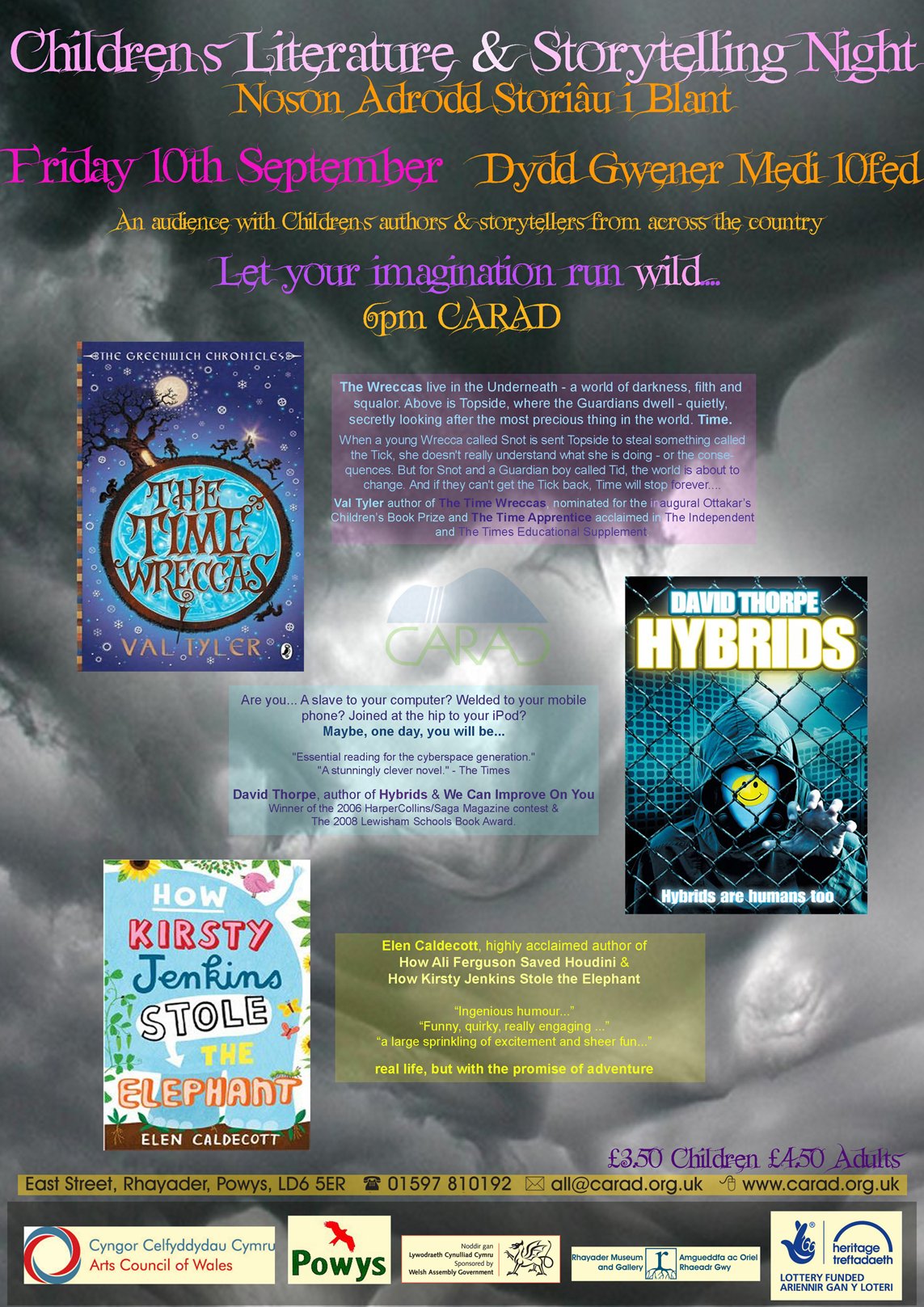
Captain Britain Hard Cover OmnibusDavid will be reading and answering questions at a literature and storytelling night for children on Friday, 10 September, 6pm in Carad, East Street, Rhayader, LD6 5ER, mid-Wales. Tel. 01597 810192.


Captain Britain Hard Cover OmnibusNew Captain Britain Hard Cover Omnibus out.


• Guest blog at The Ecologist magazine on the great British Refurbishment campaign and the new Coalition Government's Green Deal.


• Guest blog at Dragon Tongue about the influence of landscape in mid-Wales on writers.

Wednesday, May 05, 2010

How to vote tactically for a greener new government

Thanks to Frannie Armstrong for this!

A Tory government would be a disaster for the environment and climate change.

Their candidates rank climate change as 19th out of 19 most important issues and want to decrease onshore wind and increase North Sea oil drilling. Their party is riddled with climate sceptics (with one even rumoured to be lurking in the shadow cabinet).

There are six seats (Battersea, Brighton Kemptown, Calder Valley, Colne Valley, Hove and Stroud) where the Green vote is large enough to give a Labour seat to the Tories.

There are at least three (including Carshalton and Wallington, Dorset West and Torridge and West Devon) where it would either give a Lib Dem seat to the Tories or prevent the Lib Dems from taking one from them.

So we urge everyone who understands the precipice on which we all stand to be highly tactical with their vote:

  • If you live in a hope-in-hell constituency, vote Green: Caroline Lucas in Brighton Pavilion (now the bookies' favourite), Tony Juniper in Cambridge, Adrian Ramsay in Norwich South and Darren Johnson in Lewisham Deptford.
  • If you're in a Labour-Tory marginal, steel your environmentalist's heart and vote Labour rather than Green
  • If you're in a Lib Dem-Tory marginal, vote Lib Dem rather than Green
  • If you're in a Labour-Lib Dem marginal, vote for Labour, with an eye on helping stop Clegg siding with the Tories if there's a hung parliament. (Clegg said last week that he'd be happy to work with the Tories as long as they concurred on four policies - fairer taxes, a shake-up of the education system and economic and political reform. Nothing else important, Nick?)
  • If you're in a safe seat for any of the three main parties vote Green to add one more to the Greens' total and strengthen the case for proportional representation next time.

Meanwhile, till Friday morning, you can watch The Age of Stupid free for 48 hours - from now till the polls close tomorrow night.

Captain Britain and The Siege of Camelot is out!

cover of Captain Britain and The Siege of CamelotCaptain Britain and The Siege of Camelot is out, which contains my work on Captain Britain and a new introduction written by myself - plus one by the writer of the Black Knight series, Steve Parkhouse, as well as the feature and art from the Captain Britain Summer Special and Inside Comics - A short history of Captain Britain by Alan Moore.

It contains the Captain Britain strips from Marvel Super Heroes Nos.377 - 389 and The Daredevils Nos. 1 - 11 chronicling the stories by myself, Alan Moore and Alan Davis. It costs £12 from Forbidden Planet.

Sunday, April 18, 2010

Bored with the election? Try these new political parties...

Fed up of the same old politics and policies?


I thought I'd invent a few more. These are parties you can trust:

The Utopia Party


Believe: Utopia is a state of mind not a place.

Happiness is more important than wealth; and happiness is an attitude: we are already in the best of all possible worlds. It's just your mindset that needs adjusting.

Vote for us and we'll help you to change it.

The Retro Party


Believe: Things were better in the old days.

Vote for us and we'll turn the clock back. We'll:
  • Close down the internet

  • Bring back hanging

  • Bring back pounds shillings and pence (and farthings)

  • Only two tv channels

  • And four Trebor Chews for a penny


Vote for simpler times!

The Parity Party


Believe: The Poverty Gap - the difference between incomes in society - is responsible for most of our social ills.

So in future everyone will be paid the same salary pro rata no matter what job they do. Then people will choose the job they do because they want to do it not because it pays more.

Greedy people will leave the country: good riddance.

Bonus: besides creating an equal and happier society we'll save billions on paperwork in tax and NI since it'll be the same for everyone.

UKIP 2: The UK International Party


Believe: We will get the UK out of Europe by towing it to the Indian Ocean - and everyone benefits from a warmer climate.

UKIP 3: The UK Interplanetary Party


Believe: The World is going to hell in a handcart.

So we'll work to take the whole country into space and leave everyone else to fester in their own fetid juices.

The Nothing Party


Believe: We stand for nothing.

Vote for us and you won't be disappointed.

The Criminal Party


Believe: Only known lawbreakers can be MPs.

Result: for the first time you will have fully transparent MPs - you will know that they break the rules. Let's be honest: everyone breaks the rules if they can get away with it.

The Lazy Party


Believe: If you can be arsed to vote for us maybe we'll do something sometime.

Or not.

Like, how about the two day week?

Or is that too much?

Which one will you vote for?

Saturday, April 03, 2010

Some nice comments on The Drowning

I'm starting to get some good critical feedback from the first draft... thank you very much. Especially nice to have the very successful Jenny Woolf call the writing "brilliant" and "accomplished".

She asked me soe questions in her email and as they're very interesting it's worth posting some of my responses:

Influences: Alan Garner began as an influence - I remember vividly re-reading The Owl Service (set nearby) when I moved here and admiring again his sparse style, but when I tried to read him again in preparation for writing this I found the style too old fashioned. The influence in style came from more a MEMORY of him, but also a touch of Cormac McCarthy and a beautiful classic of ornithological writing - The Peregrine by J A Baker which is absolutely extraordinary in the number of different ways he finds to describe, say, a bird flying, with powerful observation. This is the first time I've set a book in a place where I live, and I did a lot of exploring and photography and talking to people.

Publisher: I have no publisher as yet. A Welsh publisher, Seren, has expressed interest, but they have little reach outside Wales unfortunately. Seren has an interesting new series updating/reinterpreting Welsh myths.


Structure: I'd pictured the opening as curling into the narrative. You see Gary, then Bryn, then Gary again. You realise both are victims in their own way, though Bryn only of Gary. So, why? Gary is the character with the furthest development arc to travel. You follow Gary through the storm, and its aftermath until he is forced into the company of Bryn on the run and the core story begins.

Bryn and Gary represent polar opposites. One endures the other dies. But it's suggested that what the one who died represents is a quality that is really the more enduring. We've sacrificed so much and we will lose more, but it is nature that endures. The land outlives us and we are blinks in its eyes. Even the legends have life beyond us.

Gary's disability cannot be used as an excuse for his irresponsibility. That's what he learns.

The website: The Chance To Create team (see the credits page) stipulated a website in their grant conditions. You wouldn't believe what else - I have to give a seminar to tourism providers in the area about local legends and other novels set locally (there are quite a few - cf also the late great Susan Cooper's Dark Is Rising series) to make the area an attractive literary destination! The things a writer has to do to earn a crust!

Anyway, I'm still buzzing from Jenny's comments!

Wednesday, March 31, 2010

The Drowning Novel - draft completed and new website

I've finished a draft of my current novel, The Drowning, and published a website all about it. Go to: The Drowning Novel.

I've begun work on my next non-fiction book - an introduction to solar technology. It's great to alternate between fiction and non-fiction!

Sunday, February 07, 2010

My house is for sale - near the Centre for Alternative Technology

We've just put our house on the market! It's near the Centre for Alternative Technology and is a 3-4 bedroom house plus a self-contained one-bed 'granny-flat' or sublet on the side, by a river! It's been well-renovated and has a large garden and has loads of potential. Only £185k! I love the whole valley - I'm just moving to a smaller place in the valley. I even spent a while commuting to London for work - you can go there and back in a day by train. More info?
http://www.davidthorpe.info/house-for-sale-mid-wales.htm

Monday, January 25, 2010

Bounty for the first citizen's arrest on Tony Blair!

Today we are launching a new fund – arrestblair.org – to reward people who attempt to arrest the former prime minister for his crimes in Iraq. George Monbiot has written the text - and it's his idea. My part is to design and manage the site. More on the website and George's blog.

Monday, January 18, 2010

Murals, myths and Mid-Wales

I'm hard at work writing The Drowning, and it's when you're deeply immersed in something that coincidences start to happen.

I was going to Borth (the village I drown in the book), and pulled up at random, by the sea front. I'd always known there were mosaics embedded in the wall at one point, but finding myself parked right beside them I took a closer look.

They depict two myths I am using in The Drowning. Here they are:

Mosaic by Pod Clare of the Cantre'r Gwaelod myth in Borth, Ceredigion, Wales

This is a mosaic by Pod Clare of the Cantre'r Gwaelod myth in Borth, Ceredigion, Wales. The myth tells of the drowning of Cardigan Bay when a prince meant to be keeping guard over the floodgates falls asleep, drunk on the job. On the right you can see the water flooding in to cover the land.

Mosaic by Pod Clare of the myth of the origin of Taliesin, in Borth, Ceredigion, Wales

This depicts the origin of Taliesin, and shows him being discovered floating in the reeds after his birth, by Elffin, the son of King Gwyddno Garanhir, 'Lord of Ceredigion', while fishing for salmon. As soon as he was found he announced that he was a poet, and began spouting poetry. The prince called him Shining Brow, which means Talisein, or blessed (radiant) one. Round the edge you can see the chase, when Ceridwen tried to kill him because he stole the special wisdom-bestowing broth meant for her ugly son, Avagddu. Using his new magical powers, Gwion, as he was then, turned himself into a hare, fish, bird and grain of corn. In turn, Ceridwen transformed into a greyhound, otter, hawk and hen, and pecked at the grain until she had swallowed Gwion.

Wednesday, January 13, 2010

Captain Britain - order it!

David Thorpe's work is in this Captain Britain omnibus• David has a profile on the new website for school visits Author Hotline.

And although it's behind schedule you can order the Captain Britain collection featuring his work from Marvel Comics, and while you're at it, the omnibus published last year

Thursday, January 07, 2010

Ideas behind The Drowning

A note on the context of the writing of The Drowning, and the philosophical approach I'm taking to conceiving and writing the book.

It touches on the theme of how 'nature' is a human cultural construct - cf Simon Schama's brilliant book Landscape and Memory.

The two main characters in my novel epitomise opposing attitudes to 'nature':
• as a place in which you must survive, and therefore understand and know how to use, and
• as an unknown out-there-ness.

Climate change in my book presents a crisis that suggests to the reader that enduring, but changing, nature puts the brief period of  human 'civilisation' in its tiny context.

The book does this partly by using Welsh mythology and updating it.